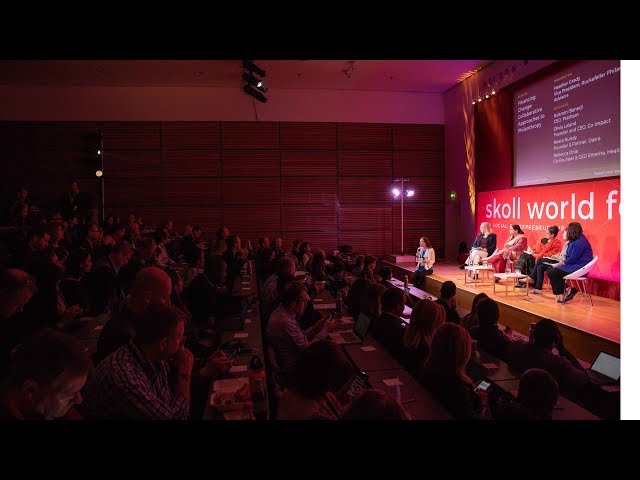
Structuring Collaboration: Mergers, Partnerships And New Business Models
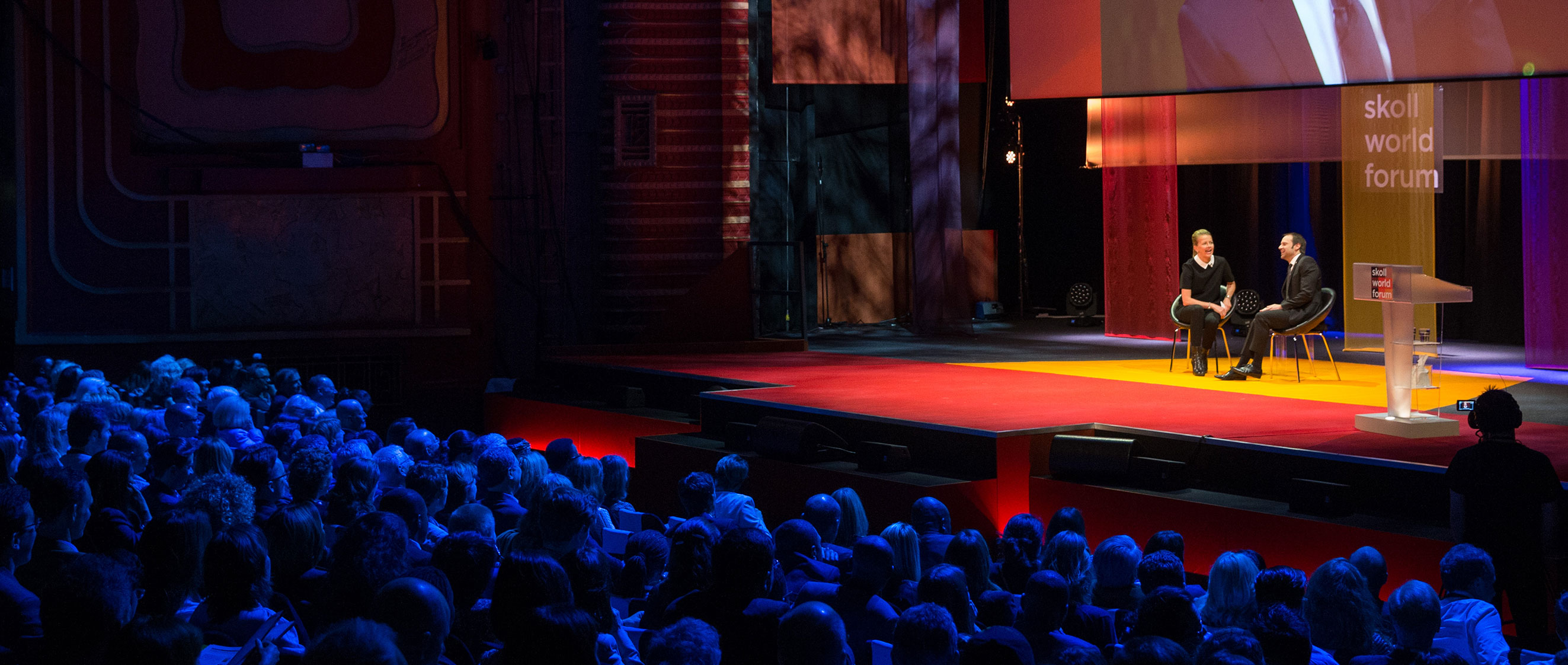
To achieve impact at scale, social entrepreneurs are inventing new ways to collaborate with a diversified range of partners. This session will share three successful approaches that have led to sustainable scale: merging two social ventures as a means for collaboration and growth; partnering with government, private sector, banks and endusers, and shaping sustainable development practices through new business models such as spin-offs structured for growth and leverage.
structuring corroborate this is what we are talking about for the next two days. And I think we start with coding. Somebody we spoke last tonight, at the opening ceremony, Jeff Skoll. Jeff said, 'Changing the world is a team sport, everyone has a role to play.' And this is actually the sentence, the code that was the most re-tweeted on Twitter in past 12 hours, and I think it's serendipity because we're here to talk about corroborate.
Because we all know that if we work together, we can achieve much more. We have three wonderful speakers here, we will talk about the way they have finalised to corroborate. The way they have structured partnerships, what new business models they have identified, the challenges, the risks, the opportunities.
Before we start I would mention the hash tag for those people who are on Twitter on Flicker as WF 10 that's WF 1 zero. We have a few bloggers here, so they will be reporting also on this session. If you are on Twitter, don't hesitate to tweet, this is what it is about. We're here to share the information to the rest of the world.
You may realize that in your program I am being identified as being David Bonstein I am not David Bronstein. I wish, actually, because he is a good writer; I'm not such a good writer. I'm Victor d'Allant. I'm in charge of social Edge, the online community for social entrepreneurs, the program of the Skoll Foundation, and this is where actually we learn about collaboration.
And I would like to mention two resources before we start. Social Edge is one. Right now if you go to SocialEdge.org you will see that there is an online conversation happening around structuring collaboration. Another one is an article that was published just recently in the most recent issue of the Stanford Social Innovation Review review by David la Piana and the title is Merging Wisely, mergers, strategic alliances, collaboration, partnership so it is in the.
We have three speakers, they are three practitioners, see my with you remaining me that i need to talk about mobile phones so i thought about twitter and any other mobile world don't forget to and your mobile phones off, pagers, everything. When we talk about, you know, questions and answers later you will have access to microphones and 10:30 when we're done, please get out because other people will come in.
It's not exactly what it says, but you get the idea.
All right. So, we have three terrific speakers They are all practitioners and they have a very valuable experience around collaboration. On your front right, Sue Riddlestone, in the middle. , Andrea Coleman; Gary White.
Sue Riddlestone is with BioRegional and I was actually about to ask her what the exact name of the company was - BioRegional Development Group - and she just told me, actually, that there are quite a few names. Tell me what all those names are exactly?
Well, we have BioRegional Development Group, which is kind of the parent or the mother company or organization. And then there's BioRegional MiniMills, BioRegional Charcoal Company, BioRegional Properties, BioRegional Quintain, BioRegional Forestry. So, we have eight associated companies. Actually, there's one that's not called BioRegional, that's The Laundry.
So we will...
Paper recycling.
We'll have a really good sense of new business models, and this is what we'll be talking about.
Andrea Coleman is with Riders for Health. And there's actually a very, piece of information, so we're talking about motorcycle riding right here. She will talk about that at some point. Andrea used to be a motorcycle rider, actually racer I believe, so it's going to be very interesting. But let's talk with Gary to begin with.
Gary please tell us who you are briefly a couple of minutes and see where we're going with Water.org.
Okay, so yes, Gary White, co-founder and Executive Director of Water.org. Water.org actually is all about collaboration and partnership, and last year even about merging. It's the essence of what we do before we were Water.org. Before the merger last year, we were actually called Water Partners, and the partnerships that we have of course extend to our donor community, but they also to extend to the developing world where we're helping communities implement safe water projects and safe sanitation, and of course being a US based NGO it would be kinda ridiculous for us to think we could go into countries and do these programs ourselves so we're all about finding local partners to work with non-governmental organizations, putting them through a screening and certification process, and then building out this network of partners around the world.
And then increasingly we're doing that in the context of microfinance institutions as we start to blend microfinance together with water and sanitation, giving small loans to people living in slums and in rural areas so they could get their water and sanitation solutions with the financial resources from the bottom up as much as the top down.
I understand that you have a video. Should we show the video now--there's a little clip--and see the way it is structured, the way it works. Can you briefly talk about this video? Sure. Short video about how Water.org lives this out in the field through one of our partner organizations, Gramalia, in India, and then also talking a bit about our water credit initiative as well.
So we'll go from there. four minutes long. In India Thirty percent of the people are using water and sanitation properly. Only thirty percent of the people are having toilets in their house. We are Water is such a building block. You can't really move forward with your life until you really meet the basics like water and sanitation.
We are using them as a parents toilet through them
Well, I think finance works so well because it allows people to get the credit tools that they need to improve their lives. Problem is, you don't have the savings to pay for that toilet, or to pay for that water connection. and if you can get affordable credit into the hands of people, they're going to make the decisions that are best for them.
These banks are going, wait this actually works, these repayment rates are At 100%, I'll loan to them, you know. The things that we're doing with the Clinton Global initiative, with our partners that have made commitments there with the Open Square Foundation, with the PepsiCo foundation, One By One, H20 Africa.
Those commitments have made all this possible, particularly here in India. You know, we're ahead of our goals. One thing about water credit. It works so well it's a little bit scary. When you tell somebody, when you make them aware of a problem this serious, but then also make them aware of a solution this practical, I think it's in people's nature to want to step up and do their part.
So you know, it's really through those partnerships, with Grevalia, with NGOs, NFIs and donors that we're able to put this all together, and then the question about the merger as well. You saw Matt Damon is the co-founder of water.org. Prior to forming water.org last year, we were water partners, and we'd been around for about 20 years, and then we had this opportunity with Matt's organization, H2O Africa, which had been recently formed to bring the organizations together.
With Matt and H20 Africa there was this incredible kind of value in terms of obviously marketing and media and fundraising. And then with water partners, we had this incredible what I call the Downstream Value, being able to go out and build these local partnerships in developing countries. So there was a great kind of symmetry between the two organizations.
And so Matt and I discussed this at length and decided to bring the organizations together. It's driving greater effectiveness, greater efficiency in the way the organizations work now. So I think it's, you don't see it too often in terms of the non-profit world, with mergers happening, but this is one that happened pretty seamlessly.
Would you mind talking about the challenges and merging two organizations because I know we're talking about the two other speakers, but we're just in the middle of merging two charities or two not for profits. I understand what the impotus was, but what were the challenges?
Well, there are certainly a lot of, kind of, legal challenges to get over with the lawyers, but those went fairly smoothly. I think that the fact that H two oh Africa was a fairly young organization and didn't have a lot of staff, there weren't a lot of issues around that, which can be very thorny, but culturally, from a mission perspective, we were just in lockstep.
So, I think that I feel very fortunate that this merger presented a minimum number of challenges and, you know, from the time we we first discussed it until the time it was finalized, was only about one year.
Andrea, so you were a motorcycle racer, then at some point in your life you launched - with your husband actually, with Barry - Riders for Health. Tell us about who you are and what Riders for Health does.
Thank you. Yes, well, when Victor asked me to tell you something personal about myself, I was very cautious because I know you all had late nights and you're all be feeling a bit fragile, so I was careful of about what I said.
Motorcycle racing has champions. Now, I actually spend a bit of time thinking about what makes a champion, and I think that what makes a champion is excellence in their team. And a team really, of course, is partnerships. And in the work of Riders for Health - work that we do in Africa to mobilize health care to reach remote communities to make sure that people don't die of preventable and curable disease.
The champions for us, are the women and the men, the health workers, who take that healthcare out to rural communities. When they're not mobilized, they have to walk. Africa's a huge continent, it has very little transportation infrastructure and most people just have to walk. And that means there are, maybe, ten thousand people that they're trying to reach, don't get healthcare.
They're neglected, they're ignored, they're isolated and people spending billions of dollars on drugs for the poor, for taking care of them. They are available, but if you can't reach them, it's not going to help. So, our champions are those men and women who are trying to get data out there to reach them.
But also they need a team behind them and part of that team is what the ride is, to help technitians and the people who support them and make sure the vehicles work. But also the money management behind it and the management of the organization. So without those partners, the very focused partners around that team and that champion is very significant and we couldn't do it.
They couldn't do it without that team. So partnership is fundamental. And also, we're a partnership organization. We're not health professionals. We are enabling people who are health professionals to get out there to do their work. You've heard speakers talking about the amazing work they're doing in Africa, but they can't do it unless they can reach the people.
So we support them in doing that, and we are a partnership organization.
I believe the BBC produced a recent movie about Writers for Health. Do you have an excerpt here, a short video showing what you're work is actually producing over there.
Yes, we're very lucky, the Skoll Foundation partnered with Rockhopper Productions, and Alvin Hall was the presenter of the program. And this particular piece of film shows the work of our sample transport. That means that healthcare samples--specimens, urine samples, blood samples--get to clinics and the results get back, and then people don't die.
So, it's really a clip showing the sort of courier system that can be run in Africa even in the very harsh conditions that exist.
Shall we show the clips, then?
It all started twenty years ago. Back then, Barry and Andrea used to raise money for other charities that worked in Africa. They went to see how their money was being spent. What they saw shocked them. They realized a whole new approach was needed. Now they're bringing it to I saw a motorcycle that was new and gleaming, and it was completely dead that had done 800 kilometers.
And we know you could have a hundred and fifty thousand kilometers of health care delivery out of that, and there it was dead at 800. The motorcycle is low cost to buy. It's low cost to run, and public health workers, and people who are running specimen transport, and so on. You can't really afford to buy a big vehicle for everybody who needs one.
They're also a single-track vehicle, so in many of the places out in rural communities are very narrow people and animal tracks, so a motorcycle can easily get down those, making sure that everybody is mobile, in this really difficult terrain. They knew, it wasn't Africa's harsh conditions that were the problem, but poor maintenance.
Inside here, we have our drivetrain.
Their solution? Train local ri[xx] and drivers to carry out simple checks and preventive maintenance. The result? Hardly any breakdowns, no matter how rough the roads. In 1991, Riders for Health launched their first program. Today, they employ nearly 300 people in seven African countries. They manage more then 1300 vehicles that provide access to healthcare for more then 10 million people.
This is Bununka Health Center. It's 30 kilometers from the nearest town, but that journey takes an hour and a half by car, let alone by bicycle or on foot. A lot of these people had to walk, and they're sitting outside on this porch waiting to see the nurse. The only healthcare professional for miles.
For miles. Helping the client means giving her the medication, which is appropriate. If we keep waiting for the results, and the disease is getting worse and worse, there is no help there is no And it's all about transportation, isn't it? Yes, it's all about transportation! Riders aim to provide a transport system that African governments can afford.
they charge a small fee just to cover their cost. the fee is fixed for 5 years so governments can easily budget for it. Riders mainly manage other people's vehicles, like those owned by Health Ministry But these are often very old and expensive to maintain. Their new plan, which they've already launched in Gambia, is to vehicles themselves and lease them out.
There are some tough challenges ahead, but I know Barry and Andrea are prepared to make difficult business decisions to ensure their social enterprise continues to deliver a cost effective service and a great benefit. Now, Andrea [sp], in this movie I think Alvin Hall [sp] talked about Gambia and the fact that you have a program over there.
It's quite interesting because actually it's one of those partnerships that I would say is a model [xx]. The fact that you have received a program ready for the investment from the foundation. You're also partnering with the Ministry of Health, I believe, in the Gambia; you're also dealing with a bank in Nigeria, if I understand well.
Can you tell us about this model, because it is a model in partnership.
Yes, it is, and we're thrilled that Skoll Foundation has the courage and imagination to make an investment in Africa and in vehicles in partnership with the Ministry of Health. Our resident genius, Barry Coleman[sp] is the person who thought of this idea and what makes it different, I think, is that if you run vehicles in Africa, they're going to last a specific amount of time, as in any environment.
The Ministries of Health is desperate vehicles, and if, once they even if they're very old, they become very expensive and really not economic to run, so to withdraw them from service at the right time to sell them on into the community as well-serviced vehicles is only possible if you own the vehicles.
We also are able to control the riders and drivers and make sure that they are asset managers. Vehicles [xx] are expensive, you know, lot of money in those vehicles. So, to own the vehicles is a very important thing for Riders for Health, but the Skoll Foundation made, we worked with them, to look at how to buy all the vehicles that the Ministry of Health in the Gambia needed to reach every man, woman, and child in that country with health care, and that was a three and a half million dollar sum.
We made an agreement with the Nigerian bank, the Guaranteed Trust Bank of Nigeria, which has a branch in the Gambia. They loaned us that money, and they loaned us the money because the Skoll Foundation were able to offer the underpinning of that loan; to work with us to do that.
And we're able to pay that loan back by charging a cost per kilometer to the government that covers fuel, maintenance - all the issues to do with running vehicles in and out - on an outsource, public-private partnership basis; and then we pay the Skoll Foundation the money that they have underpinned the loan with.
Or rather, we pay Guarantee Trust Bank, and they have then paid the Skoll Foundation.
So, it is a model that we think that, in terms of assets, can be rolled out not just by us, but by other organizations using tangible assets in that sort of setting. So, it's very exciting and structuring that partnership is not just the structure, but it's the attitudes that go with it, the courage commitment to excellence and trust, and I think it's not just just structure, but the attitudes that go with it that are so important I understand it's not only about structuring this partnership agreement, but how long did it take you from the minute you envisioned this partnership and the moment but it was moving, happening.
Well, I was talking to Ed Dina [sp?] from the Skoll Foundation this morning and of course we know the partnership is running and rolling and the whole model is running. We always have a little skips of heartbeat on the way. It's not all plain sailing, but from the moment it was conceived the moment that we got it going was surprising fast, really, given all the difficulties: about 18 months.
But we launched it in in January 2009 and it's running well and interestingly and excitingly the M
Ministry of Health is paying eight months in advance at the moment so, you know, the skips a heart beat are much-reduced. This is a very interesting business model, I think. We have another expert here, Sue Riddlestone, with a BioRegional.
You have quite a bit of expertise in structuring collorbations with businesses and actually launching businesses as well. Could you briefly tell us about yourself first and also about BioRegional?
Well, we started BioRegional back in 1994 because we were really concerned about the effect that our over-consumption in developed countries was having on the environment and we have so much, we consume so much. Whereas people in the countries where Andrea and Gary are working have so little they don't have enough.
In fact, if everyone in the world consumed as much as we do in Europe, we'd need three planets to support us. So what we need is one-planet living all around the world, a fair-share living within our fair share of the world's resources. So we thought, well what can we do about that? How can we create products and services that produce the things we need in a way that has less impact, and can we create communities and live a high quality life, but within our fair share.
So we have a number of real life projects, sustainable communities, products, which are really showing how we can actually reduce our coal emissions by the 80 - 90 percent we need to do in the UK for example. And none of this - I mean who were we - we were just concerned people without any money in our pockets.
We couldn't have done anything without the good will, the mentoring, the partnership and collaboration. Everything we do, we've done it with some great partners. And what we do is good in itself, in terms of saving resources, but the idea, the model we have is very much around creating examples and then showing people how it works so that they can learn from it and it can influence industry practice, it can influence policy change.
And our probably most well-known project is the BedZED eco-village in South London. And that's a project that really started because we'd grown to about 12 people and we needed a new office, and we thought, well, we've got to have an eco-office, and it just worked out that the local authority had a large site, and we thought, "great, we can have a whole eco-village and we can live there, too." And that was back in 97 and the project was completed in 2002, and out of that a lot of our work has grown where we're now working with partners around the world from China to Australia to North America on sustainable communties, showing that one-planet living is possible all around the world.
for adding something like 90,000 people will be affected. so we have a short film to show you about what it's like at Bedsead and then I can tell you a little bit more about how we went about setting up that partnership. This is the last video, don't expect more movies. Don't you have one Victor?
Just wondering whether to start talking to you again while we wait. Oh no, looks like we have a...Yeah. Okay, I'm going to tell you a little bit about the projects until the film comes on. We had this idea, and actually the project cost fifteen million pounds and, as I said, we didn't have any money in our pockets.
Oh, here we go. Oh no.
We worked up a pitch, we found an architect, and here you can actually see the result.
If everybody lived like we do in the UK, we'd need three planets to support us. BedZED aims to provide a community where people can live at the one-planet level. It's a mixed-use development with homes, workspace and community facilities. It was developed by the Peabody Trust, in partnership with BioRegional and ZEDfactory.
OK, so we are in a BedZED home. People have been living at BedZED since 2002, so we're quite established now. BedZED really takes a holistic view of sustainable community. It doesn't just look at the built environment it also looks at lifestyles--so, what we do with our food, transport and waste. In terms of energy use, we've reduced our carbon emissions by about 56% through a lot of insulation, some renewable energy supply and also through residents' engagement and energy efficient appliances.
And in all the kitchens we've got our water and electricity meters at eye level so we're conscious of how much we're using.
We have segregated recycling bins so we can easily recycle glass, tin cans, paper, cardboard, compost, and even shoes and textiles.
Budcity's [xx] great natural day lighting so we don't need to use so much electrical lighting. [xx] use has been reduced by about 50% through things like dual-flush toilets and low-flow taps. Here's the UK's first and only bio-membrane reactor. It takes all the ex-flow [xx] from our kitchens and bathrooms and cleans it so we can use it for toilet flushing.
Budcity [xx] has a green transport strategy. We chose a site because it has very good public transport links. There's a bus stop just across the road, a trans stop this way, and a rail station just down here. We also have a car club for residents.
Every car club car takes five privately owned cars off the road. Secure bike storage makes traveling by bike convenient. Better striking wind powers provide wind powered ventilation. The plants on the roof, a great for bio-diversity, and even though it's a really dense development, nearly every home has a garden.
But the most important thing is it better as a community, where people of all different backgrounds enjoy living and working together. You can come and visit, if you're in London.
So, I'd like to tell you a little bit, if I may, about how we put that project together. As I say, we worked up a sort of cost for it and some designs. The Science Free Span, a charitable trust, gave us a small grant to cover some of the start time to work it up. Our local authority wanted to see a sustainable community built in their area.
So, I suppose you could say they were a partner too, in that they were trying to help make this happen. And we took that project around to a number of people with our pitch, as it were. We the Peabody Trust, London's largest and oldest housing association, agreed to put up the money to do it. I guess one of the key sort of points there is that it was a person within an organization who had the decision making ability and who agreed with our vision and backed up what we wanted to do; Sir Dickon Robinson, who was the head of development at the Peabody Trust.
And he championed the project and kept it agreed with it and kept it on track all the way through. So I think that's a key thing in partnerships, that you need a senior level decision maker who will really stick with it. And we worked with them as partners to deliver that project on the sustainability aspect and I guess that's another element to successful partnerships, that both partners need to be bringing something useful to the project.
Both partners, or all the partners have to get something out of it, otherwise it doesn't really work. So we were bringing the sustainability know-how. We were also getting grant funding, we were also going to be a client, we were going to rent our office there, and we were going purchase property.
That project went really well and was finished in 2002. So we now have our lovely office and I live there, my husband and co-founder P[xx]am decide, and my colleague Ginny [sp?] here, we work there and we live there. And it's been an internationally award-winning project which people come from all over the world to see.
There have been many lessons learned. It's not perfect, but it affects the people who live there.
So Steve, who lives there, he said "Could you build another project, because I don't want to move now? I don't know where...I couldn't move. Where can I move to that's going to be as great as this?" People who live at Bedt [sp?] said, the point is they're reducing their impact massively, by the half.
So if we're reducing our impact, more people could have more around the rest of the world. And yet, they're actually having an improved quality of life, so people at BedZed know on average 20 of their neighbors, where as in most neighborhoods in the UK or even over the road to us, people only know about eight.
And the more people you know, the happier you are. I think that's the great message and that's what we've tried to replicate and scale up working with partners.
Now I'm intrigued because you clearly seem to have a business approach to the way you are solving those problems, but you launched BioRegional as a charity, as a not for profit. What's the reasoning behind this structure? When we started to look at what we wanted to do, we realized that there was an awful lot of thinking and research that needed doing.
So we decided that if we set up as a charity, that would give us access to a greater range of funds. Also, although we're taking a business approach, we're not doing it for the money, so we wanted it to be clear that we were doing something for social good as well. But on the other hand, sometimes as an exit strategy It's very important that things are set up as a self-sustaining company, and we do have eight associated companies that have come out of that.
So that's kind of one of our scaling and continuation strategies as it were. Gary, speaking about business, I know that in this video, there is some allusion to MFI's working with microfinance institutions. Can you tell us about this water credit study that you have launched?
Sure . From the point of view of collaboration, again, it's very difficult if not impossible for us to be effective working in developing countries without those types of partnerships. What we see with water credit, is there was a reluctance to partner on the part of microfinance institutions, because they didn't understand how you could make small loans for water and sanitation and have those be bankable.
So how are people going to generate income to repay those loans? So there was a definite aversion to launching loan portfolios for water and sanitation. So we really had to make the case in order to get those micro financed institutions into our network, into partner, and we were able to do that, the fact that poor people living in slums pay, on average, about twelve times what their neighbors pay who are connected to the water utilities.
Why is that? Because they to go to the water mafia, and buy water from vendors in formal networks, so they're paying a lot more than the people who are connected. The fact that most of the subsidies in water are pushed out through the pipe network systems allows those who can get connected to capture the subsidies, and the MFIs didn't understand that if we could just get a loan to people so they could get connected to the utilities, then they would be foregoing those expenditures.
We knew this because people were going to loan sharks and paying one hundred twenty-five percent interest in order to get a loan to build a toilet, or to get a water connection. So it's part of bringing the partners along in a learning process, helping them to understand that there is a kind of symbiotic relationship that Water.org could pursue, with these microfinance institutions, but even that wasn't enough and from our perspective, what we had to do, we had to kind of put our money where our mouth was, in terms of developing the partner ships.
So we bring from, we raise the philanthropic capital in the US. So that we can bring that to attract MFI's with smart subsidies.
So we'll help them, as a partner of fund, their market research will help them figure out how to design their credit products, will help them bring on board the right kind of staff in order to make this happen, with the intent that this partnership can be used as the model with key MFI's in different countries around the world.
And then building a learning platform into that so that we can tell the story of how these things work, or how they don't work in some situations. So that the partnership can become more viral so other micro finance institutions can pick this up and start developing loan portfolios for water and sanitation.
So it's about starting with the vision of knowing that water.org was never going to be the channel or the bank to reach people through water and sanitation loans, but we really had to work hard to get those partnerships in place, so that everybody is working within their greatest strength and greatest efficiency.
That's interesting actually and that leads to a question to Andrea looking at the way you have structured the partnership; what is the impact on the organization when you start working with different constituents as you are doing yourself, now?
Yes, it's very interesting because in fact once you - I think also I should just explain why we felt it was important to work with a Nigerian bank or an African bank. We felt that really to test the model properly we needed to work with a bank that was supported by the loan from the Skoll foundation and that has indeed turned out to be very important to all of us in the model.
The impact on the organization has been very significant, first of all because to figure out and to test on paper any kind of financial and operational model of that kind is pretty strenuous. So it was a mix, a collaberation in creating the model on paper between the Skoll Foundation with consultants with our internal, our people internally and other folks, so that was quite a test of teamwork.
And then from that point on, once you start along the line of not managing other people's vehicles, the procurement of vehicles is always done by somebody else, that's somebody in the Ministry of Health in Kenya or whatever it is. Once you start to own the vehicles, you have to do all the calculations to do with the finance, to do with the procurement and all those other issues, so it throws a lot of work back into our UK central organization.
And so, it does change the dynamic, if you like, of the internal organization, but it also very rapidly builds your skills and competencies in terms of financial knowledge, in terms of partnership management. And so it really kind of improves and strengthens your organization. To work with partners is so strengthening, and you learn so much.
I think it's been a very important development for Rider's as an organization.
It sounds all so positive. I want to hear the challenges of partnering. Okay, come on. This is not PR here. Sir, you want to start, the challenges of partnering with organizations? I'm sure there are a few. Come on. In terms of sort of scaling the impact up from [xx] I'll just set the scene a little bit.
We've tried to do that in a number of ways, by working with other people who come to us and say can you just give us some advice? It ended up with us setting up a consulting arm where we're just providing advice, and the profits from that go back to the not for profit. The charity is developing its own project working internationally working with partners and I'll come back to that.
That's something that Skoll have supported us to do, and we've set up our own property company. But one of our biggest challenges came on the work that we wanted to do on policy change, so obviously we thought great, now everybody can learn from this and take home the good things about it. Many, many people came to have a look but not anything necessarily actually happened, so I wrote a paper: all new homes should be zero-carbon.
We tried to get the Greater London Authority to take this on, and in the end we started to work with WWF, the World Wide Fund for Nature, because they have the connections and we actually signed a memorandum of understanding with them, and they use our work in part of their campaign for sustainable homes.
And three years later we did indeed get a policy that all new homes should be zero-carbon, just in three years, in the UK by 2016. That's a massive achievement that we've made by working in partnership with an NGO, but we also found that we had massive cultural differences and it wasn't always easy to work with.
We're a small organization, they're a large organization, and it wasn't always easy, and in the end, we decided that we'd just back off a bit and work a bit more informally together, which we do. But it got quite difficult with us having our opinion about how things should be done, and they were so much bigger than us that they could call the shots really.
Any difficulties around staff, actually, the staff on your side as well?
Well I guess where we're working on so many different projects and, you know, you have your best staff, the people that are most experienced, sometimes it's hard to know whether they should be working on the third party consulting work, or should they be focusing on the charity projects where we're really trying to make a difference overseas.
And of course when we set up the property development company we lost two very experienced people to go and set that up. So there's constant thing of training people up who can then go out and work with partners.
Gary, come on. Tell us.
Well, to me, it's, I guess I would say the success of Water.org has been determined far more by things we said "no" to, and I thing we said "yes" to.
because we live in this social entrepreneurial culture you know, this collaborative culture, Willy Foote who's a Skoll social entrepreneur, talks about pathological collaboration. There can be some positive aspects of that. But for me, it's about trying to make sure there's real substance there in terms of a partnership or a collaboration.
Really trying to understand the value added by both organizations, and not just, it's really the tendency is to tend toward collaborations and partnerships and joint ventures kind of the non profit NGO space, and i think that we've been really been pretty disappointed about saying no to a lot of things.
we also take very seriously what is kind of built into our culture, and that's always examining the cost of collaboration. Because there's a lot of cost that are associated with communication and collaborating, especially as you're launching a collaboration, and those cost have to be taken into account.
So I think it's it's just really -- we've had some partnerships that have gone off the tracks. We've had to cut some partners loose in the past, but Fortunately that's been a very, very small percentage there. But we, you know are constantly you know, people are constantly reaching out to us to partner or collaborate.
The things that actually make it to that partnership and the collaborative role are probably less than 2 percent of contacts or potential collaborations that we could get into. Andrei you mentioned something about I think you said a few minutes ago, it's not only about structuring the partnership, but it's also about bringing trust.
And that's interesting because I know that on social as you mention there was an online discussion that ran corroboration, and it is actually a key question that's being raised as we speak live. Can you elaborate on this? It's a concept of trust in structuring any kind of partnership agreement.
One of the challenges that Riders has is anything in this current climate of environmental care and so on. If you raise the issue of transportation, people frown a bit. You know they, well, you know it's vehicles--are vehicle's a good thing to be investing in? But of course as Sue said earlier it's very different between the developed world and the developing world and overuse and neglect in terms of transportation.
So, we have the challenge of people rather resisting the idea of encouraging transportation. We also have the difficulties in our organization of some of the big users of the in Africa, resisting change in terms of vehicle management. A vehicle costs a lot of money, and it really is an asset. It has to be -- it should be -- cared for.
But often people say, "well that's now not running any more after a year, we'll just park it and buy another one", and you know, if you add up that money and what it could be used for, other parts of development, it's huge. But I think that the issue of trust is so important in The Gambia, where as we're talking about, we have the model, the new model with the Skoll Foundation and GT bank.
That didn't happen overnight; the model itself took maybe two years from start to finish. But it took Barry thirteen years to develop a relationship of trust with the government of The Gambia in order to put that in place, so to scale up and replicate what we do, we couldn't possibly take thirteen years to develop a relationship with every ministry of health in Africa.
But it has to start with trust and assumption that working with government, African government, is a good thing to do, that there's trust on both sides and to find ways like track-records and so on, to show that, to prove that you are trustworthy, and that you have a mechanism that is useful to them.
And I think, one of the very fundamental things about social enterprise and public-private partnership in developing countries, is that social enterprises, it seems to me, are the perfect partners for developing world government, because we're not looking at the bottom line. As Sue says, we're not looking for profit.
We need to be sustainable. But we actually are thinking, in the case of Riders, of the health of the people of the country, that the ministry of health also want to address. So, our goal is their goal, and of course the money has to be used in order to make that sustainable and to work by actually the girls should be exactly the same.
That's what you should have. I think the whole concept of collaborating or partnering with governments developing country governments. So many, I know NGOs in the water space, it's been the intent to kind of get around government. It's very much a charity driven model. Kind of going out because the Government isn't meeting that basic responsibility of delivering water and sanitation services.
NGO's tend to kind of take the path of least resistance and avoid Government. and I think that with water.org, we're really going to be flipping that around more and more as we go forward, because with something as basic as water and sanitation you can't just give up water supply in these communities, particularly in urban areas, is just a natural monopoly.
And you have to find ways to partner with government, and I think that's one of the things about the water credit initiative too, we're not going out in these urban areas and kind of building out a parallel water supply structure. we're piggy backing on to the current investment in these water networks and helping bring them paying customers so not only do they get the connection fee from the user who took out the loan to start capitalizing the system more and improve it, they also get users who are [xx] paying each month for that.
I think there's a natural tendency in many cases to avoid government but i think we really have to look for creative ways to partner and collaborate with them. And i don't think there's as much in the way of examples out there to point to.
But it's also to do with replication if you avoid government, you can't really go to scale. It may take you longer, but you can't go to scale unless you're really partnering with government.
I couldn't agree more, and we've managed to change UK government policy and in other countries that we're working, that's our intention. And we've changed other policies by working this government and then you get that mass application, that mass replication that's so important.
So, tell us [xx] talking about policy as well. And I know you're working with policy makers, other NGO's, you're working of course for the government, and you're working overseas as well. Why and how? I mean how did you structure all those activities?
Well, everything is always different. We have so many different models. It's more about we want to get something done, and then you just set up the right model to deliver that. So we tend to want people who are from that country or based in that country already, to be taking on the work, because they obviously have a much better understanding of how the system works and the culture.
And that's, I think that's been one key factor there. We've actually set up organizations, you know, by regional sister organizations in every case so far, but we are obviously partnering with other organizations in those countries to deliver it. And the way that we've worked with companies is for example, in North America to build a sustainable community, or in Australia or China, is that we have a contract with them where we set out what we're going to do and what they're going to do, and we're working so that we formalized our process, or standardized it, so we have this one planet living approach and ten principals of sustainability from resource use through to social and economic issues and we say, together we have to write a plan for this initiative, this project, which we're going to commit to and stick to.
We will, in a way be the third-party independent endorsement of it as well. You know, you are working on this with us and we will say this is this is a good project, and we found that's a way that property companies in China, for example, will feel that they can stand out amongst the rest and say that's been the way we've approached it in terms of working internationally We have not talked about the importance of technology or how technology can be leveraged in these partnerships.
And I know, Gary, you mentioned something yesterday about the partnership with Cisco. I think it's an open-source platform. Tell us about this, is it OurWater.org?
Yeah, OurWater.org. And it's basically a platform that we're developing to give greater transparency into the water projects that we support. For instance, right now a donor could track through the website where their donation is going, the impact that it's having. There's feedback from the field up from our partners to populate a database so people can track what's happening with their program in real-time.
We're just launching this. There's another thing that we discovered that we could build off of that, and that is really with this whole democratization of information that's happening. The fact that Vodafone has launched a fifteen dollar mobile phone. The fact that these service plans are really plummeting in cost for people living in poorer areas.
I just heard yesterday, I haven't checked this out yet, but I heard that more people now have mobile phones around the world than have access to safe water. So there's a lot happening in terms of the technology, and what does that mean to water? I think we talk about collaborations and partnerships kind of in a one-to-one context sometimes, like, "We're partnering with an NGO, we're partnering with an MFI." I think there's a potential to kind of break this open and have a one-to-many or one-to-multitude kind of collaboration with people.
Say, for instance, someone living in one of the communities where we have a water program that we've supported. They can get on and send a text message and populate the database that we have that will allow anybody to know that that water project doesn't work anymore. So the donor who gave money for that in San Francisco can get on to that same database and say, "What's going on here; why did I support this organization," because their project isn't working any longer.
The fact that so many people still get their water from tanker trucks, and women spend hours every day trying to figure out when this water tanker truck is going to be in their slum and then they get there and they wait in the queue for an hour and then it runs out of water. How can we use technology to help that person?
If any of you are familiar with Disney World and the fast pass system there, the whole concept is you don't wait in line for an hour. You go and get your fast pass and then you come back two hours later and you wait for two minutes. So, can we use technology and use GPS with these tanker trucks so that people get a text message when the tanker truck is gonna be in their neighborhood Or when the public water tap, which only has water every third day, has water flowing so that people can optimize their time.
So it's about not just this top down kind of working through the NGO's, but how do we use that democratization of information to enhance the user experience of people who are trying to get their water and sanitation services.
Very interesting. Andrea, on your side, are you also using mobile technologies to better communicate with the team?
Yes, well of course, for us the mobile technology is the internal combustion engine, it's very old. But it's, you know, it's relevant. But, you know, one of the interesting things about a vehicle is that it's a perfect monitoring evaluation tool. You know, the wheels turn and the odometer counts the distance and so on.
And you know exactly how much every kilometer costs and you how much the fuel costs, so it's all a perfect sum. You also know how much it costs to reach each individual as a result of that, and that's really excellent for us in terms of collecting data.
But in terms of the eco-management, there is a lot of data to be collected. We need to - in order to invoice the Ministry of Health for every kilometer or the MGO we're working with - we need to collect data, and our technicians and the people who ride and manage the vehicles are often very, very far from their country centers, so transfer of data is very, very important to us.
We had a meeting this morning earlier with someone here from VPS and with the Skoll Foundaton about satellite communication. There are so many areas that they don't even have electricity to generate. You know, they're still using generators; they're not on any grid. So electricity is a challenge, never mind getting on the internet.
So satellite communications and some of the rather basic technologies that aren't as advanced as the things that Gary's talking about, of course those are relevant, but actually earlier technologies are still very relevant where, on continents where they've been left so far behind by technology. So there's a mix of things, and of course yes we're using GPS more and more.
So yes, it's all relevant, but we're using some pretty dinosaur stuff there.
Sue, anything to add on this? I guess mobile technology is not really something you would use.
No, but I think in terms of sort of monitoring and evaluation, having some sort of system having some targets and holding people to account and people committing to that is really important.
Actually monitoring and evaluation, that's something that is quite important to you, to your heart, I would say. We want to know why you're doing this.
You want to know why, but you also want to know if it works.
Yes. Anytime you have a partnership that's engaged with funding, of course there has to be accountability; there has to be some checks and balances on that. We rely largely on self-reporting from our partners in the field to tell us how they're doing against the metrics that are part of the grant agreements with them.
But we also then bring in an external evaluators. We've worked with Stanford and Emory University to go out and verify some of the things that are being reported to us. And our own staff also does field evaluations to make sure that we are meeting the targets that we have to have in place and it's, you know, it's something that we not only use as accountability to our donors, but it's what we use as part of our learning platforms to disseminate that information in a wider way.
We have time for a few questions, and I know we have two microphones here and there. Before we ask the first question, I have one actually. We talked about trust but we didn't really talk about respect. Can any of you can talk about respect in establishing a partnership, Andrea, maybe?
Ya, I think that, I actually think, you know, the word respect for me is actually so fundamental to the way we all live, that it's actually THE word for me, that means the world works. If you respect each other and you have respect for what somebody is doing. So yes, I think that to build trust, you have to also Respect the people you're working with and to understand, I think, respect comes from understanding.
The point of view, say the Ministry of Health if you're working with them, or the organizations you're working with. So, I don't think you can have trust without respect. But, it's actually a subject I could go on and on about. But I do think it's absolutely fundamental in a professional context as well as a personal one.
I'd agree it's absolutely essential for a good partnership or a good collaboration. Everyone has a good working relationship and respects the role of the other and what they have to do.
And for me it's so easy to do that because it's this, the humility that you get by working with your partners when you think you have a great idea and you're out there in the field with your partners and their ideas, the tweak on that just blow yours away. There's this profound sense of respect for people in those relationships.
There's a question over there.
Thank you. Thank you very much. My name is Francis Njorkam from Cameroon. I feel so honored today to listen to Gary speak about water and sanitation and the wonderful work he's been doing with his organization in many countries. I have followed your activities and I'm sure I've written to you once or twice.
You're back, that's good.
About the extension of your services to Cameroon. We work in rural, remote forested communities in very mountainous areas of the northwestern part of Cameroon. And I'm so confident and happy today to know, because water and sanitation is the biggest problem that is faced by people in rural communities.
When we go into these communities, the first thing they ask us is about water. And honestly and humanly speaking, you see that people don't have water. And in the dry seasons, there is no water anywhere in the hilly sides because also the forest is not really disappearing. I feel so happy that the work your organization is doing is really relieving and bringing such enormous support to people who are really in need of that.
I just wish that one day you could find the opportunity to reach out to the Cameroon way.
The second one, is that Riders for Health has touched the northwest corner of my hat because a transport is one of the most difficult things that most engineers working in development in far off communities face. Most donors do not provide a means for capital assets, and so I want to take the example of the city where I work.
We run programs in forested communities, planting trees with children, and elderly people. But one of the greatest things we face is that, while we can have funding to cover our activities, it is usually not possible to have support to buy motorcycles and to buy vehicles that can provide monitoring and supervision and quick s[xx] these communities.
Of course, transport is an integral part of every development process. Without transport, it can cost like two or three days trekking to communities far off and, of course, you waste more time, and you get there tired. You can't do anything, and you're coming back without doing much. And I want to feel so pleased because I'm grateful to have listened to Andrea speak about transport, and I think this is the first organization that I see really, solely responsible and supporting transport in these areas.
I feel so honored. I hope that I have the opportunity to meet you personally, I say thank you once again. Thank you very much. But also, lastly I'd like to just say that, working with nongovernmental organizations has become one of the surest ways of reaching out rapidly to far off communities. In Cameroon, for example, it would take a little longer, if working through government, to reach out to some of the communities.
And sometimes government services take a longer time to go out to villages that are enclave, those that are remote and indigenous. Sometimes some NGOs really offer opportunities for staff even to trek for days, and reach out to those people.I hope also that partnerships could be established.
To your point about these rural communities and they're so far out there, and I don't want to leave the impression that what we're doing in terms of water credit can serve all these communities. I think the fact is that there are people still living in extreme poverty, particularly in these rural areas that still need a subsidy-based approach.
The problem is that in water and sanitation, for decades, we've assumed everybody is equally poor and equally needy in terms of having to be reached through subsidies and charity and philanthropy.
Yes.
And what we want to do is really segment the market more and understand that there's lots of people who could take advantage of financial tools like micro credit to meet their needs. So you can take so much of the subsidy that's going to the middle of the pyramid and direct it to the absolute bottom in these types of communities where you're talking about, until people can get their first hand on the first rung of the economic ladder.
And they can't do that if they're walking six hours a day to get water. And if they're constantly sick because of this, girls aren't going to school 400 43 million school days are lost every year because of water and sanitation diseases. So these rural communities really do need to continue to have those subsidies that help them with the capital costs so that they can have a technology and a solution that they can afford to run in perpetuity on their own.
I think there's another issue here about working with government. No government really should have some of the--doesn 't have some of the competencies that are available from NGOs and organizations like Gary's and Susan's and Riders for Health. And we bring a very focused competence, each of us, to support and enable government.
You're really enabling government by giving that--bringing your own competence to it. And also, it turns out that, in working on our leasing model in the Gambia, it turns out that there's actually a lot of money being used on transport, and I suspect that that is the case with water and other things in ways that it's not working.
So if you gather all the money together that's already been spent on something that's not working and focus it with core competencies on things that will work, then you're leveraging the money and making it work much harder and having a bigger impact on the community. So I think there are some issues down the road that we're all learning, but there's money there, but it needs to be gathered together and focused.
Absolutely.
We have more questions here and there. Most are on this side.
Thank you. In the private sector collaboration is often facilitated by the fact that everyone more or less has the same objective, right? Which is maximizing profit and return. But in my experience, when you get into non-profit and public sector, collaboration can be stymied by the fact Even though organizations or entities may have overlap in the vocabulary of the mission, the interests of these organizations can be slightly different, so.
No, you know one may be focused on, for example literacy project that i know. One was more interested in curriculum, and the other was more interested in minority population and third was more interested in scale. And so, was wondering if you could talk about an example where you worked on a collaboration where entities had slightly different missions or objectives but you're able to overcome that successfully, you know, to work together.
go ahead if you have one of the to my
Because we all know that if we work together, we can achieve much more. We have three wonderful speakers here, we will talk about the way they have finalised to corroborate. The way they have structured partnerships, what new business models they have identified, the challenges, the risks, the opportunities.
Before we start I would mention the hash tag for those people who are on Twitter on Flicker as WF 10 that's WF 1 zero. We have a few bloggers here, so they will be reporting also on this session. If you are on Twitter, don't hesitate to tweet, this is what it is about. We're here to share the information to the rest of the world.
You may realize that in your program I am being identified as being David Bonstein I am not David Bronstein. I wish, actually, because he is a good writer; I'm not such a good writer. I'm Victor d'Allant. I'm in charge of social Edge, the online community for social entrepreneurs, the program of the Skoll Foundation, and this is where actually we learn about collaboration.
And I would like to mention two resources before we start. Social Edge is one. Right now if you go to SocialEdge.org you will see that there is an online conversation happening around structuring collaboration. Another one is an article that was published just recently in the most recent issue of the Stanford Social Innovation Review review by David la Piana and the title is Merging Wisely, mergers, strategic alliances, collaboration, partnership so it is in the.
We have three speakers, they are three practitioners, see my with you remaining me that i need to talk about mobile phones so i thought about twitter and any other mobile world don't forget to and your mobile phones off, pagers, everything. When we talk about, you know, questions and answers later you will have access to microphones and 10:30 when we're done, please get out because other people will come in.
It's not exactly what it says, but you get the idea.
All right. So, we have three terrific speakers They are all practitioners and they have a very valuable experience around collaboration. On your front right, Sue Riddlestone, in the middle. , Andrea Coleman; Gary White.
Sue Riddlestone is with BioRegional and I was actually about to ask her what the exact name of the company was - BioRegional Development Group - and she just told me, actually, that there are quite a few names. Tell me what all those names are exactly?
Well, we have BioRegional Development Group, which is kind of the parent or the mother company or organization. And then there's BioRegional MiniMills, BioRegional Charcoal Company, BioRegional Properties, BioRegional Quintain, BioRegional Forestry. So, we have eight associated companies. Actually, there's one that's not called BioRegional, that's The Laundry.
So we will...
Paper recycling.
We'll have a really good sense of new business models, and this is what we'll be talking about.
Andrea Coleman is with Riders for Health. And there's actually a very, piece of information, so we're talking about motorcycle riding right here. She will talk about that at some point. Andrea used to be a motorcycle rider, actually racer I believe, so it's going to be very interesting. But let's talk with Gary to begin with.
Gary please tell us who you are briefly a couple of minutes and see where we're going with Water.org.
Okay, so yes, Gary White, co-founder and Executive Director of Water.org. Water.org actually is all about collaboration and partnership, and last year even about merging. It's the essence of what we do before we were Water.org. Before the merger last year, we were actually called Water Partners, and the partnerships that we have of course extend to our donor community, but they also to extend to the developing world where we're helping communities implement safe water projects and safe sanitation, and of course being a US based NGO it would be kinda ridiculous for us to think we could go into countries and do these programs ourselves so we're all about finding local partners to work with non-governmental organizations, putting them through a screening and certification process, and then building out this network of partners around the world.
And then increasingly we're doing that in the context of microfinance institutions as we start to blend microfinance together with water and sanitation, giving small loans to people living in slums and in rural areas so they could get their water and sanitation solutions with the financial resources from the bottom up as much as the top down.
I understand that you have a video. Should we show the video now--there's a little clip--and see the way it is structured, the way it works. Can you briefly talk about this video? Sure. Short video about how Water.org lives this out in the field through one of our partner organizations, Gramalia, in India, and then also talking a bit about our water credit initiative as well.
So we'll go from there. four minutes long. In India Thirty percent of the people are using water and sanitation properly. Only thirty percent of the people are having toilets in their house. We are Water is such a building block. You can't really move forward with your life until you really meet the basics like water and sanitation.
We are using them as a parents toilet through them
Well, I think finance works so well because it allows people to get the credit tools that they need to improve their lives. Problem is, you don't have the savings to pay for that toilet, or to pay for that water connection. and if you can get affordable credit into the hands of people, they're going to make the decisions that are best for them.
These banks are going, wait this actually works, these repayment rates are At 100%, I'll loan to them, you know. The things that we're doing with the Clinton Global initiative, with our partners that have made commitments there with the Open Square Foundation, with the PepsiCo foundation, One By One, H20 Africa.
Those commitments have made all this possible, particularly here in India. You know, we're ahead of our goals. One thing about water credit. It works so well it's a little bit scary. When you tell somebody, when you make them aware of a problem this serious, but then also make them aware of a solution this practical, I think it's in people's nature to want to step up and do their part.
So you know, it's really through those partnerships, with Grevalia, with NGOs, NFIs and donors that we're able to put this all together, and then the question about the merger as well. You saw Matt Damon is the co-founder of water.org. Prior to forming water.org last year, we were water partners, and we'd been around for about 20 years, and then we had this opportunity with Matt's organization, H2O Africa, which had been recently formed to bring the organizations together.
With Matt and H20 Africa there was this incredible kind of value in terms of obviously marketing and media and fundraising. And then with water partners, we had this incredible what I call the Downstream Value, being able to go out and build these local partnerships in developing countries. So there was a great kind of symmetry between the two organizations.
And so Matt and I discussed this at length and decided to bring the organizations together. It's driving greater effectiveness, greater efficiency in the way the organizations work now. So I think it's, you don't see it too often in terms of the non-profit world, with mergers happening, but this is one that happened pretty seamlessly.
Would you mind talking about the challenges and merging two organizations because I know we're talking about the two other speakers, but we're just in the middle of merging two charities or two not for profits. I understand what the impotus was, but what were the challenges?
Well, there are certainly a lot of, kind of, legal challenges to get over with the lawyers, but those went fairly smoothly. I think that the fact that H two oh Africa was a fairly young organization and didn't have a lot of staff, there weren't a lot of issues around that, which can be very thorny, but culturally, from a mission perspective, we were just in lockstep.
So, I think that I feel very fortunate that this merger presented a minimum number of challenges and, you know, from the time we we first discussed it until the time it was finalized, was only about one year.
Andrea, so you were a motorcycle racer, then at some point in your life you launched - with your husband actually, with Barry - Riders for Health. Tell us about who you are and what Riders for Health does.
Thank you. Yes, well, when Victor asked me to tell you something personal about myself, I was very cautious because I know you all had late nights and you're all be feeling a bit fragile, so I was careful of about what I said.
Motorcycle racing has champions. Now, I actually spend a bit of time thinking about what makes a champion, and I think that what makes a champion is excellence in their team. And a team really, of course, is partnerships. And in the work of Riders for Health - work that we do in Africa to mobilize health care to reach remote communities to make sure that people don't die of preventable and curable disease.
The champions for us, are the women and the men, the health workers, who take that healthcare out to rural communities. When they're not mobilized, they have to walk. Africa's a huge continent, it has very little transportation infrastructure and most people just have to walk. And that means there are, maybe, ten thousand people that they're trying to reach, don't get healthcare.
They're neglected, they're ignored, they're isolated and people spending billions of dollars on drugs for the poor, for taking care of them. They are available, but if you can't reach them, it's not going to help. So, our champions are those men and women who are trying to get data out there to reach them.
But also they need a team behind them and part of that team is what the ride is, to help technitians and the people who support them and make sure the vehicles work. But also the money management behind it and the management of the organization. So without those partners, the very focused partners around that team and that champion is very significant and we couldn't do it.
They couldn't do it without that team. So partnership is fundamental. And also, we're a partnership organization. We're not health professionals. We are enabling people who are health professionals to get out there to do their work. You've heard speakers talking about the amazing work they're doing in Africa, but they can't do it unless they can reach the people.
So we support them in doing that, and we are a partnership organization.
I believe the BBC produced a recent movie about Writers for Health. Do you have an excerpt here, a short video showing what you're work is actually producing over there.
Yes, we're very lucky, the Skoll Foundation partnered with Rockhopper Productions, and Alvin Hall was the presenter of the program. And this particular piece of film shows the work of our sample transport. That means that healthcare samples--specimens, urine samples, blood samples--get to clinics and the results get back, and then people don't die.
So, it's really a clip showing the sort of courier system that can be run in Africa even in the very harsh conditions that exist.
Shall we show the clips, then?
It all started twenty years ago. Back then, Barry and Andrea used to raise money for other charities that worked in Africa. They went to see how their money was being spent. What they saw shocked them. They realized a whole new approach was needed. Now they're bringing it to I saw a motorcycle that was new and gleaming, and it was completely dead that had done 800 kilometers.
And we know you could have a hundred and fifty thousand kilometers of health care delivery out of that, and there it was dead at 800. The motorcycle is low cost to buy. It's low cost to run, and public health workers, and people who are running specimen transport, and so on. You can't really afford to buy a big vehicle for everybody who needs one.
They're also a single-track vehicle, so in many of the places out in rural communities are very narrow people and animal tracks, so a motorcycle can easily get down those, making sure that everybody is mobile, in this really difficult terrain. They knew, it wasn't Africa's harsh conditions that were the problem, but poor maintenance.
Inside here, we have our drivetrain.
Their solution? Train local ri[xx] and drivers to carry out simple checks and preventive maintenance. The result? Hardly any breakdowns, no matter how rough the roads. In 1991, Riders for Health launched their first program. Today, they employ nearly 300 people in seven African countries. They manage more then 1300 vehicles that provide access to healthcare for more then 10 million people.
This is Bununka Health Center. It's 30 kilometers from the nearest town, but that journey takes an hour and a half by car, let alone by bicycle or on foot. A lot of these people had to walk, and they're sitting outside on this porch waiting to see the nurse. The only healthcare professional for miles.
For miles. Helping the client means giving her the medication, which is appropriate. If we keep waiting for the results, and the disease is getting worse and worse, there is no help there is no And it's all about transportation, isn't it? Yes, it's all about transportation! Riders aim to provide a transport system that African governments can afford.
they charge a small fee just to cover their cost. the fee is fixed for 5 years so governments can easily budget for it. Riders mainly manage other people's vehicles, like those owned by Health Ministry But these are often very old and expensive to maintain. Their new plan, which they've already launched in Gambia, is to vehicles themselves and lease them out.
There are some tough challenges ahead, but I know Barry and Andrea are prepared to make difficult business decisions to ensure their social enterprise continues to deliver a cost effective service and a great benefit. Now, Andrea [sp], in this movie I think Alvin Hall [sp] talked about Gambia and the fact that you have a program over there.
It's quite interesting because actually it's one of those partnerships that I would say is a model [xx]. The fact that you have received a program ready for the investment from the foundation. You're also partnering with the Ministry of Health, I believe, in the Gambia; you're also dealing with a bank in Nigeria, if I understand well.
Can you tell us about this model, because it is a model in partnership.
Yes, it is, and we're thrilled that Skoll Foundation has the courage and imagination to make an investment in Africa and in vehicles in partnership with the Ministry of Health. Our resident genius, Barry Coleman[sp] is the person who thought of this idea and what makes it different, I think, is that if you run vehicles in Africa, they're going to last a specific amount of time, as in any environment.
The Ministries of Health is desperate vehicles, and if, once they even if they're very old, they become very expensive and really not economic to run, so to withdraw them from service at the right time to sell them on into the community as well-serviced vehicles is only possible if you own the vehicles.
We also are able to control the riders and drivers and make sure that they are asset managers. Vehicles [xx] are expensive, you know, lot of money in those vehicles. So, to own the vehicles is a very important thing for Riders for Health, but the Skoll Foundation made, we worked with them, to look at how to buy all the vehicles that the Ministry of Health in the Gambia needed to reach every man, woman, and child in that country with health care, and that was a three and a half million dollar sum.
We made an agreement with the Nigerian bank, the Guaranteed Trust Bank of Nigeria, which has a branch in the Gambia. They loaned us that money, and they loaned us the money because the Skoll Foundation were able to offer the underpinning of that loan; to work with us to do that.
And we're able to pay that loan back by charging a cost per kilometer to the government that covers fuel, maintenance - all the issues to do with running vehicles in and out - on an outsource, public-private partnership basis; and then we pay the Skoll Foundation the money that they have underpinned the loan with.
Or rather, we pay Guarantee Trust Bank, and they have then paid the Skoll Foundation.
So, it is a model that we think that, in terms of assets, can be rolled out not just by us, but by other organizations using tangible assets in that sort of setting. So, it's very exciting and structuring that partnership is not just the structure, but it's the attitudes that go with it, the courage commitment to excellence and trust, and I think it's not just just structure, but the attitudes that go with it that are so important I understand it's not only about structuring this partnership agreement, but how long did it take you from the minute you envisioned this partnership and the moment but it was moving, happening.
Well, I was talking to Ed Dina [sp?] from the Skoll Foundation this morning and of course we know the partnership is running and rolling and the whole model is running. We always have a little skips of heartbeat on the way. It's not all plain sailing, but from the moment it was conceived the moment that we got it going was surprising fast, really, given all the difficulties: about 18 months.
But we launched it in in January 2009 and it's running well and interestingly and excitingly the M
Ministry of Health is paying eight months in advance at the moment so, you know, the skips a heart beat are much-reduced. This is a very interesting business model, I think. We have another expert here, Sue Riddlestone, with a BioRegional.
You have quite a bit of expertise in structuring collorbations with businesses and actually launching businesses as well. Could you briefly tell us about yourself first and also about BioRegional?
Well, we started BioRegional back in 1994 because we were really concerned about the effect that our over-consumption in developed countries was having on the environment and we have so much, we consume so much. Whereas people in the countries where Andrea and Gary are working have so little they don't have enough.
In fact, if everyone in the world consumed as much as we do in Europe, we'd need three planets to support us. So what we need is one-planet living all around the world, a fair-share living within our fair share of the world's resources. So we thought, well what can we do about that? How can we create products and services that produce the things we need in a way that has less impact, and can we create communities and live a high quality life, but within our fair share.
So we have a number of real life projects, sustainable communities, products, which are really showing how we can actually reduce our coal emissions by the 80 - 90 percent we need to do in the UK for example. And none of this - I mean who were we - we were just concerned people without any money in our pockets.
We couldn't have done anything without the good will, the mentoring, the partnership and collaboration. Everything we do, we've done it with some great partners. And what we do is good in itself, in terms of saving resources, but the idea, the model we have is very much around creating examples and then showing people how it works so that they can learn from it and it can influence industry practice, it can influence policy change.
And our probably most well-known project is the BedZED eco-village in South London. And that's a project that really started because we'd grown to about 12 people and we needed a new office, and we thought, well, we've got to have an eco-office, and it just worked out that the local authority had a large site, and we thought, "great, we can have a whole eco-village and we can live there, too." And that was back in 97 and the project was completed in 2002, and out of that a lot of our work has grown where we're now working with partners around the world from China to Australia to North America on sustainable communties, showing that one-planet living is possible all around the world.
for adding something like 90,000 people will be affected. so we have a short film to show you about what it's like at Bedsead and then I can tell you a little bit more about how we went about setting up that partnership. This is the last video, don't expect more movies. Don't you have one Victor?
Just wondering whether to start talking to you again while we wait. Oh no, looks like we have a...Yeah. Okay, I'm going to tell you a little bit about the projects until the film comes on. We had this idea, and actually the project cost fifteen million pounds and, as I said, we didn't have any money in our pockets.
Oh, here we go. Oh no.
We worked up a pitch, we found an architect, and here you can actually see the result.
If everybody lived like we do in the UK, we'd need three planets to support us. BedZED aims to provide a community where people can live at the one-planet level. It's a mixed-use development with homes, workspace and community facilities. It was developed by the Peabody Trust, in partnership with BioRegional and ZEDfactory.
OK, so we are in a BedZED home. People have been living at BedZED since 2002, so we're quite established now. BedZED really takes a holistic view of sustainable community. It doesn't just look at the built environment it also looks at lifestyles--so, what we do with our food, transport and waste. In terms of energy use, we've reduced our carbon emissions by about 56% through a lot of insulation, some renewable energy supply and also through residents' engagement and energy efficient appliances.
And in all the kitchens we've got our water and electricity meters at eye level so we're conscious of how much we're using.
We have segregated recycling bins so we can easily recycle glass, tin cans, paper, cardboard, compost, and even shoes and textiles.
Budcity's [xx] great natural day lighting so we don't need to use so much electrical lighting. [xx] use has been reduced by about 50% through things like dual-flush toilets and low-flow taps. Here's the UK's first and only bio-membrane reactor. It takes all the ex-flow [xx] from our kitchens and bathrooms and cleans it so we can use it for toilet flushing.
Budcity [xx] has a green transport strategy. We chose a site because it has very good public transport links. There's a bus stop just across the road, a trans stop this way, and a rail station just down here. We also have a car club for residents.
Every car club car takes five privately owned cars off the road. Secure bike storage makes traveling by bike convenient. Better striking wind powers provide wind powered ventilation. The plants on the roof, a great for bio-diversity, and even though it's a really dense development, nearly every home has a garden.
But the most important thing is it better as a community, where people of all different backgrounds enjoy living and working together. You can come and visit, if you're in London.
So, I'd like to tell you a little bit, if I may, about how we put that project together. As I say, we worked up a sort of cost for it and some designs. The Science Free Span, a charitable trust, gave us a small grant to cover some of the start time to work it up. Our local authority wanted to see a sustainable community built in their area.
So, I suppose you could say they were a partner too, in that they were trying to help make this happen. And we took that project around to a number of people with our pitch, as it were. We the Peabody Trust, London's largest and oldest housing association, agreed to put up the money to do it. I guess one of the key sort of points there is that it was a person within an organization who had the decision making ability and who agreed with our vision and backed up what we wanted to do; Sir Dickon Robinson, who was the head of development at the Peabody Trust.
And he championed the project and kept it agreed with it and kept it on track all the way through. So I think that's a key thing in partnerships, that you need a senior level decision maker who will really stick with it. And we worked with them as partners to deliver that project on the sustainability aspect and I guess that's another element to successful partnerships, that both partners need to be bringing something useful to the project.
Both partners, or all the partners have to get something out of it, otherwise it doesn't really work. So we were bringing the sustainability know-how. We were also getting grant funding, we were also going to be a client, we were going to rent our office there, and we were going purchase property.
That project went really well and was finished in 2002. So we now have our lovely office and I live there, my husband and co-founder P[xx]am decide, and my colleague Ginny [sp?] here, we work there and we live there. And it's been an internationally award-winning project which people come from all over the world to see.
There have been many lessons learned. It's not perfect, but it affects the people who live there.
So Steve, who lives there, he said "Could you build another project, because I don't want to move now? I don't know where...I couldn't move. Where can I move to that's going to be as great as this?" People who live at Bedt [sp?] said, the point is they're reducing their impact massively, by the half.
So if we're reducing our impact, more people could have more around the rest of the world. And yet, they're actually having an improved quality of life, so people at BedZed know on average 20 of their neighbors, where as in most neighborhoods in the UK or even over the road to us, people only know about eight.
And the more people you know, the happier you are. I think that's the great message and that's what we've tried to replicate and scale up working with partners.
Now I'm intrigued because you clearly seem to have a business approach to the way you are solving those problems, but you launched BioRegional as a charity, as a not for profit. What's the reasoning behind this structure? When we started to look at what we wanted to do, we realized that there was an awful lot of thinking and research that needed doing.
So we decided that if we set up as a charity, that would give us access to a greater range of funds. Also, although we're taking a business approach, we're not doing it for the money, so we wanted it to be clear that we were doing something for social good as well. But on the other hand, sometimes as an exit strategy It's very important that things are set up as a self-sustaining company, and we do have eight associated companies that have come out of that.
So that's kind of one of our scaling and continuation strategies as it were. Gary, speaking about business, I know that in this video, there is some allusion to MFI's working with microfinance institutions. Can you tell us about this water credit study that you have launched?
Sure . From the point of view of collaboration, again, it's very difficult if not impossible for us to be effective working in developing countries without those types of partnerships. What we see with water credit, is there was a reluctance to partner on the part of microfinance institutions, because they didn't understand how you could make small loans for water and sanitation and have those be bankable.
So how are people going to generate income to repay those loans? So there was a definite aversion to launching loan portfolios for water and sanitation. So we really had to make the case in order to get those micro financed institutions into our network, into partner, and we were able to do that, the fact that poor people living in slums pay, on average, about twelve times what their neighbors pay who are connected to the water utilities.
Why is that? Because they to go to the water mafia, and buy water from vendors in formal networks, so they're paying a lot more than the people who are connected. The fact that most of the subsidies in water are pushed out through the pipe network systems allows those who can get connected to capture the subsidies, and the MFIs didn't understand that if we could just get a loan to people so they could get connected to the utilities, then they would be foregoing those expenditures.
We knew this because people were going to loan sharks and paying one hundred twenty-five percent interest in order to get a loan to build a toilet, or to get a water connection. So it's part of bringing the partners along in a learning process, helping them to understand that there is a kind of symbiotic relationship that Water.org could pursue, with these microfinance institutions, but even that wasn't enough and from our perspective, what we had to do, we had to kind of put our money where our mouth was, in terms of developing the partner ships.
So we bring from, we raise the philanthropic capital in the US. So that we can bring that to attract MFI's with smart subsidies.
So we'll help them, as a partner of fund, their market research will help them figure out how to design their credit products, will help them bring on board the right kind of staff in order to make this happen, with the intent that this partnership can be used as the model with key MFI's in different countries around the world.
And then building a learning platform into that so that we can tell the story of how these things work, or how they don't work in some situations. So that the partnership can become more viral so other micro finance institutions can pick this up and start developing loan portfolios for water and sanitation.
So it's about starting with the vision of knowing that water.org was never going to be the channel or the bank to reach people through water and sanitation loans, but we really had to work hard to get those partnerships in place, so that everybody is working within their greatest strength and greatest efficiency.
That's interesting actually and that leads to a question to Andrea looking at the way you have structured the partnership; what is the impact on the organization when you start working with different constituents as you are doing yourself, now?
Yes, it's very interesting because in fact once you - I think also I should just explain why we felt it was important to work with a Nigerian bank or an African bank. We felt that really to test the model properly we needed to work with a bank that was supported by the loan from the Skoll foundation and that has indeed turned out to be very important to all of us in the model.
The impact on the organization has been very significant, first of all because to figure out and to test on paper any kind of financial and operational model of that kind is pretty strenuous. So it was a mix, a collaberation in creating the model on paper between the Skoll Foundation with consultants with our internal, our people internally and other folks, so that was quite a test of teamwork.
And then from that point on, once you start along the line of not managing other people's vehicles, the procurement of vehicles is always done by somebody else, that's somebody in the Ministry of Health in Kenya or whatever it is. Once you start to own the vehicles, you have to do all the calculations to do with the finance, to do with the procurement and all those other issues, so it throws a lot of work back into our UK central organization.
And so, it does change the dynamic, if you like, of the internal organization, but it also very rapidly builds your skills and competencies in terms of financial knowledge, in terms of partnership management. And so it really kind of improves and strengthens your organization. To work with partners is so strengthening, and you learn so much.
I think it's been a very important development for Rider's as an organization.
It sounds all so positive. I want to hear the challenges of partnering. Okay, come on. This is not PR here. Sir, you want to start, the challenges of partnering with organizations? I'm sure there are a few. Come on. In terms of sort of scaling the impact up from [xx] I'll just set the scene a little bit.
We've tried to do that in a number of ways, by working with other people who come to us and say can you just give us some advice? It ended up with us setting up a consulting arm where we're just providing advice, and the profits from that go back to the not for profit. The charity is developing its own project working internationally working with partners and I'll come back to that.
That's something that Skoll have supported us to do, and we've set up our own property company. But one of our biggest challenges came on the work that we wanted to do on policy change, so obviously we thought great, now everybody can learn from this and take home the good things about it. Many, many people came to have a look but not anything necessarily actually happened, so I wrote a paper: all new homes should be zero-carbon.
We tried to get the Greater London Authority to take this on, and in the end we started to work with WWF, the World Wide Fund for Nature, because they have the connections and we actually signed a memorandum of understanding with them, and they use our work in part of their campaign for sustainable homes.
And three years later we did indeed get a policy that all new homes should be zero-carbon, just in three years, in the UK by 2016. That's a massive achievement that we've made by working in partnership with an NGO, but we also found that we had massive cultural differences and it wasn't always easy to work with.
We're a small organization, they're a large organization, and it wasn't always easy, and in the end, we decided that we'd just back off a bit and work a bit more informally together, which we do. But it got quite difficult with us having our opinion about how things should be done, and they were so much bigger than us that they could call the shots really.
Any difficulties around staff, actually, the staff on your side as well?
Well I guess where we're working on so many different projects and, you know, you have your best staff, the people that are most experienced, sometimes it's hard to know whether they should be working on the third party consulting work, or should they be focusing on the charity projects where we're really trying to make a difference overseas.
And of course when we set up the property development company we lost two very experienced people to go and set that up. So there's constant thing of training people up who can then go out and work with partners.
Gary, come on. Tell us.
Well, to me, it's, I guess I would say the success of Water.org has been determined far more by things we said "no" to, and I thing we said "yes" to.
because we live in this social entrepreneurial culture you know, this collaborative culture, Willy Foote who's a Skoll social entrepreneur, talks about pathological collaboration. There can be some positive aspects of that. But for me, it's about trying to make sure there's real substance there in terms of a partnership or a collaboration.
Really trying to understand the value added by both organizations, and not just, it's really the tendency is to tend toward collaborations and partnerships and joint ventures kind of the non profit NGO space, and i think that we've been really been pretty disappointed about saying no to a lot of things.
we also take very seriously what is kind of built into our culture, and that's always examining the cost of collaboration. Because there's a lot of cost that are associated with communication and collaborating, especially as you're launching a collaboration, and those cost have to be taken into account.
So I think it's it's just really -- we've had some partnerships that have gone off the tracks. We've had to cut some partners loose in the past, but Fortunately that's been a very, very small percentage there. But we, you know are constantly you know, people are constantly reaching out to us to partner or collaborate.
The things that actually make it to that partnership and the collaborative role are probably less than 2 percent of contacts or potential collaborations that we could get into. Andrei you mentioned something about I think you said a few minutes ago, it's not only about structuring the partnership, but it's also about bringing trust.
And that's interesting because I know that on social as you mention there was an online discussion that ran corroboration, and it is actually a key question that's being raised as we speak live. Can you elaborate on this? It's a concept of trust in structuring any kind of partnership agreement.
One of the challenges that Riders has is anything in this current climate of environmental care and so on. If you raise the issue of transportation, people frown a bit. You know they, well, you know it's vehicles--are vehicle's a good thing to be investing in? But of course as Sue said earlier it's very different between the developed world and the developing world and overuse and neglect in terms of transportation.
So, we have the challenge of people rather resisting the idea of encouraging transportation. We also have the difficulties in our organization of some of the big users of the in Africa, resisting change in terms of vehicle management. A vehicle costs a lot of money, and it really is an asset. It has to be -- it should be -- cared for.
But often people say, "well that's now not running any more after a year, we'll just park it and buy another one", and you know, if you add up that money and what it could be used for, other parts of development, it's huge. But I think that the issue of trust is so important in The Gambia, where as we're talking about, we have the model, the new model with the Skoll Foundation and GT bank.
That didn't happen overnight; the model itself took maybe two years from start to finish. But it took Barry thirteen years to develop a relationship of trust with the government of The Gambia in order to put that in place, so to scale up and replicate what we do, we couldn't possibly take thirteen years to develop a relationship with every ministry of health in Africa.
But it has to start with trust and assumption that working with government, African government, is a good thing to do, that there's trust on both sides and to find ways like track-records and so on, to show that, to prove that you are trustworthy, and that you have a mechanism that is useful to them.
And I think, one of the very fundamental things about social enterprise and public-private partnership in developing countries, is that social enterprises, it seems to me, are the perfect partners for developing world government, because we're not looking at the bottom line. As Sue says, we're not looking for profit.
We need to be sustainable. But we actually are thinking, in the case of Riders, of the health of the people of the country, that the ministry of health also want to address. So, our goal is their goal, and of course the money has to be used in order to make that sustainable and to work by actually the girls should be exactly the same.
That's what you should have. I think the whole concept of collaborating or partnering with governments developing country governments. So many, I know NGOs in the water space, it's been the intent to kind of get around government. It's very much a charity driven model. Kind of going out because the Government isn't meeting that basic responsibility of delivering water and sanitation services.
NGO's tend to kind of take the path of least resistance and avoid Government. and I think that with water.org, we're really going to be flipping that around more and more as we go forward, because with something as basic as water and sanitation you can't just give up water supply in these communities, particularly in urban areas, is just a natural monopoly.
And you have to find ways to partner with government, and I think that's one of the things about the water credit initiative too, we're not going out in these urban areas and kind of building out a parallel water supply structure. we're piggy backing on to the current investment in these water networks and helping bring them paying customers so not only do they get the connection fee from the user who took out the loan to start capitalizing the system more and improve it, they also get users who are [xx] paying each month for that.
I think there's a natural tendency in many cases to avoid government but i think we really have to look for creative ways to partner and collaborate with them. And i don't think there's as much in the way of examples out there to point to.
But it's also to do with replication if you avoid government, you can't really go to scale. It may take you longer, but you can't go to scale unless you're really partnering with government.
I couldn't agree more, and we've managed to change UK government policy and in other countries that we're working, that's our intention. And we've changed other policies by working this government and then you get that mass application, that mass replication that's so important.
So, tell us [xx] talking about policy as well. And I know you're working with policy makers, other NGO's, you're working of course for the government, and you're working overseas as well. Why and how? I mean how did you structure all those activities?
Well, everything is always different. We have so many different models. It's more about we want to get something done, and then you just set up the right model to deliver that. So we tend to want people who are from that country or based in that country already, to be taking on the work, because they obviously have a much better understanding of how the system works and the culture.
And that's, I think that's been one key factor there. We've actually set up organizations, you know, by regional sister organizations in every case so far, but we are obviously partnering with other organizations in those countries to deliver it. And the way that we've worked with companies is for example, in North America to build a sustainable community, or in Australia or China, is that we have a contract with them where we set out what we're going to do and what they're going to do, and we're working so that we formalized our process, or standardized it, so we have this one planet living approach and ten principals of sustainability from resource use through to social and economic issues and we say, together we have to write a plan for this initiative, this project, which we're going to commit to and stick to.
We will, in a way be the third-party independent endorsement of it as well. You know, you are working on this with us and we will say this is this is a good project, and we found that's a way that property companies in China, for example, will feel that they can stand out amongst the rest and say that's been the way we've approached it in terms of working internationally We have not talked about the importance of technology or how technology can be leveraged in these partnerships.
And I know, Gary, you mentioned something yesterday about the partnership with Cisco. I think it's an open-source platform. Tell us about this, is it OurWater.org?
Yeah, OurWater.org. And it's basically a platform that we're developing to give greater transparency into the water projects that we support. For instance, right now a donor could track through the website where their donation is going, the impact that it's having. There's feedback from the field up from our partners to populate a database so people can track what's happening with their program in real-time.
We're just launching this. There's another thing that we discovered that we could build off of that, and that is really with this whole democratization of information that's happening. The fact that Vodafone has launched a fifteen dollar mobile phone. The fact that these service plans are really plummeting in cost for people living in poorer areas.
I just heard yesterday, I haven't checked this out yet, but I heard that more people now have mobile phones around the world than have access to safe water. So there's a lot happening in terms of the technology, and what does that mean to water? I think we talk about collaborations and partnerships kind of in a one-to-one context sometimes, like, "We're partnering with an NGO, we're partnering with an MFI." I think there's a potential to kind of break this open and have a one-to-many or one-to-multitude kind of collaboration with people.
Say, for instance, someone living in one of the communities where we have a water program that we've supported. They can get on and send a text message and populate the database that we have that will allow anybody to know that that water project doesn't work anymore. So the donor who gave money for that in San Francisco can get on to that same database and say, "What's going on here; why did I support this organization," because their project isn't working any longer.
The fact that so many people still get their water from tanker trucks, and women spend hours every day trying to figure out when this water tanker truck is going to be in their slum and then they get there and they wait in the queue for an hour and then it runs out of water. How can we use technology to help that person?
If any of you are familiar with Disney World and the fast pass system there, the whole concept is you don't wait in line for an hour. You go and get your fast pass and then you come back two hours later and you wait for two minutes. So, can we use technology and use GPS with these tanker trucks so that people get a text message when the tanker truck is gonna be in their neighborhood Or when the public water tap, which only has water every third day, has water flowing so that people can optimize their time.
So it's about not just this top down kind of working through the NGO's, but how do we use that democratization of information to enhance the user experience of people who are trying to get their water and sanitation services.
Very interesting. Andrea, on your side, are you also using mobile technologies to better communicate with the team?
Yes, well of course, for us the mobile technology is the internal combustion engine, it's very old. But it's, you know, it's relevant. But, you know, one of the interesting things about a vehicle is that it's a perfect monitoring evaluation tool. You know, the wheels turn and the odometer counts the distance and so on.
And you know exactly how much every kilometer costs and you how much the fuel costs, so it's all a perfect sum. You also know how much it costs to reach each individual as a result of that, and that's really excellent for us in terms of collecting data.
But in terms of the eco-management, there is a lot of data to be collected. We need to - in order to invoice the Ministry of Health for every kilometer or the MGO we're working with - we need to collect data, and our technicians and the people who ride and manage the vehicles are often very, very far from their country centers, so transfer of data is very, very important to us.
We had a meeting this morning earlier with someone here from VPS and with the Skoll Foundaton about satellite communication. There are so many areas that they don't even have electricity to generate. You know, they're still using generators; they're not on any grid. So electricity is a challenge, never mind getting on the internet.
So satellite communications and some of the rather basic technologies that aren't as advanced as the things that Gary's talking about, of course those are relevant, but actually earlier technologies are still very relevant where, on continents where they've been left so far behind by technology. So there's a mix of things, and of course yes we're using GPS more and more.
So yes, it's all relevant, but we're using some pretty dinosaur stuff there.
Sue, anything to add on this? I guess mobile technology is not really something you would use.
No, but I think in terms of sort of monitoring and evaluation, having some sort of system having some targets and holding people to account and people committing to that is really important.
Actually monitoring and evaluation, that's something that is quite important to you, to your heart, I would say. We want to know why you're doing this.
You want to know why, but you also want to know if it works.
Yes. Anytime you have a partnership that's engaged with funding, of course there has to be accountability; there has to be some checks and balances on that. We rely largely on self-reporting from our partners in the field to tell us how they're doing against the metrics that are part of the grant agreements with them.
But we also then bring in an external evaluators. We've worked with Stanford and Emory University to go out and verify some of the things that are being reported to us. And our own staff also does field evaluations to make sure that we are meeting the targets that we have to have in place and it's, you know, it's something that we not only use as accountability to our donors, but it's what we use as part of our learning platforms to disseminate that information in a wider way.
We have time for a few questions, and I know we have two microphones here and there. Before we ask the first question, I have one actually. We talked about trust but we didn't really talk about respect. Can any of you can talk about respect in establishing a partnership, Andrea, maybe?
Ya, I think that, I actually think, you know, the word respect for me is actually so fundamental to the way we all live, that it's actually THE word for me, that means the world works. If you respect each other and you have respect for what somebody is doing. So yes, I think that to build trust, you have to also Respect the people you're working with and to understand, I think, respect comes from understanding.
The point of view, say the Ministry of Health if you're working with them, or the organizations you're working with. So, I don't think you can have trust without respect. But, it's actually a subject I could go on and on about. But I do think it's absolutely fundamental in a professional context as well as a personal one.
I'd agree it's absolutely essential for a good partnership or a good collaboration. Everyone has a good working relationship and respects the role of the other and what they have to do.
And for me it's so easy to do that because it's this, the humility that you get by working with your partners when you think you have a great idea and you're out there in the field with your partners and their ideas, the tweak on that just blow yours away. There's this profound sense of respect for people in those relationships.
There's a question over there.
Thank you. Thank you very much. My name is Francis Njorkam from Cameroon. I feel so honored today to listen to Gary speak about water and sanitation and the wonderful work he's been doing with his organization in many countries. I have followed your activities and I'm sure I've written to you once or twice.
You're back, that's good.
About the extension of your services to Cameroon. We work in rural, remote forested communities in very mountainous areas of the northwestern part of Cameroon. And I'm so confident and happy today to know, because water and sanitation is the biggest problem that is faced by people in rural communities.
When we go into these communities, the first thing they ask us is about water. And honestly and humanly speaking, you see that people don't have water. And in the dry seasons, there is no water anywhere in the hilly sides because also the forest is not really disappearing. I feel so happy that the work your organization is doing is really relieving and bringing such enormous support to people who are really in need of that.
I just wish that one day you could find the opportunity to reach out to the Cameroon way.
The second one, is that Riders for Health has touched the northwest corner of my hat because a transport is one of the most difficult things that most engineers working in development in far off communities face. Most donors do not provide a means for capital assets, and so I want to take the example of the city where I work.
We run programs in forested communities, planting trees with children, and elderly people. But one of the greatest things we face is that, while we can have funding to cover our activities, it is usually not possible to have support to buy motorcycles and to buy vehicles that can provide monitoring and supervision and quick s[xx] these communities.
Of course, transport is an integral part of every development process. Without transport, it can cost like two or three days trekking to communities far off and, of course, you waste more time, and you get there tired. You can't do anything, and you're coming back without doing much. And I want to feel so pleased because I'm grateful to have listened to Andrea speak about transport, and I think this is the first organization that I see really, solely responsible and supporting transport in these areas.
I feel so honored. I hope that I have the opportunity to meet you personally, I say thank you once again. Thank you very much. But also, lastly I'd like to just say that, working with nongovernmental organizations has become one of the surest ways of reaching out rapidly to far off communities. In Cameroon, for example, it would take a little longer, if working through government, to reach out to some of the communities.
And sometimes government services take a longer time to go out to villages that are enclave, those that are remote and indigenous. Sometimes some NGOs really offer opportunities for staff even to trek for days, and reach out to those people.I hope also that partnerships could be established.
To your point about these rural communities and they're so far out there, and I don't want to leave the impression that what we're doing in terms of water credit can serve all these communities. I think the fact is that there are people still living in extreme poverty, particularly in these rural areas that still need a subsidy-based approach.
The problem is that in water and sanitation, for decades, we've assumed everybody is equally poor and equally needy in terms of having to be reached through subsidies and charity and philanthropy.
Yes.
And what we want to do is really segment the market more and understand that there's lots of people who could take advantage of financial tools like micro credit to meet their needs. So you can take so much of the subsidy that's going to the middle of the pyramid and direct it to the absolute bottom in these types of communities where you're talking about, until people can get their first hand on the first rung of the economic ladder.
And they can't do that if they're walking six hours a day to get water. And if they're constantly sick because of this, girls aren't going to school 400 43 million school days are lost every year because of water and sanitation diseases. So these rural communities really do need to continue to have those subsidies that help them with the capital costs so that they can have a technology and a solution that they can afford to run in perpetuity on their own.
I think there's another issue here about working with government. No government really should have some of the--doesn 't have some of the competencies that are available from NGOs and organizations like Gary's and Susan's and Riders for Health. And we bring a very focused competence, each of us, to support and enable government.
You're really enabling government by giving that--bringing your own competence to it. And also, it turns out that, in working on our leasing model in the Gambia, it turns out that there's actually a lot of money being used on transport, and I suspect that that is the case with water and other things in ways that it's not working.
So if you gather all the money together that's already been spent on something that's not working and focus it with core competencies on things that will work, then you're leveraging the money and making it work much harder and having a bigger impact on the community. So I think there are some issues down the road that we're all learning, but there's money there, but it needs to be gathered together and focused.
Absolutely.
We have more questions here and there. Most are on this side.
Thank you. In the private sector collaboration is often facilitated by the fact that everyone more or less has the same objective, right? Which is maximizing profit and return. But in my experience, when you get into non-profit and public sector, collaboration can be stymied by the fact Even though organizations or entities may have overlap in the vocabulary of the mission, the interests of these organizations can be slightly different, so.
No, you know one may be focused on, for example literacy project that i know. One was more interested in curriculum, and the other was more interested in minority population and third was more interested in scale. And so, was wondering if you could talk about an example where you worked on a collaboration where entities had slightly different missions or objectives but you're able to overcome that successfully, you know, to work together.
go ahead if you have one of the to my