Microfinance in the Balance at the 2011 Skoll World Forum
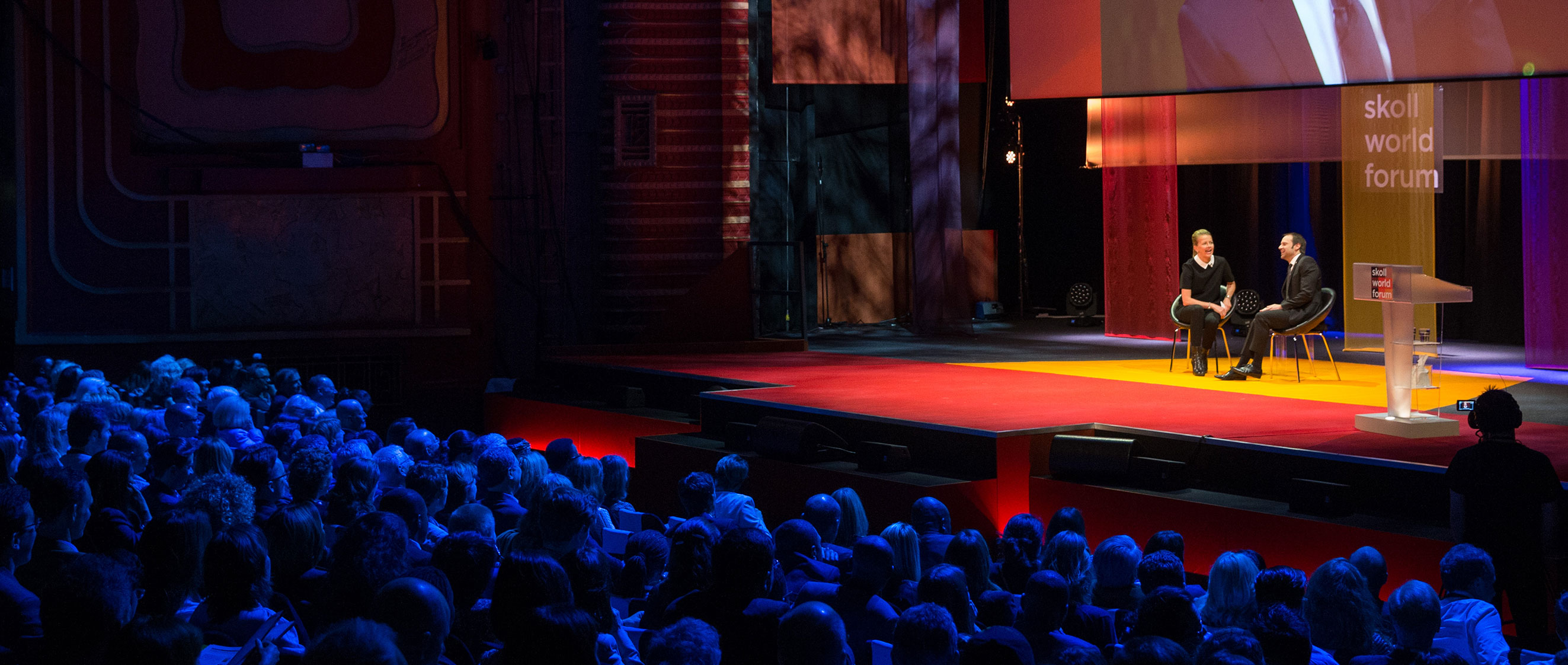
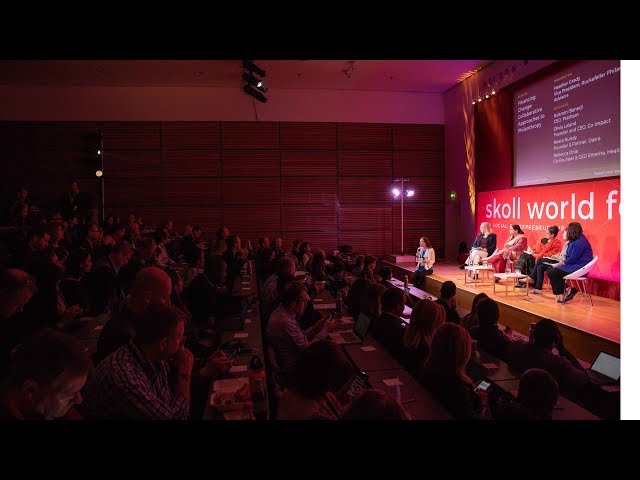
A panel of three microfinance experts discussed Large Scale Change in Action: Microfinance in the Balance at the 2011 Skoll World Forum opening plenary.
We are living in a “backlash of over-promise,” said Alvaro Rodriguez (Compartamos Banco). Moderator, Jonathan Lewis (Microcredit Enterprises) pointed out the elephant in the room: do you have to trade off profit for social impact? The answer from Roshaneh Zafar (Kashf Foundation) was “it’s not about numbers but about lives.”
Micro finance has been the preeminent success of our movement. The Innovation with the greatest reach and impact. Over the 8 years of the forum its moved from specialized instrument to emblematic principle. It is been the undisputed star by movement. It is, however, and I told you there was always the however, not without its critics, and not without charges, that its exuberance is irrational and risks the very people the movement seeks to help.
As Jeff Skoll said earlier, even Grameen's founder, Mohammed Younus, is himself currently the unjustified object of unmerited criticism. This strong brew of success, of importance of critique, makes our panel this evening especially apposite. And, we are very fortunate that Jonathan Lewis is here to chair the discussion.
As founder and chair of Microcredit Enterprises, Johnathan is profoundly immersed in the field and better informed than most. His firm is based on the Lloyds of London model and Jonathan is now a name at Skoll. He will introduce our distinguished panel. Johnathan, welcome.
Thanks.You are right. Good evening, everyone! I need to begin our discussion tonight by letting you in on one of the secret which is that the 3 of us met earlier today and because we are social entrepreneurs we are immediately had an hour of intensive problem solving and we have the panel so let me begin by introducing my co-panelists and then set the stage for conversation, which we are just going to pick up where we left off this afternoon.
And invite you to be fly on the wall and listen to us squabble and think out loud and trying to uncover; some of the tough lessons that micro finance is learning right now, in the social entrepreneur social entrepreneurial marketplace that we hope and think might be applicable to all of your social enterprises.
So Alvaro Rodriguez is the chair of the board of directors of Compartamos Banko in Mexico. It has 2 million and clients, I promised both my co-panelists that I won't do long introductions so I'll allow Alvaro to update us on the latest numbers and thinking that is going on <span class="Apple-style-span" style="background-color: rgb(255, 255, 255); ">Compartamos</span>. But I think I do a fair generalization in saying that; the <span class="Apple-style-span" style="background-color: rgb(255, 255, 255); ">Compartamos</span> management is committed to providing financial services for the poor, while earning profits for share holders.
He holds an MBA from the Harvard School of Business which seems fitting to mention since we're in this place of learning. <span class="Apple-style-span" style="color: rgb(81, 81, 81); ">Roshaneh Zafar</span> is the founder and Managing Director of Kashf Foundation in Pakistan. She has grown this enterprise to serve 300,000 clients and has reorganized it in the last 2 years into a holding company which simultaneously operates a commercial bank, a non-profit micro finance institution and raises dollars on the side for the relief the flood victims of the Pakistani 2010 flood.
She holds a master's degree in International and Economic development - Economics from Yale university, and I really really enjoyed my conversation with you this afternoon and you will as well.
Where to start? Well, it is the case, as Stefan said, micro finance is not just the poster child for a lot of social entrepreneurial activity and in particular economic development, but it is also, simultaneously, a natural global experiment in social entrepreneurship. It's a work in progress and as we convene in this moment in a place of learning and surrounded by institutions developing and addressing the expansion of knowledge, it's probably useful to embrace some words from one of the new Skoll awardees, a friend and colleagueof mine, the CEO of Health Leads, Rebecca Onie, who recently remarked that, it was incumbent upon all of us to share, not just our successes but also our failures and to reap, as you put it, the learnings, so others don't have to pay the price and it's in that spirit I think that both Alvaro and Roshaneh and I were talking today.
And here's the catalogue of where we stand now as a microfinance field. First of all, there's the emanating bad news from India. Reports of abuse ranging from the poor being exploited to profiteering to over indebtedness. In the last 3, 4 years, half decade, there have been two fabulously profitable IPOs, which are held forth are as proof positive that private markets can indeed serve the poorest of the poor.
There's been a steady flow of inconclusive research findings from the scholars and academics around the world, who have predictably called for more studies, am I allowed to say that in Oxford? There is a political witch hunt going on in Bangladesh, by a government which gives opportunism a bad name and the media and the blogosphere, are filled with charges about usurious interest rates, exploitative micro lending practices and other behavior, which offends apparently western sensibilities.
That's the noise, here's the facts. As of the end of 2009, over 3500 micro finance institutions around the world, operating in 115 countries, were are serving a 190 million clients backed by $65 billion in debt or equity investments; and it's important to note that the overwhelming the majority of those 3500 microfinance institutions are non-profits they don't get much publicity but they're out there.
Our job, and I want to trim it over to my panelists in a quick second is to figure out how all of this is fitting together and as I said why we all might learn, so let me turn to you, Roshaneh ask you this question: Keeping in mind that microfinance has millions of borrowers worldwide, In any population of that size ,there will be some borrowers who borrow unwisely.
And for less then productive purposes. Is it your sense that, the, concavity of noise, negative noise about micro finance is just simply overblown?
I think there's always an element of truth in trends as they emerge and I think we as a sector need to be more responsible and we need to learn from what's been, what's coming at us at the moment. And I think the first thing we need to really do is to understand the basis of transparent lending with our clients. We need to be closer to our clients.
I think, I think some of the things you're talking about earlier also of house scale over-reaches, and at times moves you away from your target market and that is really one of the learning that we have. The second is we need to build an equal system around the sector. That becomes extremely important and by an equal system I mean having a quota of consumer protection, having self regulatory framework and third having a credit information bureau that insures the issue of over indebtedness, in terms of mapping it and making the right lending decisions from the view of the institution. On the side of the client it's also very important that we educate them through financial education and I, I know there's this dicotomoy over this, there debate over this that should we be doing only micro finance, should we be focusing on the core business or should we add micro finance plus.
And in the current environment one of the lessons I believe is very important is that we really need to educate the client so the client can make the right financial decisions at the time of, of you know engaging with them.
Are
your clients asking for that, or is this something your management has determined it should do to combat the negative publicity?
Is this a brand issue for you?
No, it's a collaboration that comes out of the, evolving of market, the client overtime. What happens is that is one pioneer that enters the market and, and, and develops the, the segment. Then others come in, competition enters, the moment competition becomes to heat up, it's very important that micro finance institutions understand that there is a lot of information thrown at the client, but that may not be the right information at the right time, and so it is our responsibility to educate the client in this process.
One other question, I'd like to bring you into the conversation, I think I read this correctly, that your initial financial literacy programs that you're running were USAID funded, correct?
They originally started, we started this 3 years ago. We never used to do microfinance plus in that sense. So, after we realized this happened in Morocco, you had cases of similar political, the political economy of microfinance is playing out and we need to be cognizant of that, we need to be savvy, and we need to have, we need to question our own fundamentals.
I think that is what the processes is at the moment. It is also a process of self-reflection for us. The segment has grown, the sector has grown, the industry has burgeoned and as a result, we also need to grow with it and develop, and we need to rethink in that process.
What I was trying to get to there was, are you funding this? In the interest rate that you're charging?
Not at the moment, but we will in the future.
So your view of it,
the management point here, is that it's critical to do this, the poor should pay for it through the interest rates.
In the future because at the moment it's about building the ecosystem creating the awareness and we believe that is really a segment that that is the That is a strategy that needs to be developed.
Alvaro, You weigh in here.
Is this something Compartamos is doing, financial literacy its clients do have demand for, waste of money, different what, tell, talk to us.
Well, financial literacy is at the center of our methodology. So, it's really hand in hand, it's sorry for making an example, but it' like, you know, with tacos, it comes with tortillas, right.
You know, the part that is really the healthy part of it is what's inside but it has to come with the a tortilla, right? Well here is the same thing. Our methodology and the products that we work with with our clients it has to come with financial literacy. Now, we need to be very careful in being condescendant and it's, clients are very smart.
And when you're poor, you don't have the privilege of tripping. And that make very very smart and they understand it perfectly. They need some guidance and need some help in trying to to manage their finances but we need to be careful on, on not being <span class="Apple-style-span" style="background-color: rgb(255, 255, 255); ">condescendant</span>.
Yeah, just to add to that when we started out to that we had a ten day in the literacy program, which includes teaching women how to sign their names, because we're essentially a women focused program. After 6 months of doing this I had no clients. And finally, I called up Elab [sp] who apart from India, whose methodology we were replicating as well.
And she said to me, how long is your training program? I said ten days. And she said, you're crazy. Go back, just do a half an hour initial exercises and then build it up. So really, we have to grow and understand the market. And it's really essential to be close to your client when we design such programs.
Let me tell you an anecdote. I was, I was alone officer for Action New York after I graduated from Business School, and it's been one of the greatest experience that I've ever had, and part of the methodology was exactly that. Before you can get a loan, you have to get this training in classroom, so I would just watch this entrepreneur, micro entrepreneur, just waiting like get on with it because I need my money. And not a lot of attention and not a lot of a retention so it clearly didn't work very well, we have not learned that it's not, it's not what we need to be doing.
I'm not sure I got an answer to the question I just trying to get to though which is, is it the view of Compartamos, that the provision of financial literacy, however defined by your clients, ought to be built into the interest rates, or is this a function that should be provided outside the Compartamos business structure.
It's part of the methodology, part of the product and it's comprised within the intrest rate, no question. And that's been since day one. Since day one.
But it really depends on what your ethos is.
Because when we work with women, we work especially to help their businesses graduate and that takes it's time and that takes resources.
If you are really wanting job creation to happen, if you are really wanting women entrepreneurship to develop, that requires a lot of investment. Especially in a patriarchal culture, where I come from, you really have to break the ice, and when you begin to break the ice, you begin to see the iceberg.
The iceberg of patriarchy is huge beneath the surface. So, I believe that, and that is the a strategy that we espouse that in certain areas when you're wanting to bring about transformation and change, it's not about pricing, it's really about access.
So, actually, let's pursue that a little bit. I've been befuddled as a micro finance player
myself stakeholder. We know that the poor borrow from multiple sources: men, women uniformly as all of you just said, poor astutely aware of every Um, every cent, every pence that they're managing. In the current controversy about over-indebtedness, why is micro finance singled out? Why not informal friends, relatives that are borrowing, community group circles, and the proverbial loan sharks, and all the other ways that the poor borrow.
What's going on there that you think, as social entrepreneurs, has led us to this point, that we'e become the lightning rod for this backlash.
Let's go back a little bit of where we began in microfinance, and microfinance is a great innovation. It's a great innovation of delivering a product that most of us and people living in the top of the pyramid have access to what people in the base of the pyramid don't. So there needs to be an innovation in order to solve that lack of access.
And that innovation was very much funded by philantropy like most innovations or many innovations are funded by philantropy and I did this and I think many of us are guilty of it. When you are in a not-for-profit and you are trying to raise funds. Well, what do you do? You promise the holy grail.
You say, this is it, we are going to solve all promise with this silver bullet, and many of us committed that a that line so what we leaving now is backlash of that, which we over promised, and now we're being held accountable for it. And and obviously we need to stick to our guns. I am a big believer that, yes, financial services do, and access to financial services do improve the quality of life of people but guess what, we can't prove it scientifically.
We all have anecdotes. We've all had personal experiences, but we can't prove it. And that parts of the backlash that we're going through.
Do you agree?
Oh well, I think if you
go back to the issue of over-indebtness it takes two to tango, so there is a client story. If you look at the case of India they were six 57 poverty suicide that were reported of which four were indebted to microfinance and the media picked up those four and didn't talk about the others. So we really need to see you know why, why those stories came out rather than the other governance failures, because I see poverty suicides as a governance failure of, of the leadership, of the political leadership.
So keeping that behind as a backdrop I think over-indebtedness has another which is the number game that we began to play as a sector and I think as social entrepreneurs we need to reconsider that the target orientation that we have any to reconsider the KPIs, or the, you know, key performance indicators we use to measure ourselves.
To a certain extent what Alvaro is saying is correct and I agree with it. We did over promise and we over promised in a sense that we're going to alleviate poverty. Poverty is a more complex issue how will micro finance reduces vulnerabilities of those households that have access to it and so we may have given this, we may have swept certain things under the cover I do believe on the other hand that again as I mentioned earlier also, we as a sector need to be more responsible We can't push credit.
It's not about numbers; it's about transforming lives. And to transform lives, it requires a more microfinance plus focus. It's not just about financial services. So that's what I think is coming out what we what we need to do.
It does strike me as a
little dangerous to take this body of criticisms that we are hearing which, you know, from both ends of the spectrum, both the social investing community as well as the donor community and then some client feedback as well, and excuse ourselves as being overzealous for having overzealous PR departments.
There's more to this than that. I mean, we are in quest - I think, if I can characterize it this way - to figure out how we can ethically finance social change. And the magic of microfinance was that we basically had clients investing in their own entrepreneurial upward mobility, and that was very attractive to western ears and I would, I certainly think we sold two messages.
The market will work. We can stay on mission. Are we learning, that we can't serve two masters? Let me ask Alvaro, since you work for two masters.
I work for one master, which is the client. Look, I mean, they, what's underneath your, your question is this trade off of profit and impact. And I think that's always the elephant in the room and is that possible? Is it possible to maximize returns, and also have positive impact. And, obviously, we believe that we can.
It's not always the case but it can be the case. Now it very much depends on how you define your positive impact.
And no question, in our case it's the benefit of our current clients but for us the definition of impact goes beyond that. It goes into also those clients that don't have access. And for us that's a very important an element in our definition of impact.
And if we want to fulfill that mission of serving the most people as soon as possible,then growth is important. and not only growth, but speed of growth. And the best engine that is profit. So if you are maximizing you profit you're fulling the mission because you are serving that person, that today does not have access to financial service, and he's dying for it, he's waiting there saying I also want access to be able to reach that person as soon as possible.
Let me interrupt to get a clarification on a fact the largest microfinance institutions in the world one by Grameen, are not driven by the profit motive. How do you square that up with your operational experience?
Very much so, and that's why it's said that it can't. We need to be careful in being dogmatic and I'm the first one to say that philanthropic dollars into Microfinance is very important. It's very important for the innovations that we need for the future, to move this field forward, and also because I recognize that commercial microfinance does not necessarily work in all geographies.
So, you put the example of Bangladesh versus Mexico. We are, Bangladesh is one of the poorest, if not the poorest country in the world. When you raise your hand and say, I need donations because I need to do this mission or this intervention, you have access to donations. You're in Mexico, which is now a receiving country.
But sixty percent. of our population is poor, if you raise your hand and say I need donations you are going to be left with your hand up. So if you want to to solve this issue or at least to address it which is the lack of access to financial services then you need to rely on other sources of funding in this case the capital markets.
So, no question there are situations where you need a philanthropy model and there are situations where you need a commercial model. And that were I come in terms with it. And I want to stress the fact that we don't think it is the model. It is the model for some circumstances. And we think that we can get it to that.
We think it's the model to reach the numbers that we need to reach.
I want to come back to this so just the hold the thought everyone please I just want to ask you to explain your model just quickly and why you chose not to convert your non profit one hundred percent into a for profit model. Do you buy the argument that it's cultural?
Well I think the first question is why you want to set up a for profit.
Scale matters, that's certain, access, scale, reaching out a great number of people matters. So that is the end goal. If we keep the end goal in mind in terms of access, the other side as what road do we follow? And in our case we wanted to be a full service provider to our clients. So our client needed credit, insurance and savings.
As a not for profit we were unable to do that. So I think uh, it's not so much. much about being for profit or not for profit, it's really about deepening access to financial products that the client needs, and especially Low income women need. Uh, for us, that was really the driving force. How can we uh, you know, play this dance, this tango, of
new business model and still be able to provide affordable deposits services to clients, in this case women, who wanted small deposits. So that was what we decided. Now when we began to entangle, disentangle this whole process we realized that transforming the entire institution into a bank was going to cost lots of money.
It was going to mean just a huge drain on equity. We decided to go with what we call the agency approach to delivering the same product, in the sense that we set up a bank, however the bank works with foundation who works as an agent with the bank. The bank is for-profit, the bank can provide all forms of deposit products.
At the same time it does larger loan sizes which started at $1000 which makes its business model more viable. If it was doing a $100 alone it would not be viable at the moment. So we continued to service low income women, we work as agents for the bank and set up affordable you know, the same offices serve as bank branches as well.
You don't have to. Is this is an ethical issue, and just pure pragmatics?
It's pragmatic. It's, you know, idealism is a good idea. We're sitting in Oxford so I believe it's about ideas, but at the same time I also believe that social entrepreneurship is about making pragmatic and practical choices. And it's about, you know, reaffirming our beliefs, but also changing our assumptions and trying to test ourselves, like I said.
The sector, microfinance sector, really needs to rethink and and re-engineer. For example, one of the things we did. We worked with the traditional Grameen methodology which is what we learned in the mid 90s. We replicated that in Pakistan. We made a few changes to it. But three years ago we are now in individual lending with business credit backed appraisal lending.
Now we do business appraisal of all the loans that we provide. The reason being that we wanted to make sure that the money was spent for the purposes of productive generation. At the same time we wanted to build skills of our clients, on the way they spent their money. So you really have to evolve.
Now, if you'd spoken to me three years ago I would have said, group lending? That's it. Low income women need that. That's the feel good factor. That's what brings out...
Yeah.
On what Roshaneh said about being practical, I agree 100%. But, you know, one of the great challenges that you have when you're doing this, if you're a for profit or a not for profit is not having a mission drift. And let me share with you a little bit of something which we question ourselves every day.
Compartamos has an average loan balance of $400. That is 4 percent of GDP per capita, okay. So a lot of people for example compare us with Bolivians. We have an average interest rate of about 75%, Bolivia has an average interest rate about 20. And people say, "Why don't you charge like Bolivia?"
Well, the average loan balance in Bolivia eighty five percent. So if we had an average loan balance of 85% of UP per capita we can charge ten percent, not twenty, so we could easily give way to lowering the rates, the raising our average loan balance, but that would be mission drift for us. Because there are banks that have low balances, eighteen percent of GDP per capita for example, ours is four percent because we want to maintain our focus, and a strong focus that we're serving the lowest part of the social economic permit.
For us going up and lower interest rates would be mission drift.
Why aren't you raising interest rates? Will that get you closer to your mission?
No it wouldn't, we have been lowering our interest rates. Our interest rates are about 25% lower than the average in the market. Now, we need to be very careful in what we do, because we are the market leaders, in the pricing. You know you can't lower them too much because otherwise you are killing the competition.
And by the way, talking about mission, one of our greatest objectives as our mission is the creation of an industry, and we are extremely proud of the results that we've had as the institution, but one of the things we're most proud of is that there are 2,000 MFIs in Mexico. And four years ago there were 200.
So there's been an industry created. Why? Just like an industry, they follow a role model. They follow an example that has proven that it can be possible. And for us that's extremely important and carries a tremendous responsibility, and we need to make sure that those two thousand MFIs, obviously not all of them are going to flourish, but a good percentage of them are going to flourish.
Let me just put a period there, if I might, because we're running out of time and I want to take you back, both of you, because the audience, I know by now, shares my deep respect for you and just get your thought about this. Microfinance uniquely, of the social change innovations represented in this audience, is expected to be self financing, which drives the interest rate question.
Whether you're a for profit, non-profit, hybrid, tall, thin, whatever shape you're in, microfinance organizations that do not achieve sustainability, are ignored by the funders, on the donors side, by social investors. You think that's odd?
That we're I think that's ethical,
because what we're saying to
What about, but we don't expect that of educational systems health care systems. And to take the point a bit further, we're not running them through the endless outcomes, metrics, measurement, fad of the moment studies. Determine whether it's good for people to have health care in the way it's good for people to have a job.
Yeah.
It goes a little bit in line with what we've promised. But it also goes very much in line with the objective. I mean, you said that we have close to 200 million clients being served but I think the number that we can agree to is that there is a potential for a billion. There are billion people need access.
so we have 800 million to go. So we are still nasant here. Eight hundred million people, they average a loan balance in mixed market each five hundred dollars. five hundred dollars times 800 million, that is a portfolio 400 billion dollars. If we're is sustainable we're not going to get the funding.
And if I was to look at it a little differently.
If you are talking about poverty alleviation and you are trying to help transform lives, it is not going to happen with one loan. It's going to take maybe ten loans, it's going to be a decade long process. So, if we are not sustainable and we are telling our client to be sustainable, we are actually being dishonest.
If we do not apply, as I said, it is a question of ethics. Our ethics require that in the long run, these services should be affordable, they should be available, and there should be choice. And that can only happen if institutions that deliver these services are there in the long run and that is another way of looking at this whole sustainability question.
I just want to rephrase that and make sure that I understood it properly. The Kashf view is that it should be able to qualify for a loan from itself.
Absolutely, at the end of the day, that's really what it is. You have to turn it around on its head, otherwise, when you talk about profit maximization also, that is not the only reason why we are doing what we are doing. We are doing this because we see a value that it creates for society. It brings change and I can tell you millions of stories where women have become true heroes.
They have led their community; they have brought change. And that's what microfinance delivers. Even if Alvaro doesn't agree with me, I disagree on this point because I have seen that change. I've seen it in Bangladesh. I've seen it across the world. I've seen it in Bolivia. I've seen it in...I haven't been to Mexico and I hope to get there one day...and dance a tango with you.
That's in Argentina. Same difference.
But I'll dance the tango, no problem.
I'll dance a Banghda with you. How's that? That's our dance.
Nice. Really nice. Alvaro, I promised to go back to the Compartamos story for a second and I was struck when I posited that your role as chair of the board is to serve two masters, the clients, their constituents, the population, your social mission, your calling, but also you are shareholders.
You have a responsibility to your...you dismissed that rather quickly. I surprise knowing you for one you did. And do they know this?
Our mission is our door.
And when somebody buys a share of Compartamos, the mission is on the door and everybody knows it. So, we are not hiding anything. That is our objective.
Our objective is to provide financial services to as many people as soon as possible. We believe that a means to an end is profit.
How in a quick 30 seconds, how does that distinguish you from Citi Group? I mean isn't that the CitiGroup for the poor model, just the big and fat and get out there and just open as many teller windows as you can and they have two hundred million they we saw that the micro finance at large group.
Look I cant speak for Citi Group. and None of us can I can't speak for Compartamos.
How do, but I mean what's the line?
The line of...
For you.
How do you distinguish your from Citigroups? or any other financial institution.
Our mission is to provide access to financial services. Not only credit, we for example have 2.8 million in life insurance policies. Not of course voluntary and so to provide financial services to the lower socio economic pyramid, to as many people as soon as possible.
Does that fit your social mission, or would you rephrase it?
Well we talk about transforming lives, and we talk about women's
economic empowerment, so that's our mission is it
And operationally,
really quickly,how does that manifest itself at a management meeting, or a Board meeting? in a way that make.
Of course we have - since we don't have too much time - it also involves looking at impact involves the financial deepening as I was mentioning, the range of products that you offer, you know, the impact that it has on the families. So it's a much broader debate. But before we end I want to talk about Dr. Yunus.
Yes.
because I personally I am outraged by what is going on in Bangladesh and I think there is a lot that we as social entrepreneur family recognizing as a beacon for us. And I think we need to really support and be behind him as I was very glad that Jeff mentioned that. At the same time we can also, the power of the individual is quite big.
And we need to take some actions. We can send petitions, we can sign petitions that are out there. We can support him through letters to the local Bangladeshi embassies, to even the prime minister of Bangladesh because we need to have voice behind him at this moment, so I would urge... And we support that view very much.
Yeah, I think we all do. Our time is up and I feel remiss, as your host and moderator, because we just scratched the surface of an obviously very, very complex and tough moment, for the microfinance, the movement and the microfinance industry. I am not even sure we can get unanimity on which it is at this point, but the point is that social entrepreneurs, we are not giving up.
We are passionate, we are tough, and we are going to figure it out together, collaboratively. Thank you very much.
Thank you.
As Jeff Skoll said earlier, even Grameen's founder, Mohammed Younus, is himself currently the unjustified object of unmerited criticism. This strong brew of success, of importance of critique, makes our panel this evening especially apposite. And, we are very fortunate that Jonathan Lewis is here to chair the discussion.
As founder and chair of Microcredit Enterprises, Johnathan is profoundly immersed in the field and better informed than most. His firm is based on the Lloyds of London model and Jonathan is now a name at Skoll. He will introduce our distinguished panel. Johnathan, welcome.
Thanks.You are right. Good evening, everyone! I need to begin our discussion tonight by letting you in on one of the secret which is that the 3 of us met earlier today and because we are social entrepreneurs we are immediately had an hour of intensive problem solving and we have the panel so let me begin by introducing my co-panelists and then set the stage for conversation, which we are just going to pick up where we left off this afternoon.
And invite you to be fly on the wall and listen to us squabble and think out loud and trying to uncover; some of the tough lessons that micro finance is learning right now, in the social entrepreneur social entrepreneurial marketplace that we hope and think might be applicable to all of your social enterprises.
So Alvaro Rodriguez is the chair of the board of directors of Compartamos Banko in Mexico. It has 2 million and clients, I promised both my co-panelists that I won't do long introductions so I'll allow Alvaro to update us on the latest numbers and thinking that is going on <span class="Apple-style-span" style="background-color: rgb(255, 255, 255); ">Compartamos</span>. But I think I do a fair generalization in saying that; the <span class="Apple-style-span" style="background-color: rgb(255, 255, 255); ">Compartamos</span> management is committed to providing financial services for the poor, while earning profits for share holders.
He holds an MBA from the Harvard School of Business which seems fitting to mention since we're in this place of learning. <span class="Apple-style-span" style="color: rgb(81, 81, 81); ">Roshaneh Zafar</span> is the founder and Managing Director of Kashf Foundation in Pakistan. She has grown this enterprise to serve 300,000 clients and has reorganized it in the last 2 years into a holding company which simultaneously operates a commercial bank, a non-profit micro finance institution and raises dollars on the side for the relief the flood victims of the Pakistani 2010 flood.
She holds a master's degree in International and Economic development - Economics from Yale university, and I really really enjoyed my conversation with you this afternoon and you will as well.
Where to start? Well, it is the case, as Stefan said, micro finance is not just the poster child for a lot of social entrepreneurial activity and in particular economic development, but it is also, simultaneously, a natural global experiment in social entrepreneurship. It's a work in progress and as we convene in this moment in a place of learning and surrounded by institutions developing and addressing the expansion of knowledge, it's probably useful to embrace some words from one of the new Skoll awardees, a friend and colleagueof mine, the CEO of Health Leads, Rebecca Onie, who recently remarked that, it was incumbent upon all of us to share, not just our successes but also our failures and to reap, as you put it, the learnings, so others don't have to pay the price and it's in that spirit I think that both Alvaro and Roshaneh and I were talking today.
And here's the catalogue of where we stand now as a microfinance field. First of all, there's the emanating bad news from India. Reports of abuse ranging from the poor being exploited to profiteering to over indebtedness. In the last 3, 4 years, half decade, there have been two fabulously profitable IPOs, which are held forth are as proof positive that private markets can indeed serve the poorest of the poor.
There's been a steady flow of inconclusive research findings from the scholars and academics around the world, who have predictably called for more studies, am I allowed to say that in Oxford? There is a political witch hunt going on in Bangladesh, by a government which gives opportunism a bad name and the media and the blogosphere, are filled with charges about usurious interest rates, exploitative micro lending practices and other behavior, which offends apparently western sensibilities.
That's the noise, here's the facts. As of the end of 2009, over 3500 micro finance institutions around the world, operating in 115 countries, were are serving a 190 million clients backed by $65 billion in debt or equity investments; and it's important to note that the overwhelming the majority of those 3500 microfinance institutions are non-profits they don't get much publicity but they're out there.
Our job, and I want to trim it over to my panelists in a quick second is to figure out how all of this is fitting together and as I said why we all might learn, so let me turn to you, Roshaneh ask you this question: Keeping in mind that microfinance has millions of borrowers worldwide, In any population of that size ,there will be some borrowers who borrow unwisely.
And for less then productive purposes. Is it your sense that, the, concavity of noise, negative noise about micro finance is just simply overblown?
I think there's always an element of truth in trends as they emerge and I think we as a sector need to be more responsible and we need to learn from what's been, what's coming at us at the moment. And I think the first thing we need to really do is to understand the basis of transparent lending with our clients. We need to be closer to our clients.
I think, I think some of the things you're talking about earlier also of house scale over-reaches, and at times moves you away from your target market and that is really one of the learning that we have. The second is we need to build an equal system around the sector. That becomes extremely important and by an equal system I mean having a quota of consumer protection, having self regulatory framework and third having a credit information bureau that insures the issue of over indebtedness, in terms of mapping it and making the right lending decisions from the view of the institution. On the side of the client it's also very important that we educate them through financial education and I, I know there's this dicotomoy over this, there debate over this that should we be doing only micro finance, should we be focusing on the core business or should we add micro finance plus.
And in the current environment one of the lessons I believe is very important is that we really need to educate the client so the client can make the right financial decisions at the time of, of you know engaging with them.
Are
your clients asking for that, or is this something your management has determined it should do to combat the negative publicity?
Is this a brand issue for you?
No, it's a collaboration that comes out of the, evolving of market, the client overtime. What happens is that is one pioneer that enters the market and, and, and develops the, the segment. Then others come in, competition enters, the moment competition becomes to heat up, it's very important that micro finance institutions understand that there is a lot of information thrown at the client, but that may not be the right information at the right time, and so it is our responsibility to educate the client in this process.
One other question, I'd like to bring you into the conversation, I think I read this correctly, that your initial financial literacy programs that you're running were USAID funded, correct?
They originally started, we started this 3 years ago. We never used to do microfinance plus in that sense. So, after we realized this happened in Morocco, you had cases of similar political, the political economy of microfinance is playing out and we need to be cognizant of that, we need to be savvy, and we need to have, we need to question our own fundamentals.
I think that is what the processes is at the moment. It is also a process of self-reflection for us. The segment has grown, the sector has grown, the industry has burgeoned and as a result, we also need to grow with it and develop, and we need to rethink in that process.
What I was trying to get to there was, are you funding this? In the interest rate that you're charging?
Not at the moment, but we will in the future.
So your view of it,
the management point here, is that it's critical to do this, the poor should pay for it through the interest rates.
In the future because at the moment it's about building the ecosystem creating the awareness and we believe that is really a segment that that is the That is a strategy that needs to be developed.
Alvaro, You weigh in here.
Is this something Compartamos is doing, financial literacy its clients do have demand for, waste of money, different what, tell, talk to us.
Well, financial literacy is at the center of our methodology. So, it's really hand in hand, it's sorry for making an example, but it' like, you know, with tacos, it comes with tortillas, right.
You know, the part that is really the healthy part of it is what's inside but it has to come with the a tortilla, right? Well here is the same thing. Our methodology and the products that we work with with our clients it has to come with financial literacy. Now, we need to be very careful in being condescendant and it's, clients are very smart.
And when you're poor, you don't have the privilege of tripping. And that make very very smart and they understand it perfectly. They need some guidance and need some help in trying to to manage their finances but we need to be careful on, on not being <span class="Apple-style-span" style="background-color: rgb(255, 255, 255); ">condescendant</span>.
Yeah, just to add to that when we started out to that we had a ten day in the literacy program, which includes teaching women how to sign their names, because we're essentially a women focused program. After 6 months of doing this I had no clients. And finally, I called up Elab [sp] who apart from India, whose methodology we were replicating as well.
And she said to me, how long is your training program? I said ten days. And she said, you're crazy. Go back, just do a half an hour initial exercises and then build it up. So really, we have to grow and understand the market. And it's really essential to be close to your client when we design such programs.
Let me tell you an anecdote. I was, I was alone officer for Action New York after I graduated from Business School, and it's been one of the greatest experience that I've ever had, and part of the methodology was exactly that. Before you can get a loan, you have to get this training in classroom, so I would just watch this entrepreneur, micro entrepreneur, just waiting like get on with it because I need my money. And not a lot of attention and not a lot of a retention so it clearly didn't work very well, we have not learned that it's not, it's not what we need to be doing.
I'm not sure I got an answer to the question I just trying to get to though which is, is it the view of Compartamos, that the provision of financial literacy, however defined by your clients, ought to be built into the interest rates, or is this a function that should be provided outside the Compartamos business structure.
It's part of the methodology, part of the product and it's comprised within the intrest rate, no question. And that's been since day one. Since day one.
But it really depends on what your ethos is.
Because when we work with women, we work especially to help their businesses graduate and that takes it's time and that takes resources.
If you are really wanting job creation to happen, if you are really wanting women entrepreneurship to develop, that requires a lot of investment. Especially in a patriarchal culture, where I come from, you really have to break the ice, and when you begin to break the ice, you begin to see the iceberg.
The iceberg of patriarchy is huge beneath the surface. So, I believe that, and that is the a strategy that we espouse that in certain areas when you're wanting to bring about transformation and change, it's not about pricing, it's really about access.
So, actually, let's pursue that a little bit. I've been befuddled as a micro finance player
myself stakeholder. We know that the poor borrow from multiple sources: men, women uniformly as all of you just said, poor astutely aware of every Um, every cent, every pence that they're managing. In the current controversy about over-indebtedness, why is micro finance singled out? Why not informal friends, relatives that are borrowing, community group circles, and the proverbial loan sharks, and all the other ways that the poor borrow.
What's going on there that you think, as social entrepreneurs, has led us to this point, that we'e become the lightning rod for this backlash.
Let's go back a little bit of where we began in microfinance, and microfinance is a great innovation. It's a great innovation of delivering a product that most of us and people living in the top of the pyramid have access to what people in the base of the pyramid don't. So there needs to be an innovation in order to solve that lack of access.
And that innovation was very much funded by philantropy like most innovations or many innovations are funded by philantropy and I did this and I think many of us are guilty of it. When you are in a not-for-profit and you are trying to raise funds. Well, what do you do? You promise the holy grail.
You say, this is it, we are going to solve all promise with this silver bullet, and many of us committed that a that line so what we leaving now is backlash of that, which we over promised, and now we're being held accountable for it. And and obviously we need to stick to our guns. I am a big believer that, yes, financial services do, and access to financial services do improve the quality of life of people but guess what, we can't prove it scientifically.
We all have anecdotes. We've all had personal experiences, but we can't prove it. And that parts of the backlash that we're going through.
Do you agree?
Oh well, I think if you
go back to the issue of over-indebtness it takes two to tango, so there is a client story. If you look at the case of India they were six 57 poverty suicide that were reported of which four were indebted to microfinance and the media picked up those four and didn't talk about the others. So we really need to see you know why, why those stories came out rather than the other governance failures, because I see poverty suicides as a governance failure of, of the leadership, of the political leadership.
So keeping that behind as a backdrop I think over-indebtedness has another which is the number game that we began to play as a sector and I think as social entrepreneurs we need to reconsider that the target orientation that we have any to reconsider the KPIs, or the, you know, key performance indicators we use to measure ourselves.
To a certain extent what Alvaro is saying is correct and I agree with it. We did over promise and we over promised in a sense that we're going to alleviate poverty. Poverty is a more complex issue how will micro finance reduces vulnerabilities of those households that have access to it and so we may have given this, we may have swept certain things under the cover I do believe on the other hand that again as I mentioned earlier also, we as a sector need to be more responsible We can't push credit.
It's not about numbers; it's about transforming lives. And to transform lives, it requires a more microfinance plus focus. It's not just about financial services. So that's what I think is coming out what we what we need to do.
It does strike me as a
little dangerous to take this body of criticisms that we are hearing which, you know, from both ends of the spectrum, both the social investing community as well as the donor community and then some client feedback as well, and excuse ourselves as being overzealous for having overzealous PR departments.
There's more to this than that. I mean, we are in quest - I think, if I can characterize it this way - to figure out how we can ethically finance social change. And the magic of microfinance was that we basically had clients investing in their own entrepreneurial upward mobility, and that was very attractive to western ears and I would, I certainly think we sold two messages.
The market will work. We can stay on mission. Are we learning, that we can't serve two masters? Let me ask Alvaro, since you work for two masters.
I work for one master, which is the client. Look, I mean, they, what's underneath your, your question is this trade off of profit and impact. And I think that's always the elephant in the room and is that possible? Is it possible to maximize returns, and also have positive impact. And, obviously, we believe that we can.
It's not always the case but it can be the case. Now it very much depends on how you define your positive impact.
And no question, in our case it's the benefit of our current clients but for us the definition of impact goes beyond that. It goes into also those clients that don't have access. And for us that's a very important an element in our definition of impact.
And if we want to fulfill that mission of serving the most people as soon as possible,then growth is important. and not only growth, but speed of growth. And the best engine that is profit. So if you are maximizing you profit you're fulling the mission because you are serving that person, that today does not have access to financial service, and he's dying for it, he's waiting there saying I also want access to be able to reach that person as soon as possible.
Let me interrupt to get a clarification on a fact the largest microfinance institutions in the world one by Grameen, are not driven by the profit motive. How do you square that up with your operational experience?
Very much so, and that's why it's said that it can't. We need to be careful in being dogmatic and I'm the first one to say that philanthropic dollars into Microfinance is very important. It's very important for the innovations that we need for the future, to move this field forward, and also because I recognize that commercial microfinance does not necessarily work in all geographies.
So, you put the example of Bangladesh versus Mexico. We are, Bangladesh is one of the poorest, if not the poorest country in the world. When you raise your hand and say, I need donations because I need to do this mission or this intervention, you have access to donations. You're in Mexico, which is now a receiving country.
But sixty percent. of our population is poor, if you raise your hand and say I need donations you are going to be left with your hand up. So if you want to to solve this issue or at least to address it which is the lack of access to financial services then you need to rely on other sources of funding in this case the capital markets.
So, no question there are situations where you need a philanthropy model and there are situations where you need a commercial model. And that were I come in terms with it. And I want to stress the fact that we don't think it is the model. It is the model for some circumstances. And we think that we can get it to that.
We think it's the model to reach the numbers that we need to reach.
I want to come back to this so just the hold the thought everyone please I just want to ask you to explain your model just quickly and why you chose not to convert your non profit one hundred percent into a for profit model. Do you buy the argument that it's cultural?
Well I think the first question is why you want to set up a for profit.
Scale matters, that's certain, access, scale, reaching out a great number of people matters. So that is the end goal. If we keep the end goal in mind in terms of access, the other side as what road do we follow? And in our case we wanted to be a full service provider to our clients. So our client needed credit, insurance and savings.
As a not for profit we were unable to do that. So I think uh, it's not so much. much about being for profit or not for profit, it's really about deepening access to financial products that the client needs, and especially Low income women need. Uh, for us, that was really the driving force. How can we uh, you know, play this dance, this tango, of
new business model and still be able to provide affordable deposits services to clients, in this case women, who wanted small deposits. So that was what we decided. Now when we began to entangle, disentangle this whole process we realized that transforming the entire institution into a bank was going to cost lots of money.
It was going to mean just a huge drain on equity. We decided to go with what we call the agency approach to delivering the same product, in the sense that we set up a bank, however the bank works with foundation who works as an agent with the bank. The bank is for-profit, the bank can provide all forms of deposit products.
At the same time it does larger loan sizes which started at $1000 which makes its business model more viable. If it was doing a $100 alone it would not be viable at the moment. So we continued to service low income women, we work as agents for the bank and set up affordable you know, the same offices serve as bank branches as well.
You don't have to. Is this is an ethical issue, and just pure pragmatics?
It's pragmatic. It's, you know, idealism is a good idea. We're sitting in Oxford so I believe it's about ideas, but at the same time I also believe that social entrepreneurship is about making pragmatic and practical choices. And it's about, you know, reaffirming our beliefs, but also changing our assumptions and trying to test ourselves, like I said.
The sector, microfinance sector, really needs to rethink and and re-engineer. For example, one of the things we did. We worked with the traditional Grameen methodology which is what we learned in the mid 90s. We replicated that in Pakistan. We made a few changes to it. But three years ago we are now in individual lending with business credit backed appraisal lending.
Now we do business appraisal of all the loans that we provide. The reason being that we wanted to make sure that the money was spent for the purposes of productive generation. At the same time we wanted to build skills of our clients, on the way they spent their money. So you really have to evolve.
Now, if you'd spoken to me three years ago I would have said, group lending? That's it. Low income women need that. That's the feel good factor. That's what brings out...
Yeah.
On what Roshaneh said about being practical, I agree 100%. But, you know, one of the great challenges that you have when you're doing this, if you're a for profit or a not for profit is not having a mission drift. And let me share with you a little bit of something which we question ourselves every day.
Compartamos has an average loan balance of $400. That is 4 percent of GDP per capita, okay. So a lot of people for example compare us with Bolivians. We have an average interest rate of about 75%, Bolivia has an average interest rate about 20. And people say, "Why don't you charge like Bolivia?"
Well, the average loan balance in Bolivia eighty five percent. So if we had an average loan balance of 85% of UP per capita we can charge ten percent, not twenty, so we could easily give way to lowering the rates, the raising our average loan balance, but that would be mission drift for us. Because there are banks that have low balances, eighteen percent of GDP per capita for example, ours is four percent because we want to maintain our focus, and a strong focus that we're serving the lowest part of the social economic permit.
For us going up and lower interest rates would be mission drift.
Why aren't you raising interest rates? Will that get you closer to your mission?
No it wouldn't, we have been lowering our interest rates. Our interest rates are about 25% lower than the average in the market. Now, we need to be very careful in what we do, because we are the market leaders, in the pricing. You know you can't lower them too much because otherwise you are killing the competition.
And by the way, talking about mission, one of our greatest objectives as our mission is the creation of an industry, and we are extremely proud of the results that we've had as the institution, but one of the things we're most proud of is that there are 2,000 MFIs in Mexico. And four years ago there were 200.
So there's been an industry created. Why? Just like an industry, they follow a role model. They follow an example that has proven that it can be possible. And for us that's extremely important and carries a tremendous responsibility, and we need to make sure that those two thousand MFIs, obviously not all of them are going to flourish, but a good percentage of them are going to flourish.
Let me just put a period there, if I might, because we're running out of time and I want to take you back, both of you, because the audience, I know by now, shares my deep respect for you and just get your thought about this. Microfinance uniquely, of the social change innovations represented in this audience, is expected to be self financing, which drives the interest rate question.
Whether you're a for profit, non-profit, hybrid, tall, thin, whatever shape you're in, microfinance organizations that do not achieve sustainability, are ignored by the funders, on the donors side, by social investors. You think that's odd?
That we're I think that's ethical,
because what we're saying to
What about, but we don't expect that of educational systems health care systems. And to take the point a bit further, we're not running them through the endless outcomes, metrics, measurement, fad of the moment studies. Determine whether it's good for people to have health care in the way it's good for people to have a job.
Yeah.
It goes a little bit in line with what we've promised. But it also goes very much in line with the objective. I mean, you said that we have close to 200 million clients being served but I think the number that we can agree to is that there is a potential for a billion. There are billion people need access.
so we have 800 million to go. So we are still nasant here. Eight hundred million people, they average a loan balance in mixed market each five hundred dollars. five hundred dollars times 800 million, that is a portfolio 400 billion dollars. If we're is sustainable we're not going to get the funding.
And if I was to look at it a little differently.
If you are talking about poverty alleviation and you are trying to help transform lives, it is not going to happen with one loan. It's going to take maybe ten loans, it's going to be a decade long process. So, if we are not sustainable and we are telling our client to be sustainable, we are actually being dishonest.
If we do not apply, as I said, it is a question of ethics. Our ethics require that in the long run, these services should be affordable, they should be available, and there should be choice. And that can only happen if institutions that deliver these services are there in the long run and that is another way of looking at this whole sustainability question.
I just want to rephrase that and make sure that I understood it properly. The Kashf view is that it should be able to qualify for a loan from itself.
Absolutely, at the end of the day, that's really what it is. You have to turn it around on its head, otherwise, when you talk about profit maximization also, that is not the only reason why we are doing what we are doing. We are doing this because we see a value that it creates for society. It brings change and I can tell you millions of stories where women have become true heroes.
They have led their community; they have brought change. And that's what microfinance delivers. Even if Alvaro doesn't agree with me, I disagree on this point because I have seen that change. I've seen it in Bangladesh. I've seen it across the world. I've seen it in Bolivia. I've seen it in...I haven't been to Mexico and I hope to get there one day...and dance a tango with you.
That's in Argentina. Same difference.
But I'll dance the tango, no problem.
I'll dance a Banghda with you. How's that? That's our dance.
Nice. Really nice. Alvaro, I promised to go back to the Compartamos story for a second and I was struck when I posited that your role as chair of the board is to serve two masters, the clients, their constituents, the population, your social mission, your calling, but also you are shareholders.
You have a responsibility to your...you dismissed that rather quickly. I surprise knowing you for one you did. And do they know this?
Our mission is our door.
And when somebody buys a share of Compartamos, the mission is on the door and everybody knows it. So, we are not hiding anything. That is our objective.
Our objective is to provide financial services to as many people as soon as possible. We believe that a means to an end is profit.
How in a quick 30 seconds, how does that distinguish you from Citi Group? I mean isn't that the CitiGroup for the poor model, just the big and fat and get out there and just open as many teller windows as you can and they have two hundred million they we saw that the micro finance at large group.
Look I cant speak for Citi Group. and None of us can I can't speak for Compartamos.
How do, but I mean what's the line?
The line of...
For you.
How do you distinguish your from Citigroups? or any other financial institution.
Our mission is to provide access to financial services. Not only credit, we for example have 2.8 million in life insurance policies. Not of course voluntary and so to provide financial services to the lower socio economic pyramid, to as many people as soon as possible.
Does that fit your social mission, or would you rephrase it?
Well we talk about transforming lives, and we talk about women's
economic empowerment, so that's our mission is it
And operationally,
really quickly,how does that manifest itself at a management meeting, or a Board meeting? in a way that make.
Of course we have - since we don't have too much time - it also involves looking at impact involves the financial deepening as I was mentioning, the range of products that you offer, you know, the impact that it has on the families. So it's a much broader debate. But before we end I want to talk about Dr. Yunus.
Yes.
because I personally I am outraged by what is going on in Bangladesh and I think there is a lot that we as social entrepreneur family recognizing as a beacon for us. And I think we need to really support and be behind him as I was very glad that Jeff mentioned that. At the same time we can also, the power of the individual is quite big.
And we need to take some actions. We can send petitions, we can sign petitions that are out there. We can support him through letters to the local Bangladeshi embassies, to even the prime minister of Bangladesh because we need to have voice behind him at this moment, so I would urge... And we support that view very much.
Yeah, I think we all do. Our time is up and I feel remiss, as your host and moderator, because we just scratched the surface of an obviously very, very complex and tough moment, for the microfinance, the movement and the microfinance industry. I am not even sure we can get unanimity on which it is at this point, but the point is that social entrepreneurs, we are not giving up.
We are passionate, we are tough, and we are going to figure it out together, collaboratively. Thank you very much.
Thank you.
Related Videos
-
Baaba Maal Opening Musical performance – Skoll World Forum 2011 -
Stephan Chambers – Opening Remarks – Skoll World Forum 2011 -
Stephan Chambers on large-scale change: Skoll World Forum 2011 -
Jeff Skoll – The Power of the Collective – Skoll World Forum 2011 opening remarks -
Ngaire Woods – Globalization, Governance and Large Scale Change – Skoll World Forum 2011