Lord Anthony Giddens on the politics of climate change

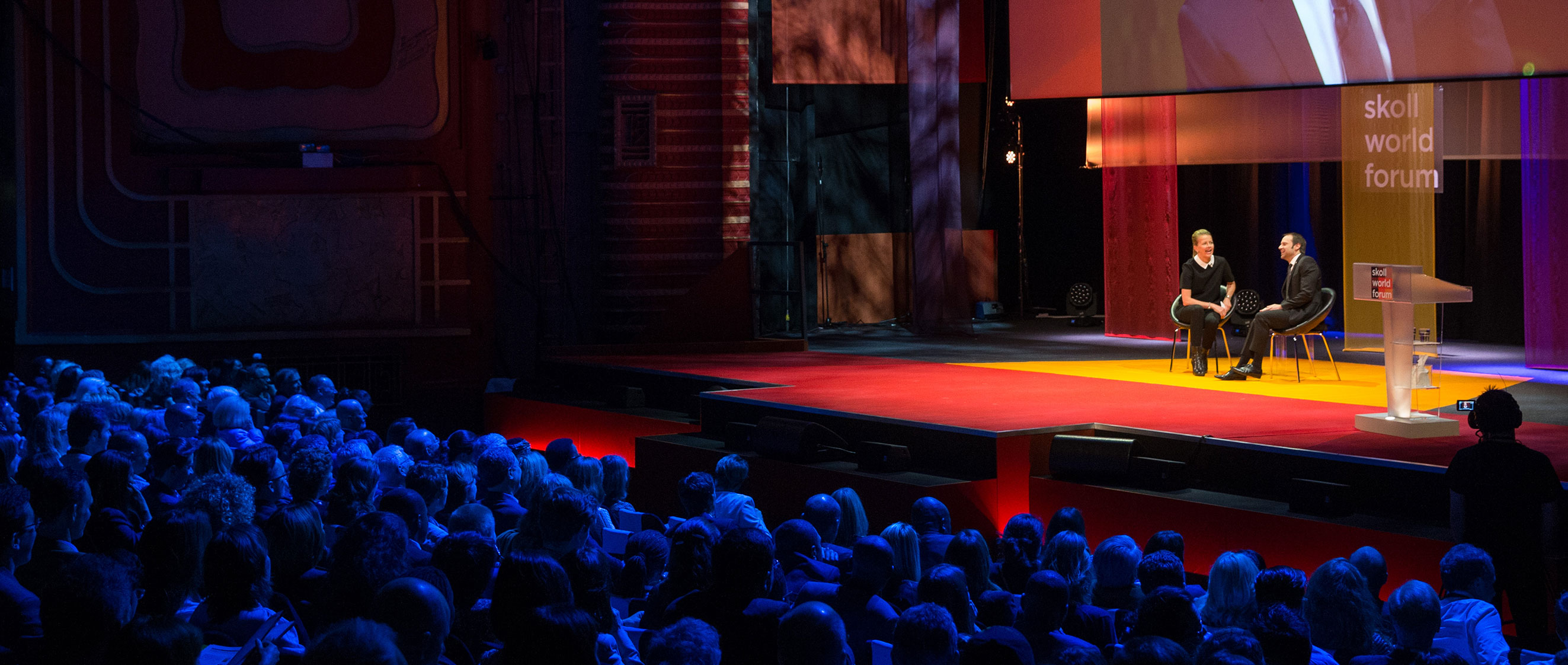
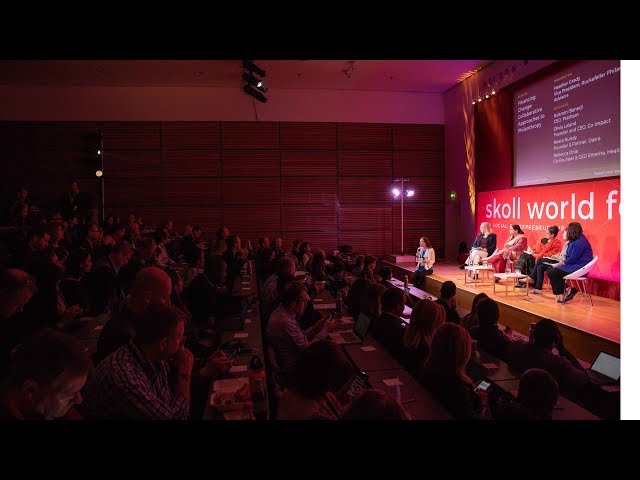
Lord Anthony Giddens of the House of Lords speaks on the politics of climate change at the 2008 Skoll World Forum opening plenary.

With: Lord Anthony Giddens
well I mean I feel, can you hear me? I feel really embarassed now because I come bereft of gifts. I don't even have a crummy four hundred dollar picture of the boat race to offer you. All I have to offer you is to my own good self, but I would like to say that it's a great pleasure for me to be here this afternoon and I'm very honored to be invited to this event.

I like to thank Alex and Jeff and all the others who have invited me here. I'd also like to echo what Stephan said in his introduction, that is I greatly admire all of the work that people sitting here do. I think that there's no doubt that as Jeff indicated in his address that social entrepreneurship has arrived and that is a truly, transformative, phenomenon for the world.

I think there is no doubt of the immense kind of wealth brings of energy which social entrepreneurship is producing across the world, now of course the notion of social entrepreneurship is controversial one. And there are many different definitions of it. And it is a bit elusive but as I would use it anyways I would see it, it involves a number of qualities.

One, a spirit of enterprise, I believe in you can do things. But just because they haven't been done before you cant do them now. Second, the spirit of ingenuity lateral thinking what was Ebay, well it was something very different from probably anyone contemplated, including it's founders I imagine when it was established.

And third I think of the kind of values winch go beyond the orthodox values of enterprise. To me least distinguish social entrepreneurship both from the voluntary sectors as such and from this fear of business and this fear of the state and there are many people who, when they look at the contemporary world, they tend to think this is like a passing world in which we live.

Which citizens have become passive in the face of World problems but I've always thought the opposite that this is a kind of reflective, active, energized world we live in and for me social entrepreneurship is an expression of that fact. Well, I'm not a social entrepreneur, but I've become very interested in social entrepreneurship over the last little while since I've been working on a large project on the politics of climate change and the politics of energy and security.

If you will forgive me, I'm not going to talk about culture.

But I am going to talk about that project and also ask your advice about its cause I think we need a deeper involvement of social entrepreneurs in all this than maybe we've had so far of course. Many people, many, many people are working on these issues. I think the history of the debate about climate change is immensely interesting because when I first started thinking about it, writing about it, it was about twenty five years ago, it was regarded as a pretty marginal and remote concern for most people.

Well you know it was sort of a concern of like, crazed environmentalists and then over, what, no more than three or four years I suppose, you've got this fantastic switch around where the debate of that climate change is everywhere. Where you can't open the newspaper without reading about it, and where the debate about climate change has become global.

Myself I'm not sure why that happened, but they say you learn something everyday, and I've learned something today, that Jeff was the inspiration behind Al Gore's film, "An Inconvenient Truth," and that's certainly one of the events that's helped propel climate change towards global consciousness.

The other, I think, is simply awareness of disaster. Hurricane Katrina may not have. Anything to do with climate change. But it shows you that a city in the richest country in the world could be reduced to ruin overnight. And then recently most people here will know The new Prime Minister in Australia, Kevin Rad, who espouses environmental causes and his advocacy of Environmentalism and Australia joining was at least one of the reasons why he triumphed in the election.

Of course, Australia has immense problems with hard air as in arid land which seem to be becoming unproductive. There are a lot of things too, like for example, massive snowstorms in China, quite recently, very very unusual, both in the depth of the snowstorms and the parts of the country which they reached.

Whatever reason, it had to a massive switch clearly in global consciousness of significance of climate change, and to that you'd to some extent bracket energy security, too. Well, when I give these talks I like to include one or two jokes. I was looking for climate change jokes. But it might surprise you, or it probably wouldn't surprise you to know, that there are very few climate change jokes.

There are plenty of Al Gore jokes. And I'll come onto that a bit later at the risk of stepping on people's toes. But anyways, here are a couple of jokes that I found. I don't know whether you'll find them funny or not. There are, but I'd like you to laugh, obviously, even in you know, guest lecture theater.

There are a couple looking at their garden and the wife turns to the husband and says, "George, the neighbor's fish has got in our garden again." Oh, you don't get it! It's because of flooding. Flooding comes along with global warming. Flooding right? Neighbor's fish has got in our garden again. and I told you it's difficult to find climate change jokes.

Well, what about George Bush? Well you might have heard that George Bush has finally decided to take climate change seriously, and he's got a project of sending twenty thousand troops to the Sun. Wow, that's a relief for us public speakers, but then George Bush jokes always get a laugh even among Americans so I've found.

Well if you look at the state of the climate change debate it's really, really interesting because for several years it was a debate between the skeptics about climate change and what you might call the orthodox position represented especially by the United Nations International Panel on climate change.

Skeptics are fairly well represented. People who said climate change is not the result of human activity. Well, first of all they said it's not happening, and then they said it's not as a result of human activity. There are still people publishing books on this; quite important in the politics of climate change because if you don't feel like doing something about it, you can always say, "Oh well it's not proven, is it?"

And against that you have the position that climate change is serious. It is a problem facing all of us, but it is a fairly incremental thing. If you look at the, especially the earlier predictions and projections of the international panel on climate change, they were saying, look, we've got big problems, 30 or 40 years down the line.

But now, reflected to some degree in Al Gore's film, you have a different school of thought, who I would call the 'climate change radicals', and I think you have to listen to them very carefully.

They say that climate change is a much much more urgent problem than before then we thought before, than the orthodox consensus believes, and that it's an issue that depends upon thresholds. So, they say the You can get very radical forms of climate change happening very quickly. They actually draw upon previous examples from the the history of climate change since the climate has always been changing to show that you have very rapid shifts within a period of something like, ten years.

Of temperature occurring in the past. So this, they say, could happen again. And they argue that there are thing is going on in the world, which could produce such threshold or events or if you like that terminology tipping points, which is why do you environmental literature. For example, take the Antarctic ice.

It used to be thought that the Antarctic ice is on land is so solid that it will only melt on slowly, but recent studies involving much more in-depth probes of the eyes. Surely, your ice could be splintering. As ice splinters, large chunks can break off and the whole thing might become unstable much more quickly then we imagine.

We don't actually know but it may do ice on Greenland, the ice cap on Greenland. It could also be true of the escape of methane from the peat bog in eastern Siberia. Methane is a vastly more powerful greenhouse gas than CO2. We just don't know exactly what is going on, though. It's quite difficult, the access for Western scientists there, but many believe this is a really, really serious and imminent problem.

So, if you look at the literature you conclude, I think, by thinking that these are risks we must take very seriously. We cannot any longer think that climate change is simply something for the future and that we can progressively build up an approach to it. It's much more likely to be something that's happening now, but also something which in the relatively near future could produce a threshold event which could cause enormous disasters across the world.

So it's a much more horrifying scenario if these people are right than the one which has been prevalent even among the orthodox scientific community until relatively recently.

If you want to read a really. bought by scientific writer on climate change. You could try Fred Pierce The Last Generation. He doesn't where the last generation on earth, what he says there is that we are the last generation who will experience a stable climate for granted a stable climate. Stable climates are actually unusual in climactic history.

The next generation will enter a period of highly unstable climatic conditions. It is a pretty scary book but it's written with a lot of scientific insight and information to back it up. So what do we do? Well, the response of the world community to my mind has not been nearly, nearly effective enough.

Two main responses on the part of the world community. First of all, the introduction of carbon trading carbon markets, which originated in the United States, then taken over by the European Union, and the European Union has the world's its carbon trading market, so far, has had almost zero effect; however, on reducing emissions and there are many many problems problems facing carbon trading markets.

So, anyone who thinks that's the magic bullet solution has to think again. Second, you have a kind of global for architectural agreement from Kyoto onto Bali and unto the so called road back from Bali, but if you look at the negotiations involved there, politics is everywhere in those negotiations, and I personally don't hold up much hope that these will produce the kind of radical innovations we need.

So we need you social entrepreneurs in there, and of course social entrepreneurs have produced a great deal of interesting projects in response. Well, to think for example of the work of the work of Reed Paget, the social entrepreneur from Oregon who developed the world's first completely biodegradable plastic bottle what she made great success with and spent the profits on introducing water or water mechanisms in India and parts of Africa as a result of that and I believe was sitting here somewhere I noticed looking back through older Skoll meetings that in 2006 I think it was she got an award for her innovations trying to push institutional investors and corporations to take more direct account of green issues in the accounting.

However, the we need things like that. But I want to suggest, I want to ask your advice really. We need something I think much more profound than that. I would like to see if social entrepreneurs can help us resolve what i would take to be the three key problems of the politics of climate change.

The politics of climate change for me is not about just reaching agreements. It's not about just Saying, oh well we'll invest in nuclear energy or whatever. It's not about saying oh well markets will resolve these issues for us. It's about the how. We don't really have much of a how in relation to climate change.

Countries have get themselves targets you look at the climate change bill her for example in the UK the climate change bill just going through Parliament in one sense, because it sets at least a sixty percent reduction target for 2050, and that will probably become an eighty percent. He has also other provisions in it but there is no how in the bill.

We don't really know how were going to reach those. Hence, the politics of the hound needs an enormous amount of work. Well, the three issues I'd like to mention to you are the following. First of all How do we cope with the fundamental and massively pervasive issue in climate change politics of free writing.

Free writing is everywhere in the politics of climate change. When you're talking about getting people to change their behavior, for example to follow a more low collar lifestyle. It's not like asking people to give up smoking. If you ask people to give up smoking that's benefit which they will feel down the line themselves in the case of climate change and policies regarding climate change you have the problem that you want a collect about come from individual solutions.

That's a classical problem of political theory because we have many people, or we can have many people who do nothing, and to leave others to take the lead and to make the changes but that's unstable situation so the moment we have some nations free riding off others with the most notable example being in the United States free writing off more or less the whole of the rest of the world community but all through society you have individuals free riding our fathers.

How do you tackle that phenomenon? Well social entrepreneurs have done things which are relevant to it and if you got any ideas, Jeff Skolls got my card, you could send them to me. In Germany, for example, some people who were driving low-energy cars started putting labels on their cars to show that they were low-energy cars.

That had the effect of shaming people who were driving the high consumption vehicles and that actually led to a government scheme in some German cities, whereby everyone who drives into the city has to have a sticker. So that if your driving Prius or something like that and you get a nice little green sticker, but if you're driving a SUV you have some glaring, horrible, red sticker on your windscreen and shaming mechanisms do seem one way in which we able to help control free riding issues.

The second big issue in climate change politics, if you'll forgive me for this terminology, but we are in the Sheldonian Theater of the University of Oxford what economists call hyperbolic discounting. Hyperbolic discounting means, if I can put it very crudely, we find it very hard to take the future seriously.

We find it very hard to react to an abstract future as compared the to the exigences of the moment. And economists have done all sorts of experiments to show how this works. So for example, if you offer someone fifty dollars, well in Jeff's case would have to be five billion dollars, in the here and now, they are likely to take that $50.00 dollars over as compared to say three hundred dollars four or five years down the line.

It's not until you get somewhere much higher than you'd think, well over five hundred dollars that most people change the bargain as it were Economists think, and I think, that's because you've got two different selves involved, if you like. You've got your everyday self, and you've got a future self.

Which you find it hard to relate to. One of the reasons why people go on smoking even though they know that its very harmful, is the effects of smoking are in distant abstract future. If you a 16 year old girl and you started smoking to impress your mates what do you care about what will happen to you when your 40.

Because 40 is such the long way down the line. It's a very, very significant aspect of how people think. A very good way of thinking about it so when in reverse is, and you might bear this in mind, is accepting invitations to go to conferences. If your asked to go to a conference, of course the conference you have to accept from this generalization.

But if your ask to go to a conference you much more like to accept it then if its a year and a half then if its very close at hand you think oh ya someones inviting to Oxford; what a great idea. But what you should always ask yourself is, would I go to this conference if it were tomorrow? Because you're time discounting the fact that you are writing off the future much more when you accept long distant invitations than when you accept an invitation coming very soon to hand.

This is such a pervasive phenomenon of everyday experience and political thinking that we are all trying to work out ways of countering it. But one way of countering it, again I think, comes from social entrepreneurs. One way of countering it is to show that the risk involved exist in the here and now, and bring that home to people to make the risk real rather than it belonging to some remote future.

One way of doing that is through vulnerability studies. And I believe that one of the things that social entrepreneurs should get involved with in many countries, and I'm afraid especially in poorer countries, is vulnerability studies which can go from local village communities upwards. Because we are all vulnerable to the impact of climate change.

Once you discover how vulnerable you are, it certainly brings home to you the reality of the issue. But there may be other ways that I haven't thought of which this could happen. Third, the third big problem we have in the politics of climate change is is what some people call the law of increasing returns, which is about energy saving or applies to lots of different things.

You might think that it's a very good thing if people insulate their home, you might think it's a very good thing if people drive their cars less. You might think its a very good thing that people adopt certain kinds of carbon, low carbon lifestyles. Well actually when you look at the real politics of it the situation is very much more complex then that may studies show that if you increase energy efficiency, energy output increases rather than decreases.

If you increase energy efficiency, the overall amount the energy that people use goes up rather than down. This can apply to an individual and it can apply to a whole society. The reason is that, if you make savings in one area of life, you have available resources to spend on other areas. So for example, people in the UK, unlike the US used to have quite small refrigerators.

And because refrigerators were a source of various kinds of environmental noxious influences, the efficiency of refrigerators was improved a great deal. What happened here? Well, people simply started buying these big American-style refrigerators, and they are actually consuming more electricity than before even though the appliance was intrinsically more efficient than before.

It's no good insulating your home if then you use the money to go on morph on holidays going on airplanes and thereby having an environment consequences. How do you deal with that? Because this is a really significant problem for tax incentives. If you have a tax incentive to help people insulate their home, you're wasting your money if they then use more energy than they did before.

So you must have some way of getting around that issue. Again, we do have some interesting experiments that have been done by people who you could describe as social entrepreneurs in the North of England who've got what they call sequential rewards. So instead of getting a tax base reward if you insulate your house, you get credits which allow you to do more environmentally friendly things.

And you can expand those credits in a sort of geometrical fashion so that you build a more environmental lifestyle without falling, succumbing to the so called law that I just mentioned. Well in all these areas, and many others I think, we need lateral thinking really. We need people like you to help with the issues.

My firm belief is that if we can't resolve these three issues, and of course there are many others, we will not have an effective response to climate change. These are disturbingly significant in the everyday politics of climate change and without answers to them, I don't think we'll be able to manage to respond adequately.

So I would like to ask your involvement in all of this and well I'd like to finish with an Al Gore joke. I don't know if that's allowed, but I was, you know I was looking through all these joke books trying to find the climate change jokes and all you find Al Gore jokes. Well, Al Gore you know, won the Nobel Prize for this famous film; quite rightly, too.

Amazing achievement I must say, and you know, Al Gore had a certain problem with the presidency of the United States because, he won quite a lot of votes and didn't become president, actually. Well the story is Al Gore is sitting by the phone, and a guy phones his up and says "Al, you've got more votes then anyone else for the Nobel Prize." And Al Gore says, "Yeah.

Who won?"
Related Videos