Jeff Skoll on the Global Issue of Clean Water (2008 Skoll Awards)

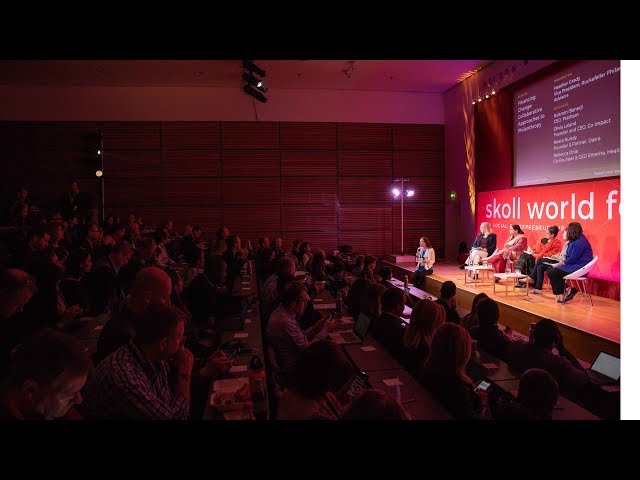
Jeff Skoll speaks at the 2008 Skoll Awards. He focuses on the issue of clean water around the world.

With: Jeff Skoll
Thank you. Thank you very much, Sally. Boy, I feel a little breathless after that runner's high. I'll tell you, hanging around with this group of elders. You've never seen a group of people with more energy and enthusiasm. And this is such a wonderful and enlightening thing for all of us and for social entrepreneurs in general.

I'd like to start by thanking the Oxford community and the Skoll Center, Stefan Chambers and Liz Nelson and Alex Nichols for being such a wonderful host again this year. We're delighted to have our 5th Annual Skoll World for forum here at Oxford and as Sally eluded, one of the joys I've had this year has been to work as an adviser of sorts to the elders.

Frankly though advising people like Arch Bishop Tutu and Mary Robinson and President Carter is a little like advising George Clooney on how to be a movie star because most of what I know I learned from observing them in the first place. But I think I finally found my unique contribution. From what I understand, the elders have a combined 987 years of experience between them, and when you add in the 13 years I've had since graduate school that vaults them over the 1,000-year mark so I'm proud to play that role.

I'd like to start today by telling a story. Next summer, in a small town in the state of Montana, we'll commemorate the 60th anniversary of a tragic fire that took the lives of thirteen young men. And the reason the fire is famous outside Montana is because of what another young man did to survive the same tragedy.

An innovation that has since saved thousands of lives and here's how it came about. The young men were all part of a team of smoke jumpers who parachuted in to battle a small forest fire in the mountains that was sparked by lightning storm. And they made their stand along the north ridge of what is known as Man Gulge.

In front of him was the fire. Behind him was grass land leading to a river which was their escape route and things were going well, but then the wind shifted. All of the sudden, the fire jumped across the gulch and ignited the grassland behind them, blocking their access to the river. Their only escape was up the grass slope that rose at almost an 80 degree angle.

And so they started running fanning out across the slope as they ran. And as they picked up speed so did the fire gaining on them evermore rapidly until it was less than 200 yards away. As it was about to engulf them. One smoke jumper did something miraculous. He took out a match and lit a fire in the grass ahead of him.

And it quickly spread uphill. He stepped into the newly-burned area and laid down. And since burnt grass can only be burned once, when the inferno raging behind him, caught up to him. It burned around him and passed him before tragically overtaking the other 13 and that quick innovation saved his life.

And from that day forward the technique has been known as an escape-fire. It has saved countless lives in similar situations since then. And when I first read that story in a wonderful speech by a man named Don Berwick, it didn't fully impact me, but now as I think about it in the context of climate change and the scarcity of clean drinking water and the population explosion expected in the next 50 years or global pandemics like HIV/AIDS and so on, it takes on a new meaning.

Even in the face of overwhelming evidence that all of these fires are burning around us and gaining on us minute by minute. There is still some who believe they can build an escape fire and in the worst cases, not only do some deny that the fires are advancing, they even deny that the fires exist. But hope as some might, here's some bad news.

There is no escape fire for climate change. There's no escape fire for global pandemics and there is no escape fire for environmental degradation. As this forum has helped make clear, either all of the us are safe or none of us are safe. The one thing we don't have on our side is time. As Winston Churchill once said just prior to World War 2, the era of procrastination, of half measures, of soothing and baffling expedience and delay is coming to its close.

In its place, we are entering a period of consequences. And I was reminded of those consequences on some trips that I took last year to Africa and India and there were 2 things in particular that struck me. The first was that in Africa and India much like everywhere else in the world, people were noticing that their climate was changing.

One tribesman in the Maasai Mara told us of a terrible story of a flood that came about in a hail storm, and the flood washed away his brother. And this was something that was unheard of in the ancestral history of his tribe. When we went to India we heard stories from the poorest villagers of how it was hot when it was supposed to be cold, and it was wet when it was supposed to be dry, and people were dying. And that isn't an example of something that may happen in the next five or ten years. It's something that's happening now. It's affecting their lives today. The second thing that struck me had to do with water. As many of you know more than a billion people in the world today rely on water sources that are hard to get to, unreliable, or unsafe for their daily washing, cooking, cleaning, and drinking.

In countries like Ethiopia, Somalia, Tanzania, the amount of water used per person per day is about the same as a person in the developed world uses to brush their teeth only once. And we've all seen the images of African girls and women who work 4-16 hours hours a day, bringing water back to their homes.

The social toll of this is enormous. In India, by contrast, virtually every village home and shack has it's own small water pump and almost a billion people in India depend on the aquifer today for their drinking water. The problem is though, that the aquifer in India is now down to about 300 feet and at 400 feet it turns into saltwater.

So if nothing is done in ten to twenty years, these same people today that are pulling potable drinking water will be pulling up salt water, and that would be a terrible disaster. And it's not just India. The United Nations is estimated that two-thirds of the world's population will not have enough water in 2025 if current trends are not reversed.

Secretary General Ban Ki-moon said this past January, the challenge of securing safe and plentiful water for all is one of the most daunting challenges faced by the world today. And he understands that this isn't just about water. It's also about war. In the twentieth century wars were fought over oil.

In the twenty-first century they'll be fought over water. The tragedy of Darfur began when the rain stopped and the farmers took up arms against the herders. And sadly we may see a lot more Darfurs in the years ahead. As we've heard repeatedly this week, water's not the only issue for which time is not on our side.

From the population boom ahead of us, to the rapid shift towards urbanization, to the spread of pandemics, to the tens of millions of young children who may never go to school, we have entered a period of consequences. We have more wealth, more brainpower, and better technology than at any time in human history, but we're still doing too little.

We have to find better ways to put our biggest resources to work against our biggest problems. And that's why the people at this forum are so important. As much as the urgency of these issues inspires anxiety, it's the people here today and thousands like you who inspire hope. It's the social entrepreneurs in every field and every part of the world who are not running away from the fires, but who are instead turning to face the flames, each of you with your own bucket.

And more than that you're encouraging others to turn and face those fires with you. Hopefully some with firehoses. I think about people like Amitabha Sadangi and ID India who have used technology and market linkages to enable almost a million small farmers to earn profits of about $400 per person per year, and at the same time, contributing to a reduction in CO2 emissions of over 1.3 million tons a year. Or I think about Vicky Colbert who has found creative new ways to educate rural children through Escuela Nueva and has her programs established as a national policy in her native Cuba.

And she's implemented these programs in 20,000 rural schools before being expanded to reach five million children, in fourteen Latin American countries as well as Uganda and the Philippines.

Or I think about Gary Cohen and his organization Health Care Without Harm. Gary has helped to close more than 90 percent of the medical waste incinerators in the United States and virtually eliminated mercury medical products from US and European hospitals.

Or finally, I think about Al Gore and the film "An Inconvenient Truth" which came out about two years ago. All of a sudden, denying climate change became about as credible as being a member of the Flat Earth Society. And the science hadn't changed, but Al Gore and the millions of people who heard his call have changed the way people see the issue by asking us to imagine a better world.

And so together I'd like us now to just imagine. Imagine a world where every African farmer is also an energy entrepreneur selling electricity from their solar panels back to the grid. Imagine a world where vaccines against malaria, polio and HIV/AIDS are distributed as widely and affordably as Coca-Cola. Imagine a world where clean water and quality healthcare are readily available to everyone on Earth.

Imagine a world where stories from Africa and Bangladesh are not driven by AIDS and infection rates, but by graduation and literacy rates. Imagine a world where the Middle East is a model for people living in peace and harmony, where the hot topics of conversation are not oil and strife but innovation and jobs.

And finally, imagine a world that becomes better with each generation. A world where all people regardless of geography, background, or economic status, could enjoy and employ the full range of their talents and abilities to make this a better world. And that's the world we all want to see and that's the world that social entrepreneurs are working to create today.

At the Skoll Foundation, we are privileged to face the fires with you and to help you create the world we all would like to see. Thank you.

And now for something really special. Over the past five years, we've been privileged to be joined on the stage by a number of extraordinary leaders. Today, we add a new chapter to that story and there aren't many people who can say that being president of the United States was just the beginning of their contributions to the world, but then there haven't been many... But then there haven't been many key people in history like President Jimmy Carter.

Thirty years ago, President Carter, brokered peace between Israel in Egypt, the first of its kind in the middle east. He was the... Absolutely. He was the first American president to put human rights at the center of America's foreign policy, and the first to lend to support to dissidents like Václav Havel Hadel and Nelson Mandela.

In the years since he left office, President Carter has worked tirelessly to help end poverty, improve health, and promote peace. Through the Carter Center, he has monitored controversial elections around the globe and he has driven diseases like guinea worm and river blindness to the verge of extinction and never has the platform of a former presidency been leveraged for greater global good.

His work... His work was aptly recognized when he won the Nobel Peace Prize. I had the privilege of meeting the president a few years ago when I launched a peace initiative to bring the movie Gandhi to Palestine. And the more I learned about the President's work, the more I felt that his story needed to be told.

And with the President's agreement, my company, Participant Productions produced a documentary called Jimmy Carter, Man from Plains, that followed the President on a recent book tour. And we have a trailer of that movie here for you now.

The Camp David Conference should be renamed.
It was the Jimmy Carter Conference.

You worked harder than our forefathers did in Egypt building the pyramids. After leaving office many ex-presidents choose to sit back and rest on their laurels, but not former president Jimmy Carter.

Jimmy Carter was the thirty-ninth in the United States and a winner like me of the Nobel Price for Peace. Bringing peace, permanent peace to Israel, would be at the top of my list. How's that east and west, how's that this way? It's looking pretty good. Okay really? I came to the Carter Center with a question. How can I save the world?

To come here and see how little work is being done in New Orleans and this is a disgrace to our country, and I think we need to make sure everybody knows that not enough is being done. Primarily because of my policies, we were importing about 5 million barrels of oil per day and now it's back up to 12 million barrels per day.

I don't think that the situation will be any better between us and Iran right now if I had destroyed a major part of Iran with a missile. I have become increasingly concerned about what's going on in Palestine.

Former president Jimmy Carter is responding to the controversy flaring over a new bestseller on the Middle East. Well, I want it to be both accurate and somewhat provocative. Freedom comes with consequences.


"Thank you Mr. President"
"Thank you for your courage."
"Thank you."

There hasn't been a single day of peace talks in the Holy Land in six years. Not many people know it, or care. I care.

It's a wonderful
film, if I may say so myself. And now available on DVD. The Skoll Foundation's relationship with President Carter began two years ago with an award for $3 million to the Carter Center with its expertise and access to the highest levels of government, academia and international policy making bodies.

The Carter Center is the perfect partner in peace for the foundation to advance the work of social entrepreneurs all over the world. This evening we are honored to pay special tribute to, President Carter, recognizing his life's work in promoting health, peace, and the end of poverty. And towards that end, I'm pleased to announce a special award to the Carter Center as a demonstration of our continued support for the objectives set for by your extraordinary leadership.

It's my great pleasure to introduce a true role model for our time, or any time, President Jimmy Carter.
Related Videos