Fadi Ghandour – Entrepreneurs, Networks and Collaborative Action

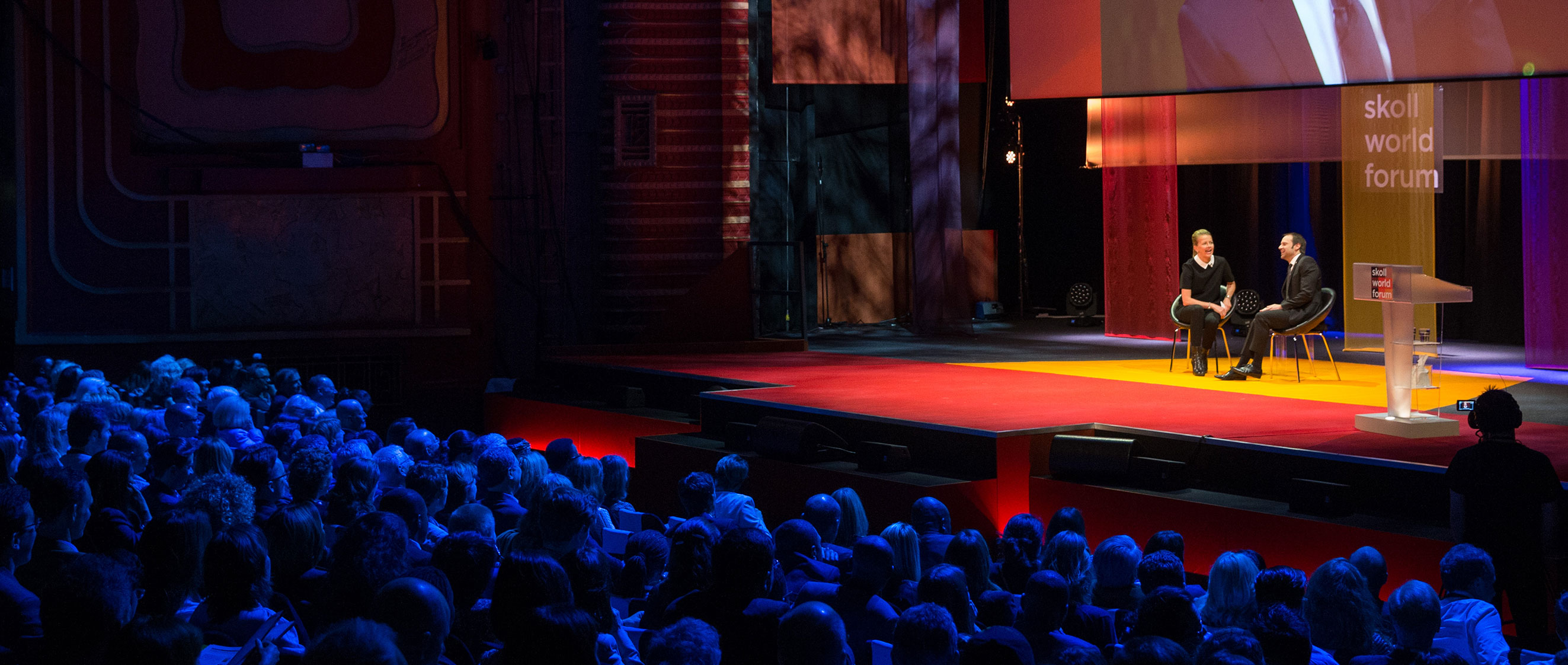
Fadi Ghandour, founder and CEO of Aramex, the first company from the Arab world to be traded on the NASDAQ, delivers his speech on entrepreneurs, networks and collaborative action at the 2011 Skoll World Forum closing plenary.

Thank you, Pamela, for that incredible introduction. I have rarely stood up to speak and having a Aueen and Archbishop Desmond Tutu right in front of me. So it's scary. And then for the Queen to say she is a warm up act and what a warm up act. So that puts a lot of pressure but I want to start by, since I am the last one to speak and they make sure that the Queen is ahead of me so that you are all here and you don't leave before, is that I was listening to Bridget Kendall's talk with the panel earlier today, and they were talking about heroes and I think being the last speaker it is important that one recognizes and applauds, and thanks to Jeff Skoll for the incredible work that he has done.

Thank you Jeff. You are definitely my hero. So thank you for making me a speaker and the last speaker of this evening. Ladies and gentlemen, I will continue the story that Her Majesty started by focusing a little bit about the generation and waiting in the Arab world. For decades, bad news has crowned us in the Arab world, much like epitaphs on a tombstone.

And it is the very sad story of squandered youth that stands at the heart of our region's epic tale of failure. 40 percent of youth hugging Algeria's walls, 24 percent Egypt's, 30 percent Tunisia's, 27 percent Jordan's, 39 percent Saudi Arabia's, 30 percent Syria's, and yes, 46 percent Gaza's. And when work is finally found, the pay is lousy, job security is non-existent, and the working conditions are dismal.

All this and I haven't even begun to pick at the other problems that plague us. Rich and poor living galaxies apart. Endemic corruption, weathering environments, deeply entrenched discrimination against women, pervasive abuse, of civil rights. A people are at the cusp of disaster you might say or maybe revolution.

Well, barely two months ago I thought I would be standing here today to talk to you about Arab civil societies and quiet action for change. A story I've been telling for a while now to anyone who cared to listen. You can imagine, it was a hard sell. In the sight of a region that seemed at a standstill, paralyzed by too many traumas, and brought low by heartbreak, the verdict everywhere against our civil societies seemed as fair as it was
cruel. Worn out, feeble, and stuck. And then Tunisians and Egyptians spoke in passionate unison. So I actually do get to say in my lifetime, "Vindication at last." Vindication because what we are witnessing this very minute, there and now, did not actually happen on a whim. It happened because our civil society has finally turned out to be more alive, more vibrant, more confident, and yes, more furious than many of us thought they were.

Vindication because of all the calls for change, the most powerful has been the one for citizenship. Vindication, because there is of it all, the collective cry for freedom, for jobs, for better pay, for security, and yes, for dignity really. Behind this collective cry, for change stands the hard toil of Arab activists, activists of all color, rich and poor, men and women from labor movements and without professionals, and vegetable vendors, loggers, and field organizers.

A mass activists, really, what have shown us that the flip side of the famous, which we had heard earlier about, famous deficits cited and the U N D P Arab human development report is none other than empowerment. And if the youth of the Arab world has shown shown us anything in these past two months, it is that the pain and dispossession can beget change of the most dignified kind. That when time bombs explode the results, sometimes, can be unusually inspiring. They have shown us that they are actually avid readers, our youth.

86 percent of them are connected to the internet. 65 percent of them connected to social media, and 18 percent of them tell us they actually read logs. They have shown us that women may have been left behind and out by an Arab system. They are at the fore front of change. They have shown us they have an enduring desire for democracy.

They are telling us they are telling us now as many surveys confirm that they prefer to work in the private sector. And that, in fact, half of the 18 to 24 year olds intend to start their own business in the next five years, and they are telling us that they have a growing sense of global citizenship.

We in the private sector are indeed very lucky, because we, especially in the entrepreneurial society among us, know how to turn uncertainty into opportunity and transform enthusiasm into tangible achievement. We know that this fervor in the Middle East is just as much about societies wanting a better life as they do better governments.

And we know that our company 's healthy bottom line is a sham if it is divorced from our community's well being. But truthfully, for far too long, we have been conservative, us in the private sector, reactive, even fearful, playing second fiddle to our government's, and walking in the distant shadow of civil society.

Almost always we had been the most vocal apologists for the status quo. The age of timidity ladies and gentlemen is gone. The Arab world is at the crossroads and the choices we make are of profound consequences. Friends, on May 6th, 1954, 3000 spectators gathered at the Iffley Road Track here Oxford for the annual match between the amateur athletic association and Oxford University.

A dreary, cold, windy day, have a really lucky crowd for they were about to witness Roger Bannister break the impossible four minute mile. A feat once deemed by American scientist, G.P. Mead, beyond the realm of reason. Well, Bannister broke that record in three minutes and fifty-nine seconds and a fraction.

But, that's not the moral of the story. Only six weeks after Bannister broke his record, an Australian by the name of John Landy broke Bannisters record again and this record is meaningless today because it continues to be broken. Roger Bannister always comes to mind when I think of magnificent power of role models and their effect on people and how people can react to somebody who has shown them it can be done and then everybody else says "Yes we are going to go out and do it." And, activists and social entrepreneurs in the Arab world are going out a doing it using many role models.

Social entrepreneurs like Maher Kaddoura, a countryman of mine, a businessman, who, after the tragic loss of their son in a car accident, worked relentlessly for safer roads in Jordan, rather than wait for the government to do so. In three years their results are astounding. 32% drop in fatalities from car accidents, from traffic accidents and a massive 46% dropped in serious injuries.

We have Yasmina Abayusuf [sp] who established xx, a vocational academic school for tramps in Ezbit, one of Cairo's countless haphazard slums where close to half of the capital's 17 million population live.

We have role models like Samir xx
and Hassam xx who created xx the leading Arab online portal and paved the way for the Arab web industry inspiring a whole generation of web entrepreneur.

We have people who have created networks for mentorships like Habib Hadad who launched Al Masta in Lebanon A boot camp of sorts that brings together motivated Arabs from across the region, developers, graphic designers, product experts, start-up enthusiasts, marketing gurus and artist for a 54 hour event that builds communities, companies, and projects.

We have none other than our Soraya Salti, from INJAZ Arab, who empowered through education. Her organization, INJAZ Arab, instills entrepreneurial skills and the deep sense of business ethics in youth, at schools and universities across the Middle East and North Africa.

And then you have us, at Druard [sp].
A group of business of entrepreneurs, who decided to venture into social entrepreneurship and bring our skills, resources and networks to the Arab world's downtrodden and forgotten. The word atelmiya, or entrepreneurs for development, is a private sector-led model that puts entrepreneurship at the service of community, development and empowerment. A youth centric model at the heart, at it's heart that offers education to economically and socially marginalized youth, in exchange for community service. The model attacks into the resources of the community itself, thereby unleashing its creativity, generosity, and finding solutions for its own problems, a model that believes in people power that nurtures grassroots leadership.

Ladies and gentlemen, I have shared with you tiny, wonderful vignettes of Arabs in the society hard at work in the service of the people. I don't know what life has in store for us around the corner. But I am certain that we, the entrepreneurs of the region, must do our part in shaping it into something infinitely better than the years that thankfully are behind us.

Thank you.
Related Videos