Deep Leadership: Interior Dimensions of Large Scale Change
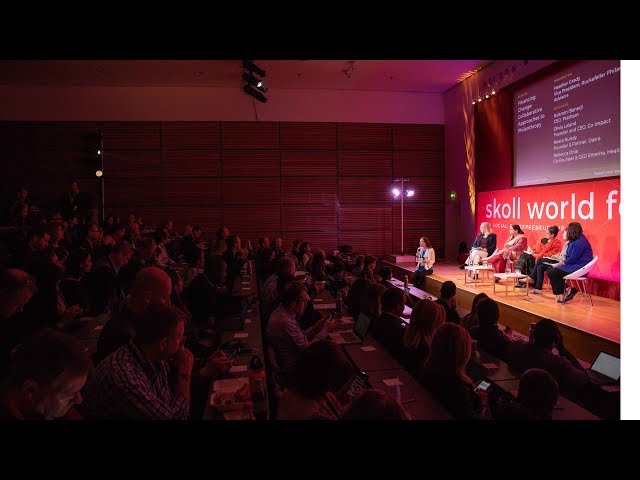
This panel at the Skoll World Forum 2011 is about deep leadership. Those working to change the world face obstacles rarely addressed in traditional leadership doctrines. Vision, risk and uncertainty take on new meaning in realms where lives are impacted by poverty, pandemics, conflict and injustice.
With: Mabel van Oranje, Archbishop Emeritus Desmond M. Tutu, Joe Madiath, Cecilia Flores-Oebanda, Paul Farmer
Good morning. My name is Mabel van Orange, and I am the CEO of an organization called the "Elders", which is explained on this lovely leaflet that you will find on the way out, or maybe distributed on the chairs. The chairmen of the elders is Archbishop Tutu, and we'll talk maybe about it a little bit more later.
This session is about a subject that I think has never been discussed, either at the school world forum, or in any forum like this. We often talk in the context of social entrepreneurs, of people who are trying to lead great change, about the external challenges that we face, how we can grow our organization, how we can scale up our work, how we can better use social media, how we can become better leaders of our teams.
But we talked very little about the internal dimensions of leadership. Maybe because these are sensitive issues, they are personal, we might have to show our weaknesses. Yesterday, Jeff, in his opening remarks, referred to the fact that social entrepreneurs are often very courageous people,very determined but after all, we're all human.
And so I'm wondering, where do we go when we get frustrated? How do you stay sane when you see human tragedy happening around you every day, how do you stay motivated when you see that change is not happening as quickly as you had envisioned it? What do you do when everybody around you says that you are absolutely mad to follow that big vision, that dream that you have.
What do you do when your kids ask you, "Why are you again trying to help others, and why are you not there on my birthday?" Who supports you? How do you stay balanced and energised? Those are some of the questions that we would like to discuss this morning. We have an amazing panel to do so. Let me quickly tell you a little bit about them.
Cecilia Flores Oebanda is the founder and also executive director of the Visayan Forum Foundation from the Philippines. She has a amazing life story. She was a child. She founded her foundation to help other people achieve freedom and to be able to lead decent lives and her foundation has done absolutely amazing work in the piece of human trafficking.
Joe, who's sitting here comes from India, He runs and founded an organization called, "Gram Vikas". He has an amazing life story, like, I guess everybody in this room. He grew up in a State in India that had the first Marksist government that ever empowered anywhere in the world. He was a troublemaker at school, his parents decided to send him off to boarding school, but he quickly decided to use these rebellious energies to help others. So, in 1971 he start helping communities that were raged by a cyclone at the time and 1979 he found Gram Vikas which was initially focused on the renewable energy for rural communities, but fairly quickly changed into a more holistic development model and his work has affected hundreds of thousands of people.
Paul Farmer, for everybody who was here last year, who remembers his amazing speech. I can not remember if it was the open or closed session, but it brought many of us to tears. He is the founder and one of the co-leaders of Partners In Health. Which is basically trying to prove that cost effective high quality health care can be delivered even to those are living in a most hopeless of situations, and he founded Partners in Health in 1987, and they keep working on a community based healthcare system and he's a great advocate for global health equality as well. And then the man next to me, Arch, the chairman of the Elder. I don't think he really needs an introduction and even if I try to give an introduction those people who are introducing him tonight when he gets his award probably get very upset because I might be taking some of their words away.
So I'm just going to tell you one or two things about him. Others call him South Africa's moral conscience. He's described as the worlds most famous champion for human rights I know him as the man, the only man I think in the world, only person in the world who can herd cats, who can keep order in an unruly bunch of ten former heads of states, former Secretary Generals, which is was the elders is. People like Jimmy Carter, Kofi Annan, Gracia Michelle, Lakdhar Brahimi. He keeps them in good order. You know that, he never forgets any birthdays of any of them , or their wives, or their wedding anniversaries and always congratulates them.
That's the heart he has. That's how amazing he is. Now, these panelists are going to be brief, and they're going to be brilliant. But we're not going to have them talk all the time, as i mention these questions of inner Leadership, I'm convinced that all of us struggle with them at times. So we want to involve you as much as possible in this discussion.
But that means that even though they are going to be brief and brilliant when one of you gets the floor you can try to outshine them which but you have to stay shorter than their interventions. Anyway, we have a lot of ground to cover but lets get started with the following question. Every every social entrepreuner every social change maker had one and more movements in the past where you said look I am going to do something completely different.
I have this vision. I want to create this kind of change. These initial moments of motivation. Now, I guess we can all, after what I said a bit about your backgrounds, know a little bit about what motivated you at the beginning. What I am very curious about is, to which extent are you still driven by that vision of change, by that drive that you had
10, 20, 40, 50 years ago. Cecelia, would you like to start?
I think my passion start when I was actually in prison, and living in prison with my children, and of course separated from my son. I thought that our life in prison is really the worse life that everybody can have. But after the rescue, victims of human trafficking I realize that actually our life, it is really nothing compared to them.
From them I really resolve that freedom is very important. I will never give. I will continue to do it. And, how can I give up? How can they betray the girls that actually traffic from the Far Pang community in the Philippines and sold into prostitution. And sold to slavery. I don't know, but for me, my vision and my passion is always consistent, and my belief,
in the goodness of God and and my belief in freedom is always in tact so I would say that maybe the life is changing and you know the situation is changing but that passion and the vision is always consistent and always with and will never give up in any difficult circumstances. Because it means a life of a girl.
It means the life of eighty percent that I rescue before I come here it means the future of Philippines to explore opportunities without the risk of being sold and enslaved it is the future of next generation and I offer my life, until the last drop of my blood to continue that vision. Paul.
When I was thinking about the question I realized that you can back the answer up. A long way. Anyone can perform autobiographical tricks to do so. So I was thinking not when I first decided I wanted to be a doctor who focused his attention on people living in poverty, but when I realized it was too late to go back.
And and I'm glad some of you chuckle, because it's a pretty frightening feeling, actually. I'm sure others in this room have felt it and for me it was in the course of several months. I can't remember how many, when I was in my early twenties, and my mid twenties. I had started medical school and was going between Harvard in Haiti.
My friends, in Haiti who were my age mates they were peers. We worked together on a health survey, traveled all over villages in that part of central Haiti. And one of them died of perforation due to typhoid. Disease before he ever saw his 30th birthday. Another one who became the record keeper in the clinic we just built died of puerperal sepsis from having a baby under poor conditions.
And the third of these friends I lost, died of cerebral malaria, misdiagnosed as having a psychiatric illness because she went crazy with cerebral malaria. And that determined many things. I decided what kind of doctor I wanted to be, where I would focus my energy. And yeah, I feel as passionate about those kinds of tragedies and medical errors now as I did then.
The difference of course is that in those places where I first saw them, they're gone. We don't have those kind of errors really. Women don't die in childbirth. They don't of obstructed labor. They don't die of a little perforation because you put in clean water and the Cholera that is spreading across
Haiti is not, they are referred to us from other places. But we see this all over the world. And as a result we've tried to move our energies around the world too, because we are hoping as people believe in basic rights, social and economic rights, civil and political rights that anybody in the world can understand what it might I like to be
sick and alone. And we find that people like this quest for freedom, people understand that every one of God's creatures needs accompaniment and help when they're sick, so I do feel just as passionate now.
I was always thrilled by the notion of equity. So I was appalled to see when I was a small boy, at one time I was a small boy, 10 years that I come from that time. My family comes from the state of Kerala My mother's father, grandfather, he would line up the people who were working in the field and would have a hole in the ground, and then would pass a banana leaf over fire so it becomes very supple, push that in, and then would pour rice into the leaf which is in the hole.
So one day I saw this I went up to him and said this is the way might treat dogs, not human beings and he turned to me and asked me, Are they any better? I was shocked. How could a human being say about another human being even if he is my grandfather. In this manner. So I think it was at that time if I begin to trace.
I cannot say that I made the most certainly a decision, but that was the moment when i said this is not right. If i can do something to right to make it right i will do it but how i did not know, so i went i was i began to organize the laborers of my father. He kicked me out. I went to the boarding school, there i thought, i mean i am god's so an answer to the organizational of all these school's.
So i began to organize the students. So i was kicked out from school, came to the university became also the president of the university. But this thing of inequity that prevailed in our society, there there was this untouchable ability of the people who were so called untouchables or low casts, people who were tribal, separated from the society and I said, OK, this is where I will work and did not take up career, I went to villages.
There was a cyclone. I started working in Orissa, but always this idea of equity, and today after many years of travel, if we are in the field of water and sanitation that is gram vikas. Because I see that water and sanitation is needed by everyone. If there is even one family which does not practice proper sanitation it can defile everyone else's water so we took that as a point to come together for the entire community and total inclusion, and then proceed further.
This is how that search for equity and there's still continuing there's tremendous inequity: economic, social, any sphere that you take in India and the journey continues still.
Now its your turn. Thank you so very much may I, first of all, pay a very, very warm tribute to all of you? You are amazing people and you you awe me. I mean, as I listen to the incredible things that you do. All of you. You make one so proud of being human, and thank you for that. Thank you, thank you on behalf of the many, many, many who want to thank you, who often do not have that opportunity, and thank you on behalf of God, because I think there must me many times when God says ... whatever got into me to create that lot?
And then God sees you and others like you, and God says they have vindicated you. You have vindicated God, and that's for real. please know that there are many in the world who wish to be eloquent enough to say thank you, thank you, thank you, thank you, thank you and I also wanted to thank you for the very warm welcome that you gave me and sort of making me think i was something when they learn I got on a train in Atlanta, and somebody that they recognized me and so they take came and they were asking for autographs and i try to look suitably modest as i, as I was signing, as i was signing these autographs, and one lady came up and pushed a piece of paper in front of me, and as I was signing she turn to these people and says "who is he"?
So, I thought it was very good for the soul. One day, one day, I was I think maybe seven or eight I went with my father who was headmaster of his school, and so in the Black community, a very important man and we went into town, segregated of course. And we got into the shop , and there was the slip of a girl behind the counter, a white girl, and when it was our turn to be served, I was standing next to my father.
And this girl said to my father, "Yes, boy." I wondered how my father must of felt being humiliated in front of his small boy. But i got to know because several years later our last child was born in London and she knew nothing about South Africa's apartheid and she was free and i am walking with her and I've got her by the hand and she saw some children on swings on round a bouts and she said, "Daddy, I want to go on the swing." and i said, "No, darling. You can't" she said "But there's other children" and all this, but how do you tell your child, you are not like other children, you are a Black child. I knew then how my father must have felt.
I wished the ground would open up and swallow me and then a little later still in the same town I was riding a bicycle, I was the only black priest who had his own bicycle. My father used to send me to town to go and buy newspapers and things, and i went past a school for white children, again they're all segregated, and saw three kids from my ghetto and they were scavenging in the school rubbish bin, getting out perfectly lovely apples and think because the government was providing school to white kids who didn't really need it.
They preferred their mother's lunch packets and much, much later [sp] was to say why Black children who needed it, were not being supplied with school feeding, he said, because we can't feed all, we won't feed some. Imagine Paul saying "Well, I can't cure all of you here, so I'm not going to try and cure any"... I can't say that that made me really get sort of hot under the collar very much, no, but it was later Laia and i were school teachers and the same Vervood [sp?] introduced something called bond for education, an education deliberately designed to produce docile, unthinking Black children.
They said, "Why do you teach black children mathematics? What they are going to do with mathematics, they must know enough English and African to understand instructions by their White masters and mistresses, don't let them hear anything about the American War of Independence or the French Revolution, these are going to put bad ideas into their heads and then I said I am not going to collaborate with this , this cruel thing, cruel things said to our children but I was inspired by some incredible human beings, Trevor Hartleston [sp?] and then I was into this really by default because the Nelson Mandelas were in jail, others were in exile and nature does not allow for vacuums and so I just happened, well I just happened to be the first Black person to be Dean of Johannesburg.
And was given a platform and as they sometimes say, the rest is history. The speakers are not allowed to bring the moderator to tears, thank you. I would like first talk a bit about one set of questions, which is the question of, how do you keep going? Where do you turn when you feel that the challenges you're facing are too big?
What do you do when your child is accusing you of not being there at important moments in his or her life? And, before we open this part of the discussion up, i wanted ask you, Joe, when we spoke a little while ago you said, "I started 30 years ago, and the change that we have achieved is so far away from what I had envisioned at that time.
There's still so much to do. How do keep going when you have the feeling it's not going quickly enough? And how do you tackle so much, do with some of these, these internal questions of frustration of doubt.
Unlike the Archbishop, 35 years ago I was not so modest. I thought that in a few years I am going to change India. So I set out and well India is almost where it was. But my colleagues and me, we have been struggling on a path of justice on the path of equity, on the path of well being for the poor, but often it is hard, i remember my first child was born and i was in a remote village and i was there for 10 days.
Only after 10 days when i come back, i realized i'm a father. So i thought anyway, I'll try again. The storm was working overtime , so, my second child, the daughter was born, again. I think my wife, I told her, I want to be there, but then she miscalculated the date I was again in a far off indigenous village.
And I was very happy to come and see "oh, I have a daughter". I said, Okay, I must try once more. The third child, again, I was not there. And each time, on one side I used to laugh at the irony that the more determined I got that I should be there in these big moments the further I was away. This can bring you down now and then.
There are times when I come I wanted that change that that village where they will forget their differences where the rich will show some assemblance of concern and care for the poor, and it didn't happen, maybe the tenth meeting ... nothing happened. There will be times when I would just take the pillow and cry into the pillow.
So how do we go on? Then I discovered this terrific elixir, this tonic when ever my battery was down, really really low, then, and I realized that if the battery is beyond that, a certain level and is down it need what is called a bench charge. So I would go out into the villages. Where the people have come together worked among themselves, we were a part of that and they built, whatever it is, whether it is a a good agricultural system, total inclusion, total sanitation, a water supply system for which they would say "we have done it, we could do it"!
Yes, you helped us a little bit, yes, but we did it. One or two villages and living two or three days or nights with those people further living in their ambition, further dreaming up with them, that would give me a complete battery charge, bench charge. You see, usually a battery gets a bench charge in a few hours, but my battery is a very poor battery and so it needed two to three days, but I got charged, came back... a new person. Fully charged up!
Because of that, I always took some extra charge with me so that I could also plug into my colleagues batteries, so they would also go. So this, ultimately for me, my staying power, how I can go on, is because of the people with whom I work. I agree. I had set out to change the whole of India, and there is a hole in India now.
We have not managed anywhere near that. But, when I see what did I set out for and where have I reached, then I remember what Mother Theresa said. "I may be a drop in the ocean. I mean, I may be a drop in a bucket. But without that drop, the bucket will be poorer by that drop". So I only want to be that drop.
And I do everything possible to be a good drop. That's all. Thank you.
So Celia how do you keep going?
Well, to be honest there are times that I also got in the crossroads, the first time and the last times that I actually almost gave up is when I received the first death threat, from the traffickers. Living in prison and a single mother of four it is really very hard for me, because I need to make a choice for the safety of my children and the freedom that I fought for the other girls.
Well, our friends are talking about other things and would like to concentrate as a mother, and how I balance my life because honestly speaking, I have never balanced life. I have, a life in prison, a husband who left the four children, a single mother, running after traffickers. Filing cases, heal with the victims ... phew! I thought I can never have that kind of life.
But I would say that yes, indeed, I think I'm managing well because I believe that I cannot survive alone. We have people that work with us. My children love my work and take pride of my work. They make an extra effort to make my difficult life easier they help in whatever they can. My colleagues are always there to support me.
We always journey together and that makes my life balance, because I don't think that balance is just a thing that you really .... balance is a gift. It's the gift that you can give to yourself. It's the balance that keep you going. At the same time, how can I give up when a girl, when a 14-year-old girl was sold to prostitution.
First to insert cotton dipped in the pigeons blood, in her sex organ just to be marketed just as a virgin many times. How can you give up? When the girl is only 14-years-old was sold in Syria, the worker is a domestic worker and sold to multiple employers and put them to jail, and they never give up.
They still have hope in their hearts. They still want to go on. So that kind of victory, that kind of trust, I cannot I cannot be selfish and just bring my children and be safe. Because, that's not me, I'm a very stubborn girl. I'm a stubborn women. And with all the harassment and with all the death threats and everything I find it now more exciting, especially that I have this cool community.
I know Jeff Skoll, I know Sally, you know, before I come here, my goodness, I am like a kitten who is really afraid. I don't know what to do. I am struggling as a person because the problem is too big, but I have my community, I have the trust and I have the power of the people, especially the women that we saved, to continue fighting, and for me that keeps me going.
And I will have a high energy, as always. And beyond everything I think I am still very lucky that I was called and I follow and serve given the opportunity to make my life worth, and given the opportunity to serve and make this life really worth living for, and I am really grateful for that.
This session is about a subject that I think has never been discussed, either at the school world forum, or in any forum like this. We often talk in the context of social entrepreneurs, of people who are trying to lead great change, about the external challenges that we face, how we can grow our organization, how we can scale up our work, how we can better use social media, how we can become better leaders of our teams.
But we talked very little about the internal dimensions of leadership. Maybe because these are sensitive issues, they are personal, we might have to show our weaknesses. Yesterday, Jeff, in his opening remarks, referred to the fact that social entrepreneurs are often very courageous people,very determined but after all, we're all human.
And so I'm wondering, where do we go when we get frustrated? How do you stay sane when you see human tragedy happening around you every day, how do you stay motivated when you see that change is not happening as quickly as you had envisioned it? What do you do when everybody around you says that you are absolutely mad to follow that big vision, that dream that you have.
What do you do when your kids ask you, "Why are you again trying to help others, and why are you not there on my birthday?" Who supports you? How do you stay balanced and energised? Those are some of the questions that we would like to discuss this morning. We have an amazing panel to do so. Let me quickly tell you a little bit about them.
Cecilia Flores Oebanda is the founder and also executive director of the Visayan Forum Foundation from the Philippines. She has a amazing life story. She was a child. She founded her foundation to help other people achieve freedom and to be able to lead decent lives and her foundation has done absolutely amazing work in the piece of human trafficking.
Joe, who's sitting here comes from India, He runs and founded an organization called, "Gram Vikas". He has an amazing life story, like, I guess everybody in this room. He grew up in a State in India that had the first Marksist government that ever empowered anywhere in the world. He was a troublemaker at school, his parents decided to send him off to boarding school, but he quickly decided to use these rebellious energies to help others. So, in 1971 he start helping communities that were raged by a cyclone at the time and 1979 he found Gram Vikas which was initially focused on the renewable energy for rural communities, but fairly quickly changed into a more holistic development model and his work has affected hundreds of thousands of people.
Paul Farmer, for everybody who was here last year, who remembers his amazing speech. I can not remember if it was the open or closed session, but it brought many of us to tears. He is the founder and one of the co-leaders of Partners In Health. Which is basically trying to prove that cost effective high quality health care can be delivered even to those are living in a most hopeless of situations, and he founded Partners in Health in 1987, and they keep working on a community based healthcare system and he's a great advocate for global health equality as well. And then the man next to me, Arch, the chairman of the Elder. I don't think he really needs an introduction and even if I try to give an introduction those people who are introducing him tonight when he gets his award probably get very upset because I might be taking some of their words away.
So I'm just going to tell you one or two things about him. Others call him South Africa's moral conscience. He's described as the worlds most famous champion for human rights I know him as the man, the only man I think in the world, only person in the world who can herd cats, who can keep order in an unruly bunch of ten former heads of states, former Secretary Generals, which is was the elders is. People like Jimmy Carter, Kofi Annan, Gracia Michelle, Lakdhar Brahimi. He keeps them in good order. You know that, he never forgets any birthdays of any of them , or their wives, or their wedding anniversaries and always congratulates them.
That's the heart he has. That's how amazing he is. Now, these panelists are going to be brief, and they're going to be brilliant. But we're not going to have them talk all the time, as i mention these questions of inner Leadership, I'm convinced that all of us struggle with them at times. So we want to involve you as much as possible in this discussion.
But that means that even though they are going to be brief and brilliant when one of you gets the floor you can try to outshine them which but you have to stay shorter than their interventions. Anyway, we have a lot of ground to cover but lets get started with the following question. Every every social entrepreuner every social change maker had one and more movements in the past where you said look I am going to do something completely different.
I have this vision. I want to create this kind of change. These initial moments of motivation. Now, I guess we can all, after what I said a bit about your backgrounds, know a little bit about what motivated you at the beginning. What I am very curious about is, to which extent are you still driven by that vision of change, by that drive that you had
10, 20, 40, 50 years ago. Cecelia, would you like to start?
I think my passion start when I was actually in prison, and living in prison with my children, and of course separated from my son. I thought that our life in prison is really the worse life that everybody can have. But after the rescue, victims of human trafficking I realize that actually our life, it is really nothing compared to them.
From them I really resolve that freedom is very important. I will never give. I will continue to do it. And, how can I give up? How can they betray the girls that actually traffic from the Far Pang community in the Philippines and sold into prostitution. And sold to slavery. I don't know, but for me, my vision and my passion is always consistent, and my belief,
in the goodness of God and and my belief in freedom is always in tact so I would say that maybe the life is changing and you know the situation is changing but that passion and the vision is always consistent and always with and will never give up in any difficult circumstances. Because it means a life of a girl.
It means the life of eighty percent that I rescue before I come here it means the future of Philippines to explore opportunities without the risk of being sold and enslaved it is the future of next generation and I offer my life, until the last drop of my blood to continue that vision. Paul.
When I was thinking about the question I realized that you can back the answer up. A long way. Anyone can perform autobiographical tricks to do so. So I was thinking not when I first decided I wanted to be a doctor who focused his attention on people living in poverty, but when I realized it was too late to go back.
And and I'm glad some of you chuckle, because it's a pretty frightening feeling, actually. I'm sure others in this room have felt it and for me it was in the course of several months. I can't remember how many, when I was in my early twenties, and my mid twenties. I had started medical school and was going between Harvard in Haiti.
My friends, in Haiti who were my age mates they were peers. We worked together on a health survey, traveled all over villages in that part of central Haiti. And one of them died of perforation due to typhoid. Disease before he ever saw his 30th birthday. Another one who became the record keeper in the clinic we just built died of puerperal sepsis from having a baby under poor conditions.
And the third of these friends I lost, died of cerebral malaria, misdiagnosed as having a psychiatric illness because she went crazy with cerebral malaria. And that determined many things. I decided what kind of doctor I wanted to be, where I would focus my energy. And yeah, I feel as passionate about those kinds of tragedies and medical errors now as I did then.
The difference of course is that in those places where I first saw them, they're gone. We don't have those kind of errors really. Women don't die in childbirth. They don't of obstructed labor. They don't die of a little perforation because you put in clean water and the Cholera that is spreading across
Haiti is not, they are referred to us from other places. But we see this all over the world. And as a result we've tried to move our energies around the world too, because we are hoping as people believe in basic rights, social and economic rights, civil and political rights that anybody in the world can understand what it might I like to be
sick and alone. And we find that people like this quest for freedom, people understand that every one of God's creatures needs accompaniment and help when they're sick, so I do feel just as passionate now.
I was always thrilled by the notion of equity. So I was appalled to see when I was a small boy, at one time I was a small boy, 10 years that I come from that time. My family comes from the state of Kerala My mother's father, grandfather, he would line up the people who were working in the field and would have a hole in the ground, and then would pass a banana leaf over fire so it becomes very supple, push that in, and then would pour rice into the leaf which is in the hole.
So one day I saw this I went up to him and said this is the way might treat dogs, not human beings and he turned to me and asked me, Are they any better? I was shocked. How could a human being say about another human being even if he is my grandfather. In this manner. So I think it was at that time if I begin to trace.
I cannot say that I made the most certainly a decision, but that was the moment when i said this is not right. If i can do something to right to make it right i will do it but how i did not know, so i went i was i began to organize the laborers of my father. He kicked me out. I went to the boarding school, there i thought, i mean i am god's so an answer to the organizational of all these school's.
So i began to organize the students. So i was kicked out from school, came to the university became also the president of the university. But this thing of inequity that prevailed in our society, there there was this untouchable ability of the people who were so called untouchables or low casts, people who were tribal, separated from the society and I said, OK, this is where I will work and did not take up career, I went to villages.
There was a cyclone. I started working in Orissa, but always this idea of equity, and today after many years of travel, if we are in the field of water and sanitation that is gram vikas. Because I see that water and sanitation is needed by everyone. If there is even one family which does not practice proper sanitation it can defile everyone else's water so we took that as a point to come together for the entire community and total inclusion, and then proceed further.
This is how that search for equity and there's still continuing there's tremendous inequity: economic, social, any sphere that you take in India and the journey continues still.
Now its your turn. Thank you so very much may I, first of all, pay a very, very warm tribute to all of you? You are amazing people and you you awe me. I mean, as I listen to the incredible things that you do. All of you. You make one so proud of being human, and thank you for that. Thank you, thank you on behalf of the many, many, many who want to thank you, who often do not have that opportunity, and thank you on behalf of God, because I think there must me many times when God says ... whatever got into me to create that lot?
And then God sees you and others like you, and God says they have vindicated you. You have vindicated God, and that's for real. please know that there are many in the world who wish to be eloquent enough to say thank you, thank you, thank you, thank you, thank you and I also wanted to thank you for the very warm welcome that you gave me and sort of making me think i was something when they learn I got on a train in Atlanta, and somebody that they recognized me and so they take came and they were asking for autographs and i try to look suitably modest as i, as I was signing, as i was signing these autographs, and one lady came up and pushed a piece of paper in front of me, and as I was signing she turn to these people and says "who is he"?
So, I thought it was very good for the soul. One day, one day, I was I think maybe seven or eight I went with my father who was headmaster of his school, and so in the Black community, a very important man and we went into town, segregated of course. And we got into the shop , and there was the slip of a girl behind the counter, a white girl, and when it was our turn to be served, I was standing next to my father.
And this girl said to my father, "Yes, boy." I wondered how my father must of felt being humiliated in front of his small boy. But i got to know because several years later our last child was born in London and she knew nothing about South Africa's apartheid and she was free and i am walking with her and I've got her by the hand and she saw some children on swings on round a bouts and she said, "Daddy, I want to go on the swing." and i said, "No, darling. You can't" she said "But there's other children" and all this, but how do you tell your child, you are not like other children, you are a Black child. I knew then how my father must have felt.
I wished the ground would open up and swallow me and then a little later still in the same town I was riding a bicycle, I was the only black priest who had his own bicycle. My father used to send me to town to go and buy newspapers and things, and i went past a school for white children, again they're all segregated, and saw three kids from my ghetto and they were scavenging in the school rubbish bin, getting out perfectly lovely apples and think because the government was providing school to white kids who didn't really need it.
They preferred their mother's lunch packets and much, much later [sp] was to say why Black children who needed it, were not being supplied with school feeding, he said, because we can't feed all, we won't feed some. Imagine Paul saying "Well, I can't cure all of you here, so I'm not going to try and cure any"... I can't say that that made me really get sort of hot under the collar very much, no, but it was later Laia and i were school teachers and the same Vervood [sp?] introduced something called bond for education, an education deliberately designed to produce docile, unthinking Black children.
They said, "Why do you teach black children mathematics? What they are going to do with mathematics, they must know enough English and African to understand instructions by their White masters and mistresses, don't let them hear anything about the American War of Independence or the French Revolution, these are going to put bad ideas into their heads and then I said I am not going to collaborate with this , this cruel thing, cruel things said to our children but I was inspired by some incredible human beings, Trevor Hartleston [sp?] and then I was into this really by default because the Nelson Mandelas were in jail, others were in exile and nature does not allow for vacuums and so I just happened, well I just happened to be the first Black person to be Dean of Johannesburg.
And was given a platform and as they sometimes say, the rest is history. The speakers are not allowed to bring the moderator to tears, thank you. I would like first talk a bit about one set of questions, which is the question of, how do you keep going? Where do you turn when you feel that the challenges you're facing are too big?
What do you do when your child is accusing you of not being there at important moments in his or her life? And, before we open this part of the discussion up, i wanted ask you, Joe, when we spoke a little while ago you said, "I started 30 years ago, and the change that we have achieved is so far away from what I had envisioned at that time.
There's still so much to do. How do keep going when you have the feeling it's not going quickly enough? And how do you tackle so much, do with some of these, these internal questions of frustration of doubt.
Unlike the Archbishop, 35 years ago I was not so modest. I thought that in a few years I am going to change India. So I set out and well India is almost where it was. But my colleagues and me, we have been struggling on a path of justice on the path of equity, on the path of well being for the poor, but often it is hard, i remember my first child was born and i was in a remote village and i was there for 10 days.
Only after 10 days when i come back, i realized i'm a father. So i thought anyway, I'll try again. The storm was working overtime , so, my second child, the daughter was born, again. I think my wife, I told her, I want to be there, but then she miscalculated the date I was again in a far off indigenous village.
And I was very happy to come and see "oh, I have a daughter". I said, Okay, I must try once more. The third child, again, I was not there. And each time, on one side I used to laugh at the irony that the more determined I got that I should be there in these big moments the further I was away. This can bring you down now and then.
There are times when I come I wanted that change that that village where they will forget their differences where the rich will show some assemblance of concern and care for the poor, and it didn't happen, maybe the tenth meeting ... nothing happened. There will be times when I would just take the pillow and cry into the pillow.
So how do we go on? Then I discovered this terrific elixir, this tonic when ever my battery was down, really really low, then, and I realized that if the battery is beyond that, a certain level and is down it need what is called a bench charge. So I would go out into the villages. Where the people have come together worked among themselves, we were a part of that and they built, whatever it is, whether it is a a good agricultural system, total inclusion, total sanitation, a water supply system for which they would say "we have done it, we could do it"!
Yes, you helped us a little bit, yes, but we did it. One or two villages and living two or three days or nights with those people further living in their ambition, further dreaming up with them, that would give me a complete battery charge, bench charge. You see, usually a battery gets a bench charge in a few hours, but my battery is a very poor battery and so it needed two to three days, but I got charged, came back... a new person. Fully charged up!
Because of that, I always took some extra charge with me so that I could also plug into my colleagues batteries, so they would also go. So this, ultimately for me, my staying power, how I can go on, is because of the people with whom I work. I agree. I had set out to change the whole of India, and there is a hole in India now.
We have not managed anywhere near that. But, when I see what did I set out for and where have I reached, then I remember what Mother Theresa said. "I may be a drop in the ocean. I mean, I may be a drop in a bucket. But without that drop, the bucket will be poorer by that drop". So I only want to be that drop.
And I do everything possible to be a good drop. That's all. Thank you.
So Celia how do you keep going?
Well, to be honest there are times that I also got in the crossroads, the first time and the last times that I actually almost gave up is when I received the first death threat, from the traffickers. Living in prison and a single mother of four it is really very hard for me, because I need to make a choice for the safety of my children and the freedom that I fought for the other girls.
Well, our friends are talking about other things and would like to concentrate as a mother, and how I balance my life because honestly speaking, I have never balanced life. I have, a life in prison, a husband who left the four children, a single mother, running after traffickers. Filing cases, heal with the victims ... phew! I thought I can never have that kind of life.
But I would say that yes, indeed, I think I'm managing well because I believe that I cannot survive alone. We have people that work with us. My children love my work and take pride of my work. They make an extra effort to make my difficult life easier they help in whatever they can. My colleagues are always there to support me.
We always journey together and that makes my life balance, because I don't think that balance is just a thing that you really .... balance is a gift. It's the gift that you can give to yourself. It's the balance that keep you going. At the same time, how can I give up when a girl, when a 14-year-old girl was sold to prostitution.
First to insert cotton dipped in the pigeons blood, in her sex organ just to be marketed just as a virgin many times. How can you give up? When the girl is only 14-years-old was sold in Syria, the worker is a domestic worker and sold to multiple employers and put them to jail, and they never give up.
They still have hope in their hearts. They still want to go on. So that kind of victory, that kind of trust, I cannot I cannot be selfish and just bring my children and be safe. Because, that's not me, I'm a very stubborn girl. I'm a stubborn women. And with all the harassment and with all the death threats and everything I find it now more exciting, especially that I have this cool community.
I know Jeff Skoll, I know Sally, you know, before I come here, my goodness, I am like a kitten who is really afraid. I don't know what to do. I am struggling as a person because the problem is too big, but I have my community, I have the trust and I have the power of the people, especially the women that we saved, to continue fighting, and for me that keeps me going.
And I will have a high energy, as always. And beyond everything I think I am still very lucky that I was called and I follow and serve given the opportunity to make my life worth, and given the opportunity to serve and make this life really worth living for, and I am really grateful for that.