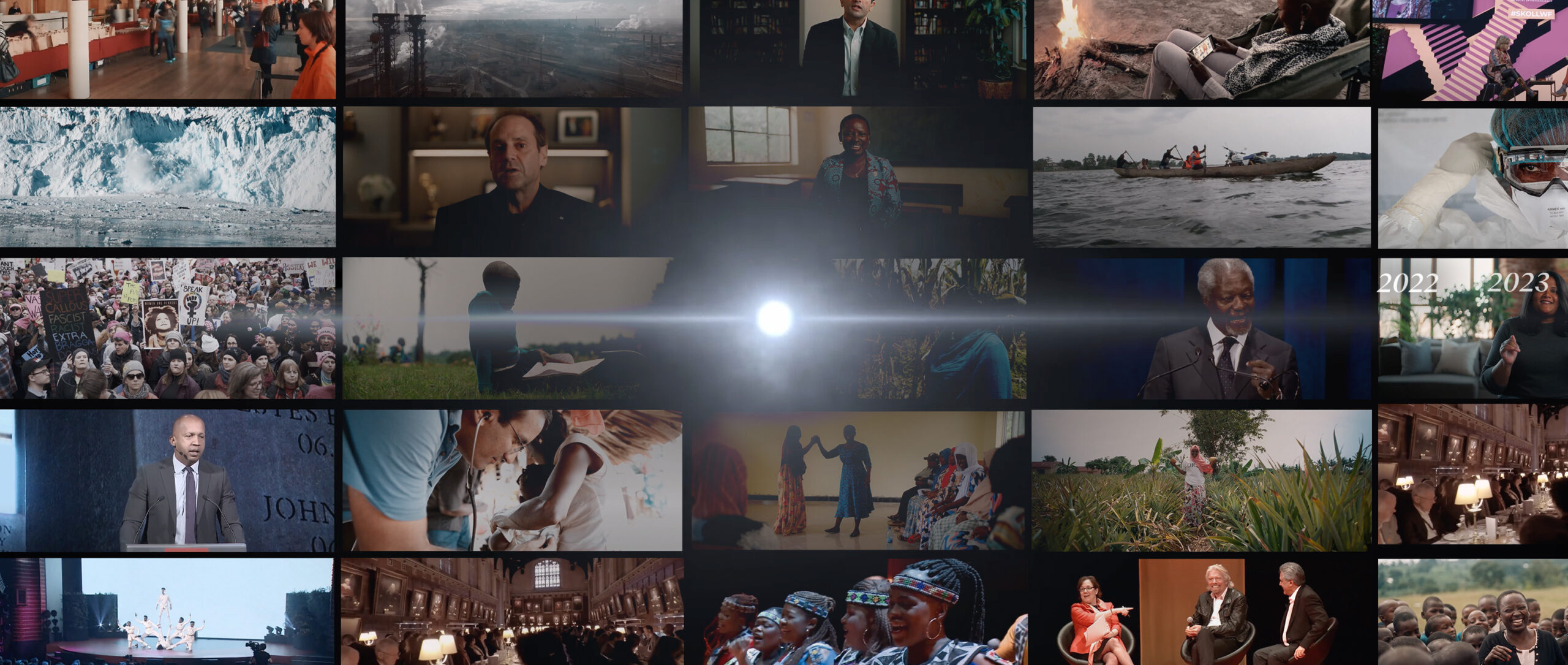
Closing Remarks from Sally Osberg at 2008 Skoll World Forum

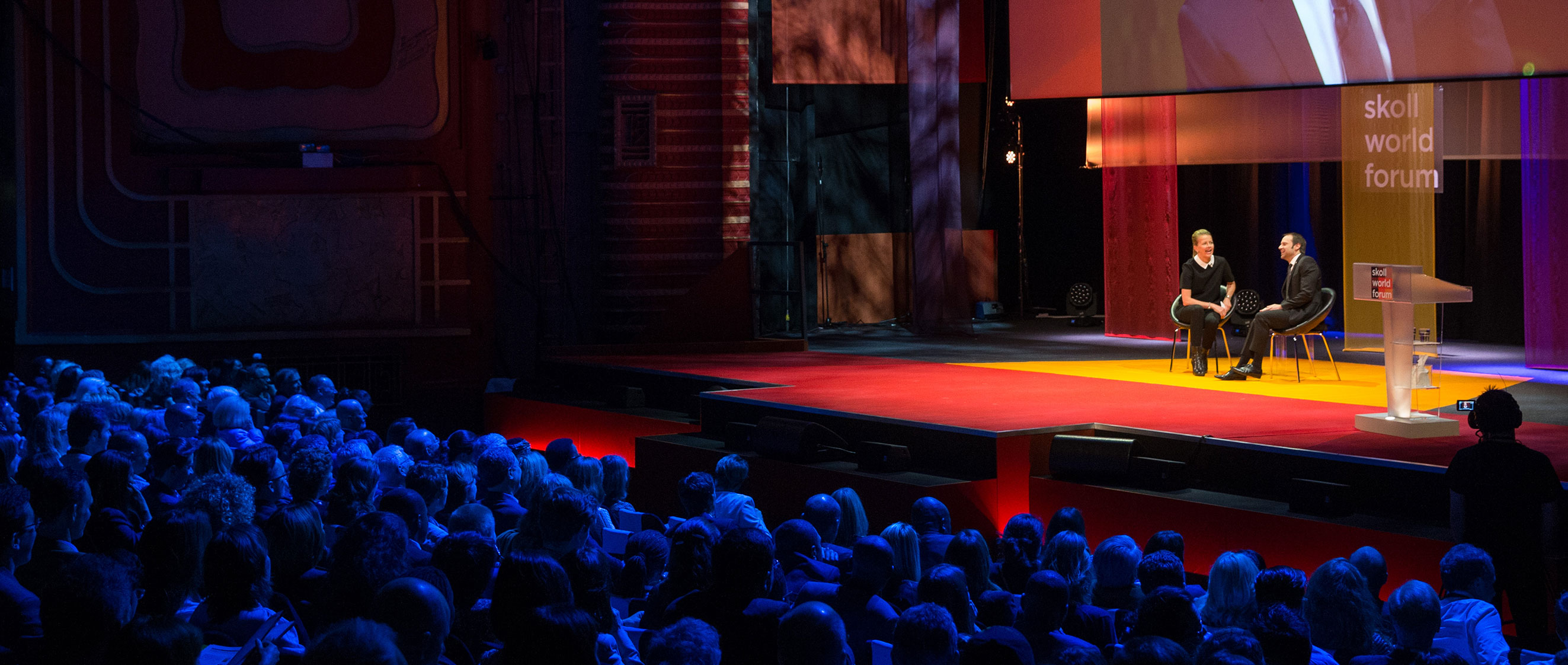
Closing remarks by Skoll Foundation CEO Sally Osberg at the 2008 Skoll World Forum. She speaks of the first Skoll World Forum in 2004, saying that one of the ideas behind it was “The legacy of past transgressions — on the environment, on human possibility, on the common good — should not be passed to future generations,” Osberg says.

With: Sally Osberg
I don't know about you, but I'm still trying to navigate this distance we've come from hearing Lord Anthony Giddens talk about hyperbolic discounting and what was in our way, and then just hearing the vice president tell us that nothing can stand in our way. Thank you so much. And thank you Paul and Paul all and our wonderful panel.

This has just been a spectacular, spectacular conclusion. Well, we're nearly there and I do hope everyone had one of those full English breakfast this morning, because I know you're running on fumes at this point. But, I just want to take a few moments only to wrap all this up, one of the more interesting commemorations, in a place that's had it's fair share of commemorations happened some 200 years ago next fall when Britain celebrated the 50th anniversary, the Grand Jubilee, of King George III ascension to the throne.

The king choose. Oh Mindy, I see you yawning I am so sorry, and I'm going to mention you so stay awake. Okay. The king choose to celebrate this occasion in a unique way, giving two thousand pounds from his personal dowry to the Society for the Relief of Persons to help more than seven thousand people pay their debts.

The reason was simple; he believed that the legacy of past debts should not burden future generations. In a way, it's that same belief that brought us together when we first met in 2004, the idea that the legacy of past transgressions on the environment, on human possibility on the common good should not be past to future generations.

That together we could come up with new ways to solve the worlds toughest problems. We weren't exactly a voiclomotis, but there weren't very many of us to say we've attracted others to join the good fight is something of an understatement. In a span of just a few years there has been an explosion of books, articles, television programs, blogs celebrating and supporting sustainable social change.

The world's top business and professional schools have launched programs dedicated to social innovation and social entrepreneurship. Social entrepreneurs have been central players at the Clinton Global Initiative and the World Economic Forum. They've won Noble Peace Prices, they've been recognized as McCarther geniuses.

They're advising heads of state all over the world, as well as the current crop of US Presidential candidates. Concurrent with this trend has been a worldwide explosion in newly created non- governmental organizations with solutions. In Russia, we've gone from virtually no NGOs eight years ago, to more than four hundred thousand today.

In China, there are more than 280,000 registered and twice that number not registered. In India, the number is more than half a million and in the U.S., more than one million, half of which were formed in this decade. All of these developments point to a deeper truth. Social entrepreneurship all you in this room have achieved the crucial and all too elusive task of capturing the public imagination.

But what's the next chapter in our story? I believe it's the ecosystem. More and more social entrepreneurship is not only about the power of the brilliant individual. Increasingly, it's about the power of partnerships, the coalitions that take the solutions that you envision and bringing the impact of those solutions to scale, Not necessarily one organization to scale the impact of the solution to scale.

This is the direction we are headed - toward a dynamic, open-source model of social change, smarter, broader, infinitely expansive and more flexible collaborations with business, governments, universities, and of course, with one another. It is no accident that over the last three years, the Nobel Peace Prize has been awarded to an individual and an institution.

Last year, it was the Vice-President and the intergovernmental panel on climate change. Before It was Muhammad Yunis and the Grameen Bank, and before that it was Mohamed ElBaradei and the International Atomic Energy Agency. It often takes an individual to have that game changing insight, to see what no one else has seen, to make that leap beyond what is known to what can be imagined, but without institutions, even the most transformative ideas are unlikely to translate into sustainable change.

As Jean Monnet, architect of the EU put it, "Nothing changes without individuals. Nothing lasts without institutions." And we take the truth one step further, and unite many institutions in formal and informal multi sector alliances. That's when we can realize the potential of brilliant people and ideas to change the world.

I believe that this is the next step in our work, achieving this community effect wherever possible, whether it's in defeating disease, transitioning to less carbon intensive global economy, or devising solutions that will ensure that supply of clean water to human beings all over the planet. Many models of this kind of creative partnership exist, and more are forming.

One is focused on malaria. But to fully appreciate today's approach it's an important to reflect on an earlier time when the world tried to defeat this disease. The cautionary tale of Fred Soper. Fred Soper proved that malaria could be defeated with an astonishing assault on the anopheles mosquito first in 1930's Brazil where he marshaled some forty thousand health workers in a successful war, and then internationally when he became head of the Global Malaria Eradication Program in the forty's.

Fiercely determined, he was described as the General Patton of entomology. His campaign deployed workers throughout infected parts of the world to kill mosquitoes, first with commonly used pesticides, diesel oil, pyrethrum, and a toxic arsenic based compound known as Paris Green. And later with an amazing new technology, a chemical, the pesticide DDT, developed by Swiss chemist Paul Mitchell who won the the Nobel Prize for medicine for his discovery in 1948.

Fred Soper, together with the center for disease control, the world health organization and the more than 55 nations that signed on to the campaign by 1948 were certain that vector control was the strategy and DDT, the silver bullet. But then, unintended consequences, not only mosquitoes but birds, wildlife and entire swats of nature.

Succumbed to DDT. In 1962, as we've heard, naturalist Rachel Carson published the "Silent Spring" an indictment against the ravages of DDT, public outcry despite her challenges grew. The nascent environmental movement gathered force and by 1972, the US had banned DDT. Other countries followed and once more regions of the world that had been plagued began to see an alarming rise in the populations of anopheles mosquitoes.

Fred Soper's great campaign turned out over some thirty plus years to be a defining lesson in the complex dynamics and variables that inform all systems. We have learned that the search for silver bullets is naive, perhaps even dangerous. Today, we've again taken up permission to defeat malaria, but this time it's a broad coalition of groups and an even broader coalitions of solutions.

One of the more promising collaborations is a partnership between the Institute for One World Health, founded by social enterpreneur Victoria Hale, the biotechnology company Amyris and a team at the University of California at Berkeley. They're working together to manufacture a synthetic version of the key component for treating malaria, artemisinin - supplies for which are severely limited by the supply of the wormwood plant.

The team believes that they are going to get this down to sixty cents a dose, which will make possible saving millions of lives a year. Simultaneously many other efforts are under way, governments and NGOs, all around the world are deploying health care workers to market and distribute bed nets and to teach people the behaviors keep them safe, sleeping under the bed nets, staying inside after dark, clearing up those pools of stagnant water.

Foundations, corporations, governments, churches, sports association. Each of these sectors, and many others, has a role to play in this enormous mission. And through smart coordination each group's unique contribution can be enhanced by the contribution of partners. We see similar coalitions around many issues like the collaboration, this is for you Mindy, spured by series, led by social entrepreneur Mindy Lubber between the U.N. foundation and dozens of leading investment banks, institutional investors, pension funds to factor the risk associated with carbon intensity into their financial decisions, or the campaign the Vice President just mentioned that's being developed by the Alliance by Climate Protection founded by this great social entrepreneur. Or even the upcoming Pangea Day slated for May 10th this year and I need my Sundance people to help me here, but it is a way to bring the world together around film, video and the expression of what makes us human.

Jeff Skoll has been a wonderful adviser to this phenomenon that we'll all experience on May 10th. Your solutions deserve to be celebrated, but as all know well, lasting change isn't inevitable. Lasting change comes about when individuals, institutions and alliances create the ecosystem needed to nourish and sustain it.

What is the equivalent of the modern global malaria network of networks in your domain? The partners who can weave in, out, and around your idea, creating that resilient web of change. As we have heard here this week, answering the question is not easy. It points to the difference between working for change and organizing for change, two distinct and related actions.

The work we do together to organize alliances will be crucial for assuring your ideas realize their promise. That's one reason we organize this forum every year to give you the chance to make the connections that can lead to new alliances, bolder ideas and ever more powerful partnerships. And since this is our fifth anniversary for the School World Forum, let's pause for a moment to see just a short video, four minutes, reflecting our common experience together.

Is it working? It's still setting. Yeah.

Its working.


Okay, okay. I am Mohammad Yunis. I am the managing director of Yeman Bank. I wanted to find a solution to a problem, and I wanted to do whatever it takes to do to end that problem.


I think that there are times when we look around the world and we say, " How could this be?"

Most people have to see to believe, but I think that social entrepreneurs believe and then they see. I think the most important thing to find out what the field needs. So, we try to engage with practitioners to ask the question, what should we be doing to help you.

I think the highlights of this forum was a jolt of inspiration. Because you come to an event like this, and you say "Oh my god!". You know, there are so many people doing such good work. Makes you say "I want to go out there and make it happen." Common cause doesn't necessarily mean agreeing on everything.

I keep reminding myself that having a common purpose is neither necessary nor sufficient for us to be able to operate effecitively together.

Perhaps the most remarkable thing is bringing together this extraordinary election of men and women all of you can stand up and enthrall us with the remarkable work that you're doing.

It should make you optimistic that we have collectively conquered the worst disease that we have ever had.

It was respect for and trust in your partners and colleagues that if they really believed in it as much as you did they wouldn't do what they said they were going to do.

I think as a fields, it will do us well to create lots of different kinds of heroes, who will play in many different roles and making change happen.

We invite these folks into a community of their peers locally and across the world. It's that community, which is now growing very fast, that is the power of the field. We're dealing with such complex problems in this world that we can't expect for just the public sector, just the private sector, or just the social sector to be able to adjust them all.


Few people have begun to make a clear in the field of social entrepreneurship , but really what we're talking about is power - to really unleash the potential and the power that's in every human being.

Nearly 50 years ago, an
author was presented with just such a moment of opportunity, Wallace Stegner, Pulitzer Prize winning American novelist and early conservationist was approached by a young researcher from the University of California at Berkeley.

The center there had been given a task by the Federal Government to write a six page letter for publication, in a fairly obscure congressional report, articulating why saving the environment was important. Stegner ceased the moment. He wrote the now famous Wilderness letter that talked about wilderness not just as a place or thing to be protected, but as an idea, a concept that was important for full realization of human potential.

He wrote: something will have gone out of us as a people if we ever let the remaining wilderness be destroyed. If we permit the last virgin forest be turned into comic books and plastic cigarette cases, if we drive the few remaining members of wild species into zoos or to extinction, if we pollute the last clear air and dirty the last clean streams and push our paved roads through the last of the silence.

So that never again can we have a chance to see ourselves single, separate, vertical, an individual in the world. We simply need that wild country available to us, even if we never do more than drive to it's edge, and look in. For it can be means of reassuring ourselves of our sanity as creatures.

a part of the geography of hope.
With in a year Stegner's
letter was every where, he saw it posted in a game park Kenya on posters in Rodhesia, South Africa, Australia, Canada, and Israel. The phrase, "geography of hope" lent itself to the title of at least seven books. And most importantly, it provided the intellectual underpinning for early conservationist who past the most far reaching wilderness protection in American history three years later.

That is the affect of one passionate person, dedicated to change, seizing a moment. I believe believe that spirit is alive and well here at Oxford this week. Your dedication gives us new optimism that we can solve the challenges we face. you and your work help reassure us of our humanity and our sanity as creatures.

You are helping expand the geography of hope.

A final thank you,
now, to all our incredible speakers and moderators. And to everyone who has shared an idea or made a connection this week. Thank you especially to the extraordinary Skoll World Forum team, I will ask you to stand, Andy Dewitt, Kelly Kreading, Heather Mason, Micatspian Production folks, Samantha Beineker, and the two amazing leads who held it together every step of the way, Liz Nelson and Paula Kravitz.

We have been privileged to yake this step a long our journey with you. No poem for me, this time, just a simple phrase inspired by that quirky little bit we saw at the opening of the video. You've just seen, when Muhammad Yunis asks of the camera crew "Is it working?" It's working. Thank you. Safe travels.

See you all next year.
Related Videos