Speaker: Stephan Chambers

Director of the MBA, Saïd Business School, University of Oxford , Chair of the Standing Committee, Skoll Centre for Social Entrepreneurship

Stephan Chambers is Chair of the Standing Committee for the Skoll Centre for Social Entrepreneurship, which he helped to found, and Director of the MBA at Oxford University’s Saïd Business School.  He is also chairman of IWA Publishing and sits on the advisory board of Princeton University Press.  He is a fellow of Lincoln College.

2012 SESSIONS
 

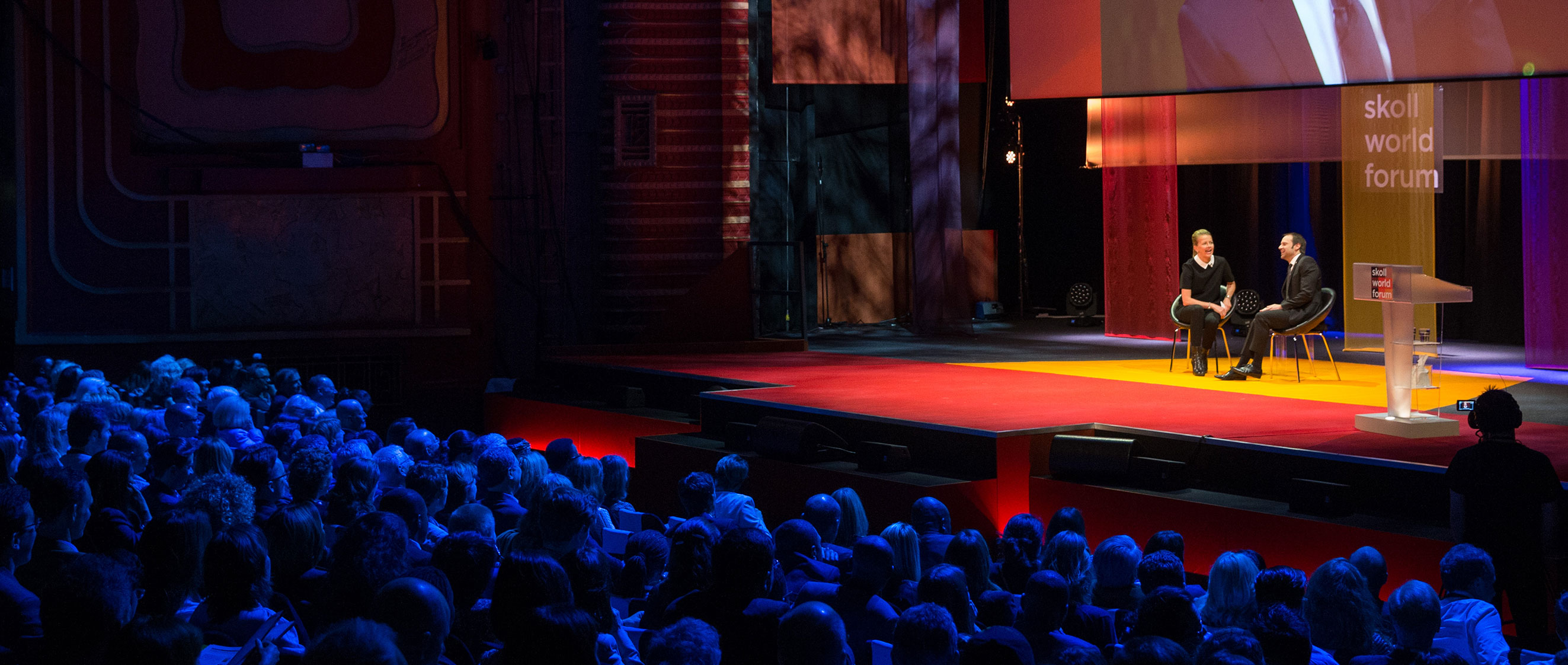
Opening Plenary 2012 Skoll World Forum

Location: New Theatre, Oxford

Opening Plenary of the 2012 Skoll World Forum.

OPENING VIDEO
Murmuration

OPENING REMARKS AND MASTER OF CEREMONIES
Stephan Chambers, Director of the MBA, Saïd Business School, University of Oxford; Chair of the Standing Committee, Skoll Centre for Social Entrepreneurship
Peter Tufano, Peter Moores Dean, Saïd Business School

THE SPIRIT OF CHANGE
Jeff Skoll, Founder, Skoll Foundation, Skoll Global Threats Fund, Participant Media, Capricorn Investment Group

UNEXPECTED FACTS ABOUT A POPULATION IN FLUX
Hans Rosling, Professor of International Health, Karolinska Institutet; Co-founder, Gapminder Foundation, Sweden

INNOVATION IN TIMES OF FLUX: OPPORTUNITY ON THE HEELS OF CRISIS
Judith Rodin, CEO, Rockefeller Foundation
Patrick Meier, Director of Crisis Mapping, Ushahidi
Roger Martin, Dean, Rotman School of Business, University of Toronto
Soraya Salti, Senior Vice President of Middle East/North Africa for Junior Achievement Worldwide, INJAZ Al-Arab

MUSICAL PERFORMANCE
Eva Ayllon and Band

Speakers: Peter Tufano, Eva Ayllon, Hans Rosling, Soraya Salti, Roger Martin, Stephan Chambers, Judith Rodin, Jeff Skoll, Patrick Meier
2012 SESSIONS
 

Morning Plenary

Location: New Theatre, Oxford

Thursday morning plenary at the 2012 Skoll World Forum.

OPENING REMARKS AND MASTER OF CEREMONIES
Stephan Chambers, Director of the MBA, Saïd Business School, University of Oxford; Chair of the Standing Committee, Skoll Centre for Social Entrepreneurship

GLOBAL PERSPECTIVES
Gordon Brown, Former UK Prime Minister

INVENTING A NEW FUTURE: BEYOND OUR HUMPTY DUMPTY WORLD
Pamela Hartigan, Director, Skoll Centre on Social Entrepreneurship

RESILIENCE AND STRENGTH: STORIES AND IMAGES OF PEOPLE IN FLUX
Nick Danziger, Photographer, Author, Filmmaker

WOMEN, PEACE AND SECURITY: A REPORT FROM THE FRONT LINES
Eve Ensler, Playwright; Founder, V-Day

Speakers: Gordon Brown, Eve Ensler, Nick Danziger, Stephan Chambers, Pamela Hartigan
2012 SESSIONS
 

Closing Plenary 2012 Skoll World Forum

Location: Nelson Mandela Lecture Theatre and live streaming in the Networking Marquees
After three days of intense collaboration, delegates of the forum come together at the closing plenary in the Nelson Mandela Theatre with live streaming in the comfortable networking marquees and other less formal locations. Remarks will be followed by a reception in the networking marquees to cap off your experience at the Skoll World Forum!

OPENING REMARKS AND MASTER OF CEREMONIES

Stephan Chambers, Director of the MBA, Saïd Business School, University of Oxford; Chair of the Standing Committee, Skoll Centre for Social Entrepreneurship

LOST IN NOISE: AMPLIFYING UNTOLD STORIES IN AN AGE OF FLUX
Zoe Williams, Columnist, The Guardian
Arianna Huffington, President and Editor-in-Chief, The Huffington Post
Carl Pope, Senior Strategic Advisor, Sierra Club; Convenor, Global Alliance for Access to Renewable Energy
Gidon Bromberg,  Israeli Director, EcoPeace / Friends of the Earth Middle East

Speakers: Zoe Williams, Carl Pope, Arianna Huffington, Gidon Bromberg, Stephan Chambers
2011 SESSIONS
 

Opening Plenary 2011 Skoll World Forum

What better way to kick off the 2011 Skoll World Forum than with inspiring music? That’s what Baaba Maal, Senagalese singer and guitarist, did when he sang in the Opening Plenary. Master of Ceremonies Stephan Chambers, Director of the Said Business School and Chairman of the Skoll Centre for Social Entrepreneurship, warmly welcomes attendees.

Jeff Skoll talks about how we are “fighting for our collective future…for sustainable growth, peace and prosperity for everyone. For the most part, humankind created these seemingly intractable global problems… Whether it’s climate change, education, water scarcity or human rights. The only way we’re going to survive as a species is to pull together in our collective self interest.”

Ngaire Woods, Professor of International Political Economy and Academic Director of the Blavatnik School of Government at University of Oxford, talks about scaling up and collaborating.

The opening plenary concludes with a great panel on microfinance. Some of the top in the field share what works, what doesn’t, and why microfinance is so crucial in the world. Moderator was Jonathan Lewis, Founder and Chair of Microcredit Enterprises and panelists were Alvaro Rodriguez, Chair of Compartamos Banco and Roshaneh Zafar, Managing Director of the Kashf Foundation.

Speakers: Baaba Maal, Stephan Chambers, Jeff Skoll, Ngaire Woods, Jonathan Lewis, Alvaro Rodriguez Arregui, Roshaneh Zafar
2010 SESSIONS
 

Closing Plenary Of The 2010 Skoll World Forum

After an inspiring three days, attendees gathered for the closing plenary. Skoll Centre for Social Entrepreneurship Director Pamela Hartigan opened by talking about the idea of the heroic social entrepreneur. “‘Is that not misguided?’ I am frequently asked. ‘Certainly it takes more than a visionary individual for his or her initiative to be successful.’”
Hartigan answered this question in her speech.

Then, Caroline Casey, Founder & CEO of Kanchi, shared her disability that surprised the audience, and how it’s helped her become persuasive. Her talk, “The Power of Persuasion: Pulling in the Reluctant Collaborators,” was uplifting and an example of how to be positive—whether you have a disability or not.

Aruna Roy, Nikhil Dey and Shankar Singh talked on “The Anatomy of a People’s Movement.” Roy said it’s important to know what is going on in India, because if you don’t, “You can’t get your schooling, you can’t get your medicines, you can’t get your rations, you can’t get anything.”

Tim Smit, CEO of the Eden Project, talked about your vision in life. “We all sort of think death is optional, so we piss around wasting our lives away. You need to have the fire, to imagine how many birthdays there are from now until your death, and suddenly you think, ‘When am I going to go to the Antarctic, when am I going to do that?’ And suddenly you are fired up. So many people piss their lives up against the wall because they are too scared to take risks,” Smit says.

The Skoll World Forum came to an end with words by Stephan Chambers, chairman of the Skoll Centre Standing Committee at Said Business School. Chambers offers some wisdom learned. “Intractable problems, even big, scary, recalcitrant, painful ones, are not intractable when subject to the power of truth, reconciliation and innovation,” he said.

Speakers: Caroline Casey, Aruna Roy, Nikhil Dey, Shankar Singh, Tim Smit, Stephan Chambers, Pamela Hartigan

Closing Remarks – 2010 Skoll World Forum

here is the future truth for you, someone in Wall street. Somewhere in the city of London. Somewhere in Paris. Someone is building. chariot of scams. Ladies and gentlemen, friends and colleagues, I am the last man standing. And it's my very great pleasure to offer a few concluding remarks for this extraordinary event.

First, Thank you for making this event for thirty days over and over during the last three days people have spoken to me about the atmosphere at the World Forum. They've spoken of of engagement I don't think it's a coincidence that this, the most remarkable of any event I know, happens here in Oxford.

It's not just it a deliberations take on the flavor of the souring of this and the ancient. To thinking hard about hard questions. The questions you've been worrying about this week. the artist questioned awoke. A spool hawking put it you are asking have to Imaging what human being is less scantly for no less importantly You're allowing us to re-imagine what it is to think and act in the face of In justice and disasters both natural and not.

When our curator, the wonderful Paula Kravitz, asked me if I'd be happy to close your forum this year, and offer a few words of synthesis and summary, of course, I agreed. I assumed that diligent note taking, adequately grey hair and lots of assiduous conversations in corridors and over coffee this week would give me some strands to define and some themes to highlight.

I reckoned without one of the lesser known Skoll effects. And that's the law that states that the more inspiring the forum is, the less easy it is to summarize. The bad news therefore, is that there's no simple narrative of the week that I can serve up to you in conclusion tonight. The good new of course is that there's no simple narrative of the week and nor should there be in a week that's ranged both widely and deeply across the idea of collaboration.

So, I thought what I'd do is to list a few of the things that I've learned this week. I've learned that there are two birds and two cakes. I've learned that intractable problems even big, scary, recalcitrant, painful ones are not intractable when subject to the power of truth, reconciliation and innovation.

I've learned that sometimes it pays not to understand what you're interpreter is saying you said. I've learned that often when it appears that no one knows, we know. I've learned that language matters. That stories matter. That entitlement matters. And they matter, because so much of what is wrong results from a failure of empathy.

Stories are empathy agents. I've learned that imposed solutions don't work, but that local ones can. A dried up pond is of no use. I've learned that of the many resources unequally distributed, one of most important is entitlement; the notion that there are rights to demand and to defend is very important.

I've learned that the immune response prompted by the pathologies of power look quite a lot like you. and that nothing you do is inconsequential. And I've learned that it takes depth of courage to Force us to look into the abyss as the poor farmer did here two nights ago and more still to show us Some ways out of the abyss.

We have no choice but to adopt his preferred Definition catalysis and finally in gets dangerously closes sentences I've learned that one of the most famous distinctions in western philosophy may well have been overturned. by you all this week. 1739 David Hume made the distinction between is and ought between very roughly speaking, and it is very roughly speaking, accurate descriptions of the world and consequent inaccurate aspirations about the world.

It occurred to me listening to you all this week to the awardees, to the panelists, to contributors, to various of you over coffee and drinks, that here at the Skoll World forum ought is resolving to is. I thank you for your contributions this week and for continuing to build this creative and necessary event.

If nothing is inconsequential then you can be sure that some things are more consequential than others. This gathering is one of those things. For those of you who can get home, I wish you safe travel. To all of you, I wish you an engaged, productive, collaborative year and look forward to welcoming you back to this city of your dreams next year.

Meanwhile, may your ought be is. Thank you.
 
2009 SESSIONS
 

Opening Plenary Of The 2009 Skoll World Forum

Taiko drumming’s magical sounds set the stage for the 2009 Skoll World Forum. This performance by Taiko Meantime combined traditional Japanese rhythms and techniques with eclectic, original compositions.

Stephan Chambers, chairman of the Skoll Centre for Social Entrepreneurship, and Jeff Skoll welcomed guests.

Roger L. Martin, dean of the Rotman School of Management at the University of Toronto shared his findings of what qualities all great leaders share.

The opening plenary panel was called “Power to the People: Citizen Engagement and Social Transformation“. The moderator is Ray Suarez of The NewsHour on PBS and panelists are Kailash Satyarthi, chairman, global March Against Child Labour; Daniel Lubetzky, founder and president, PeaceWorks Group; The Honourable Mary Robinson, president, Realizing Rights.

Kenneth Brecher, executive director of the Sundance Institute, ended the opening plenary with his talk, “Unfinished Portraits of Powerful Ideas.” He discussed the significance of poetry and shared a powerful story about Stalin asking a woman to write a poem praising him in exchange for releasing her son.

Speakers: The Honourable Mary Robinson, Daniel Lubetzky, Kailash Satyarthi, Ray Suarez, Roger Martin, Stephan Chambers, Jeff Skoll, Ken Brecher

Opening Remarks: Stephan Chambers at 2009 Skoll World Forum

Thank you tycometime [sp?] the wonderful tycometime [sp?] are from Japan i wear grenedge, and i help this view from different times i since enjoyed sharing tyco time Vice Chancellor, ladies and gentlemen, distinguished guests, friends. It's my very great pleasure to welcome you to the sixth Skoll World Forum.

For the next three days you will create a haven where the easing is mostly quantifiable but never quantitative. I welcome you here on behalf of the XX Business School, The Skoll Center, The Skoll Foundation and the University of Oxford. We are proud to host this remarkable event and proud that you have made this the most important gathering of it's kind in the world.

This year sees the biggest forum ever; it has more programs sessions, more delegates and more speakers then ever before. For the first time, we're joined by all five years of the Skoll scholarship recipients and they constitute a really formidable and impressive alumni group. They and you have been instrumental in making making this program as rich and rewarding as possible.

This forum does what we passionately believe should be done. It convenes great people. It celebrates great achievements. It provokes new thinking. It educates brilliant minds from all over the world. And it runs counter to an instrumental world in which only incentives and private rewards have meaning, and it descends from all orthodoxy's but one, the one that charges us to take on the biggest problems of our time.

We're grateful to have you here I hope these three days will change your lives a bit and we hope that these three days will change the world a lot more. We meet, of course, in the teeth of a recession that threatensus all, even as it impoverishes numerical superlatives. However calamitous, however hard, however challenging this recession is, I contend good for social entrepreneurs and good for us.

It nudges us from periphery to center. It increases access to talent; it highlights the case for responsible, intelligent management of risk and it expands our definition of risk to encompass social and environmental questions. It makes our consistent, considered, clarion calls less Cassandra-like.

Most importantly of all, the recession put pressure on all those externalities, those things not in the cost of things. It puts pressure on them to be properly, internally, accounted for. The balance sheets of our companies will come to express the real costs of pollution, of insecurity, of water shortage, of poverty, of war and disease and when they finally really we will have reconciled the genius of capitalism with its shortcomings.

Its incentives for innovation, with its reluctance to account properly for the costs of those incentives. It's a big project but one that we're all here to work on and one that I encourage you to relish. Our theme this year is power, or Properly for those of you who've studied the program. The shifting power dynamics and the President participial, shifting, suggests the power dynamics are in the process but at the same time it suggest we much shift them by our own efforts a challenge for us all.

In writing that theme, we wanted to combine Patient View, he memorably wrote that power is a compound of time and patience. With the less patient view of our own Paul Farmer, who also memorably wrote, now is the time to get on the social justice bus. We choose this theme of shifting power sometime before it became clear that some things were already shifting.

Obama's victory was a shift. Our loss of trust in the unsupervised management of global finance was a shift. Any residual belief that the world's economies were decoupled, and that disasters in one place would leave others unaffected was a shift. Deserting a wholehearted commitment to consumption in favor of a more anxious, more revolved sense of our place in the world was a shift.

These are big shifts. And we also chose this theme because it is clear that things haven't shifted anything like enough. There remain problems of intractable Complexity and planetary seriousness. Conflict, corruption, disease, water, climate change, and billion of people in. Poverty are problems that require much bigger shifts still.

We understand nudge, we want shift. The philosopher Immanuel Kant predicted, that there would one day be universal peace. "The only question", he wrote. peace would come about by human insight or by catastrophe. Someone very clearly resolves this question in favor of insight over catastrophe, and someone who really understands.

shift is Jeff Skoll. Its my pleasure to introduce founder of Participant Media, Founder of the Skoll Foundation, the Founder of this enterprise, and a friend of us all here - Jeff Skoll.
 
2009 SESSIONS
 

Corporate Leadership For Change

Fascination with leadership is growing daily, fuelled by global complexity, free-falling capital markets, conflict and growing environmental and social deterioration. Key business leaders will discuss the kind of leadership required in the face of accentuated resource scarcity, more pervasive need and highly uncertain prospects. They will explore the excitement and challenges of operating through networked approaches that eschew traditional “command and control” models for a more “viral model” where the minds of many are more powerful than that of a few.


Speakers: Michael J. Critelli, Tae Yoo, Alan Hassenfeld, William Swope, Stephan Chambers, Fadi Ghandour
2008 SESSIONS
 

Opening Plenary Of The 2008 Skoll World Forum

The 2008 Skoll World Forum kicked off with a warm welcome from Stephan Chambers, Chairman of the Skoll Centre for Social Entrepreneurship, and Jeff Skoll.

Lord Anthony Giddens of the House of Lords talked about the politics of climate change.

The opening panel was “The dynamics of working cross culturally – experienced voices from the field.Pat Mitchell, president of the Paley Center for Media is the moderator, Panelists included Nafis Sadik, MD, UN Special Envoy for HIV/AIDS in Asia and the Pacific; Karen Tse, founder and CEO of International Bridges to Justice, and Jody Williams, Nobel Peace Prize Laureate, Nobel Women’s Initiative

Phil Hope, MP, parliamentary secretary, Minister for the Third Sector, spoke on Culture, Context and Policy Innovation.

Stephan Chambers gave closing remarks.

Speakers: Lord Anthony Giddens, Nafis Sadik, Jody Williams, Phil Hope, Karen Tse, Pat Mitchell, Stephan Chambers, Jeff Skoll

Stephan Chambers shares closing remarks at the 2008 Skoll World Forum opening plenary

xx many thanks for that characteristically illuminating discussion. What I think we've heard this evening, "it's the culture stupid" Which is to say, it's the shared experience; it's the language; it's the hyperbolic discounting. It's the compassion, it's the interconnectedness. Thats what I think we heard tonight.

Wittgensteins observation that there are remarks that sow and remarks that reap. And it is in the spirit sewing but I offer one or two practical announcements before we end. We move from here to a reception at Trinity College. Which, is more or less directly opposite. If, as entrepreneurs, you're allergic to fashion following the crowd, please follow the orange cloud marshals instead.

Those of you attending dinner at Kiva Later this evening will be collected just before eight o'clock from trinity also by orange cloud marshals. I now stand between you and the chance to feel your limbs and talk informally. And I will therefore, be brief. Our thanks to this evening speakers, for so beautifully setting the tone for the forum to come.

No one who has heard what's been said here tonight can fail to see the scale of the opportunity. Know of the crucial influence of our behaviors, our hopes, and our fears. It's precisely because of our behaviors that there is hope. Behavior isn't geology. Our thanks to the evening sponsors and supporters, to you the delegates, to our tireless organizers, Liz Nelson, Paula Kravitz, Alex Nichols, Samantha Beinhacker, Heather Mason and her teammates Caspian, and of course to our exceptional partners at the Skoll Foundation.

I will conclude in the spirit of remarks that sow. This forum is your blank sheet. The world will notice your doodles. Thank you

Stephan Chambers welcomes guests to the 2008 Skoll World Forum

Vice chancellor, distinguished guests, and friends, it is my very great pleasure to welcome you. To the fifth Skoll world forum, in social entrepreneurship. For the next three days, you will coalesce around the question of culture and social change.

You will debate some really hard questions. You will get to know each other and you will, occasionally, agree. You will, we hope, be inspired by this extraordinary university and its beautiful buildings, and leave here infused and invigorated. You are remarkable people. You come from all over the world, from every imaginable sector, and from a wide diversity of positions.

You share a commitment to change to action and to reflection. You'll also share, I think, despite Different biographies. A belief that the gathering complexities of the world, the world's key questions if you like. Require inventive, sophisticated, rigorous, optimistic and joined up delusions that's why you're here.

The Said Business School is very proud to host the Skoll of a social entrepreneurship and proud to be the Skoll foundation's partners in organizing this remarkable event. It's entirely right I think that so many of this ancient and vulnerable universities recent initiatives should explicitly address the most critical questions of our age.

Those, for example, of climate change and global health across a variety of disciplines and From finance to cultural branding. Our own skull center, the James an institute, the twenty first century school, the environmental change institute, the school for enterprising environment and many other departments around the university all seek to develop debates, communities, evidence and progress around these big problems.

Your work this week will, I hope, contribute significantly to that progress. The theme of This year's forum is culture. Culture is who we are. what we believe, how we behave and what we make. We chose this theme because we understand that sometimes the problems we face aren't about cash, or the supply chain, or incentives.

Sometimes the problems we face are about behaviors and habits and histories. And often the solutions we seek aren't about cash, or the supply chain or incentives , there about behaviors or habits or art or sport. Our focus will be on the human reality of the local context. On the complications of culture on the difficult contingent, unpredictable and sometimes, perverse truth of who we are, what we do and what we make.

In his Nobel acceptance speech, The Irish poet Seamus Heaney reminds us that art, like business, or politics is rarely neutral and how we got here, rarely fair. The documents civilization", he writes "have been written in blood and tears. Blood and tears no less real for being remote. We know that the documents of our future civilization must be written hope and idealism, in innovation and in kinship.

This forum Is your blank sheet and your documents will characterize a myriad initiatives and a carry out improvements. Another pert expelled I think from University About one hundred meters from where we sit, described poets as the unacknowledged legislators. of the world. It may not be too greater stretch, since we're here after all to talk about culture, to hope that as social entrepreneurs, you take gone Shelly's job description this week.

It is now my very great pleasure to this one he most definitely has that job description. Jeff Skoll is founder and chairman of the Skoll foundation and of participant productions. He's a great entrepreneur, and a great philanthropist, and above all, a great friend to all of us here. Without his insight and commitment, we would be further behind.

Like Wren, whose building this is, if you seek his monument, look around you. Please join me in welcoming Jeff Skoll.
 
2008 SESSIONS
 

Closing Plenary Of The 2008 Skoll World Forum

Three days of insights and inspiration, and the Forum came to a close. 
Stephan Chambers, Chairman of the Skoll Centre for Social Entrepreneurship, said goodbye.

Paul Collier, professor of economics at the University of Oxford, talked about, “Social Entrepreneurship and the Bottom Billion: Why the poorest countries are failing and what can be done about it.

The panel at the closing plenary was entitled: “Working Within Cultures and Contexts – Lessons Learned“. David Bornstein moderated, and panelists were Rupert Howes, CEO of the Marine Stewardship Council; Fiona Muchembere, program manager of institutional development at CAMFED; Vicky Colbert, founder and director of Escuela Nueva Foundation, and Jacqueline Novogratz, founder and CEO of the Acumen Fund.

Paul Farmer, MD, PhD, Co-founder, Partners in Health shared his reflections of his work, especially working cross-culturally.

Al Gore, 2007 Nobel Laureate, former Vice President of the United States spoke about his work on the environment.

Ending the Forum was Sally Osberg, President and CEO of the Skoll Foundation who mentioned the first Skoll World Forum in 2004, saying that one of the ideas behind it was “The legacy of past transgressions — on the environment, on human possibility, on the common good — should not be passed to future generations.”

Speakers: Fiona Muchembere, Paul Collier, Jacqueline Novogratz, Al Gore, Paul Farmer, Vicky Colbert, Rupert Howes, Stephan Chambers, Sally Osberg, David Bornstein

Stephan Chambers – highlights of the 2008 Skoll World Forum

Ladies and gentlemen, friends. Welcome to the last session of the remarkable fifth world forum behalf of Said Business School, Skoll Center, the University of Oxford and all my colleagues, thank you for making such an exciting and productive event. Those poor benighted souls who've spent this week elsewhere might have been forgiven for thinking the world a rather gloomy on the place.

Particularly if they were bankers and particularly, if they were bankers arriving departing through Heathrow. And those of you gofer it today's FT. We'll see the headline terminal decline. Despite that, it's been an incredibly gratifying week here in Oxford. and to feel the energy this week, all of it positive, all of it sustainable, has been astonishing.

When we gathered on Wednesday, in the Caeldonian [sp?], we dared to hope that this week bring us closer together, and that it would move us forward. I'm not sure that even those of us who had a rough idea of what was coming could have predicted the cumulative, energizing effect of the last few days.

I've been amazed by the coruscating optimism of President Carter. The salutary admonitions of Tony Giddons the amazing insights with Jodie, Pat, Nafis and Karim, the inspiring stories of this year's awardees. And the remarkable work of all of you in sessions, panels, clinics, tents, and dining halls.

Anything but terminal decline. It is now my very great pleasure to introduce Paul Calia [sp?] interview this morning. Paul is a distinguished economist and director of the Center for the Study of African Economies here in Oxford. his book, The Bottom Billion, which has just won the 2008 Lionel Gerber prize, has sparked thousands of conversations around the world.

Those conversations are happening in government, in the academy, and in corporations. and they're very important. Paul Collin.
 
2007 SESSIONS
 

Opening Plenary Of The 2007 Skoll World Forum

OPENING MUSIC
Salman Ahmad, Pakistani musician, UN Goodwill Ambassador HIV/AIDS, and founder of Junoon, South Asia’s most popular rock band

WELCOME
Stephan Chambers - MBA Director and Fellow of Saïd Business School, University of Oxford, Forum Moderator

OPENING REMARKS
Jeff Skoll - Founder and Chairman, Skoll Foundation and Participant Productions

OPENING REMARKS
John Hood - Vice Chancellor, University of Oxford

SOCIAL INNOVATION – WHAT IS IT, WHY IS IT IMPORTANT, WHAT ARE THE BARRIERS, HOW CAN IT BE ACCELERATED?
Geoff Mulgan - Director, The Young Foundation
Rushanara Ali - Associate Director, The Young Foundation

QUEEN RANIA OF JORDAN

SOCIAL INNOVATION – THE NEW PHILANTHROPISTS
Charles Handy - Writer, Broadcaster and Social Philosopher

THE CREATIVE IMPULSE: AN ECONOMIST’S ACCOUNT OF THE VERY DIFFERENT PATTERNS OF PERSONAL CREATIVITY
David Galenson - Professor of Economics, University of Chicago

NOBEL LAUREATE MUHAMMAD YUNUS IN CONVERSATION WITH PAT MITCHELL
Muhammad Yunus - Founder, Grameen Bank
Pat Mitchell - President and CEO, Museum of Television and Radio

CLOSING REMARKS
Stephan Chambers

Speakers: Geoff Mulgan, Muhammad Yunus, Salman Ahmad, John Hood, Rushanara Ali, Charles Handy, David Galenson, Queen Rania of Jordan, Pat Mitchell, Stephan Chambers, Jeff Skoll

Stephan Chambers Speaks at the 2007 Skoll World Forum