Speaker: Sally Osberg

President and CEO, Skoll Foundation

Sally Osberg is President and CEO of the Skoll Foundation, partnering with Jeff Skoll to champion change. Named one of the “Millennium 100” for her role in shaping and leading Silicon Valley, she is a leader among social entrepreneurs and other innovators. On the boards of the Skoll Foundation, the Skoll Global Threats Fund and the Oracle Education Foundation, she also serves on the advisory board of the Elders.

2012 SESSIONS
 

2012 Skoll Awards For Social Entrepreneurship

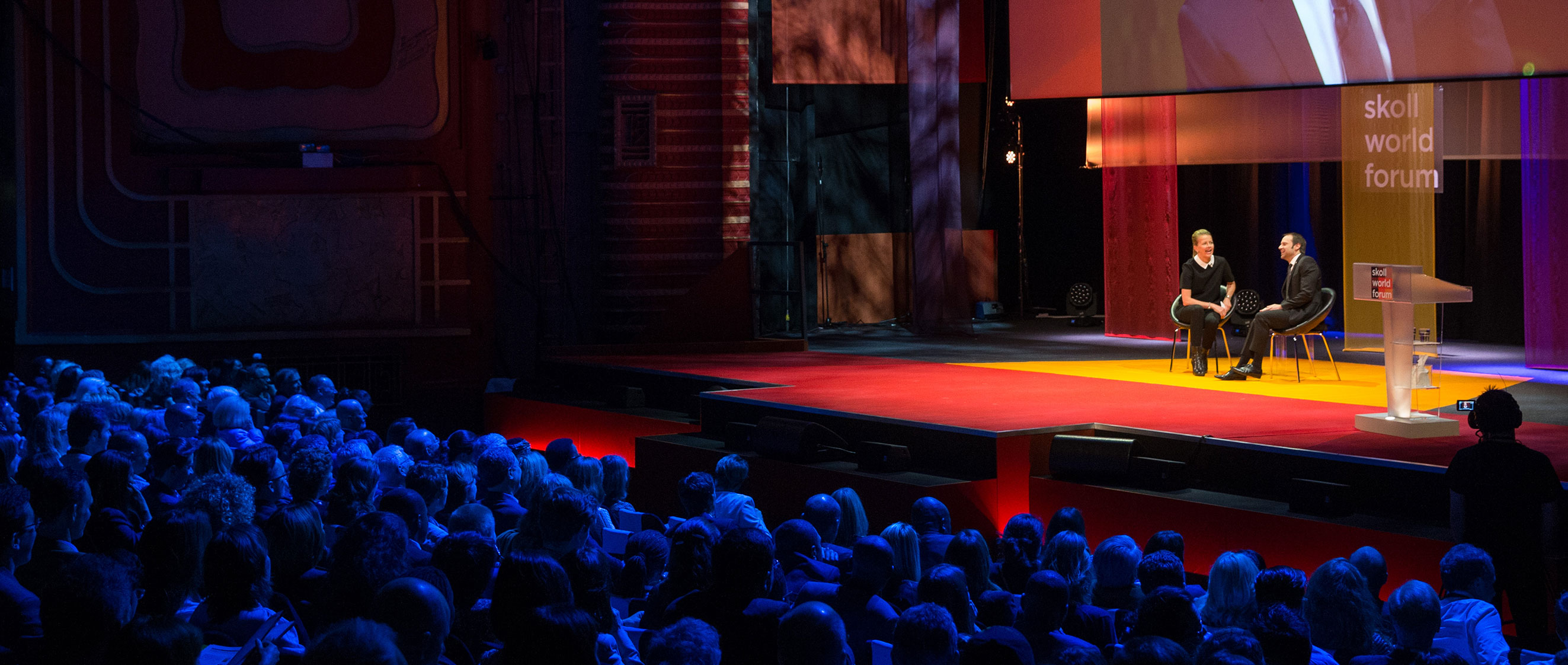
Location: New Theatre, Oxford

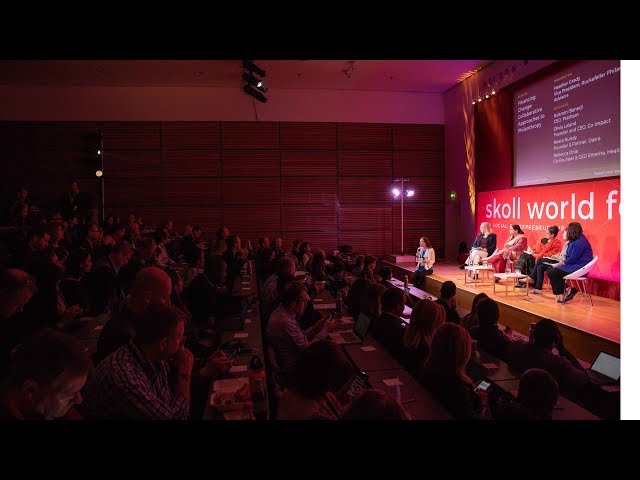
The Skoll Foundation invites you to attend the Skoll Awards for Social Entrepreneurship to honour the 2012 Awardees and to celebrate all those who are working to create a peaceful, prosperous and sustainable world.

OPENING REMARKS AND MASTER OF CEREMONIES
Sally Osberg, President and CEO, Skoll Foundation

SHORT FILM PRESENTATIONS
Hanging in the Balance: The Future of a Forest
Visayan Forum Foundation

MUSICAL PERFORMANCE
String Fever
Annie Lennox

Speakers: String Fever, Annie Lennox, Sally Osberg
2011 SESSIONS
 

2011 Skoll Awards For Social Entrepreneurship

The Skoll Foundation invites you to revisit the Skoll Awards for Social Entrepreneurship where we honour the 2011 Awardees and to celebrate all those who are working to create a peaceful, prosperous and sustainable world.

2011 Awardees included Rebecca Onie of Health Leads, Madhav Chavan of Pratham, Ellen Moir of New Teacher Center and Ned Breslin of Water For People.

Featuring remarks by and the awarding of the Skoll Global Treasure Award to:
Archbishop Emeritus Desmond M. Tutu, Chair, The Elders

Musical performance by:
Peter Gabriel and Baaba Maal

Speakers: Archbishop Emeritus Desmond M. Tutu, Baaba Maal, Rebecca Onie, Madhav Chavan, Ellen Moir, Ned Breslin, Sally Osberg, Peter Gabriel, Jeff Skoll

2011 Skoll Awards for Social Entrepreneurship Ceremony

Social entrepreneurs don't generally set out to incite protests or topple despots, but they are revolutionaries none the less. They understand that wars can be waged by a thousand cuts, that crimes against humanity occur when millions of children die of diarrhea or tetanus. When medicine fails the poor, when education squanders young educators and sacrifices its young.

And they refuse to accept that this is reality, the status quo, just the way things are, they know better and they set out to make it so. The 2011 Skoll Award winners we honor tonight offer scalable proven solutions to these toughest of problems, and to the unacceptable conditions of poverty and injustice that breed and sustain them.

Jeff, would you please join me on stage for our awards presentation? First up, Rebecca Onie. Health Leads. Rebecca Onie recognize the compounding effects of poverty on illness designed a protocol and set about to cure a sick system. With Doctor Barry Zuckerman and Boston Medical College, Rebbecca founded Health Leads to bridge the health gap between medicine and social work.

Health Leads expands the capacity of clinics and hospitals, to meet the underlying needs of poor patients. Doctors prescribes the support services along with medication and Health Leads volunteers connect patients to sources of food, housing, job training. In other words, to sources that can accelerate their healing and keep them healthy. Within 90 days the majority of patients served by Health Leads have secured at least One essential resource, an 83% of its volunteer graduates have gone onto jobs or advanced studying the fields whit health and poverty.

Rebecca Onie, Health Leads.


In October of 1985, I walked in to the waiting room of a chaotic busy urban clinic. The TV I distinctly remember play this endless reel of cartoons and the exhaustion of mother who had taken two three and some time four buses to bring their children in to the doctor was palpable. The doctors it seemed never really had time for all the patients.

And over the course of six months I would corner them, rather while they were scrawling notes in the medical records, or swallowing their lunches in the hallway. And I would say to them, "if you had unlimited resources what is the one thing you would give your patients"? And they said the same thing again and again and again.

A story we have now heard hundreds of times.

They said everyday we have
patients who come into the clinic, child has an infection and we give the family medicine, but the truth is, I know there's no food at home. The truth is, I know this family is living with thirteen other people in two bedrooms, and I don't even ask about those issues because there is nothing that I can do.

On those issues we practice a 'don't ask, don't tell' policy. And in fact, in that clinic it is true; the patients pile up in the waiting room, the doctors have just a few minutes, and they would say "I don't where to find food for the patients and I have no help in doing so." In that clinic there is one social worker for 24,000 patients.

This clinic, to be clear, is not in Lima, it is not in Nairobi, it is not in Bogota and it is not in Port au Prince. It is Boston, Massachusetts, in the shadow of Harvard Medical School - the epicenter of some of the fanciest and most expensive healthcare in the world. And indeed, in cities across the country, in Harlem, New York, Southeast Washington, D.C., the South-side of Chicago and other clinics throughout the country, this is the way healthcare is delivered.

And it shows. In the communities where Health Leads works - in Baltimore, Maryland - the life expectancy is lower than it is in Bangladesh. So let me be plain here. The impact of poverty on health is not developing world issue. It is not a developed world challenge. It is a challenge that is faced by poor people everywhere they live in the world.

Health Lead's response is simple. It is cheap, it is effective. We enable physicians to write prescriptions for basic resources like food, housing and heat, alongside prescriptions for medication. Patients then take those prescriptions to our desks in the clinic waiting room, where we have a core of 700 college volunteers who fill those prescriptions by connection patients out to the resources that they need.

Over the next 3 years Health Leads will create 25,000 successful resource connections for low income patients and their families. But our goal is not merely to serve more patients; the goal is to change the way that healthcare is delivered, so that doctors can prescribe solutions that improve health, just as they prescribe prescriptions that will enable families to manage disease.

This is our vision. And this is why the Skoll award is so important. Health Leads model is a distinctly non-innovative approach. The purpose of the award is to allow us to follow in the footsteps of and to learn from Paul Farmer, Vera Cordeiro, Gene Falk, Mitch Besser and so many others in this room who share our vision for the way that healthcare should be delivered everywhere across the globe.

What Health Leads has been able to show is that a poeple that a couple of volunteers in a clinic reading room, you empower physicians to ask the real question of their patients. And you create a next generation of front line health care Providers and leaders who really will change the health care system.

A couple of weeks ago I had the chance to talk to Amelie Lozada [sp],one of our alumi who is now in medical school student and spent 3 years as an undergraduate working in that same clinic at Boston medical center. She said, when my classmate write a prescription, they think their work is done. When I write a prescription I think can the family read the prescription?

Does the family have transportation to the pharmacy? Do they have money to pay for the prescription and do they have food to take with it? Those are not questions that I learned in medical school. Those are questions that I learned with Health Leads. Thank you.


Ellen Moir, New Teacher Center.

In the US one third of our new teachers, young men and women entering a noble profession with noble aspirations, don't make it.

The turnover rate saps education of its talent, and scars schools, classrooms and students. Even worse the problem hits the most vulnerable the hardest since new teachers are most commonly placed in the toughest school settings. Ellen Moir traces her passion for education to her high school Spanish teacher, who encouraged her to become the first one in her family to attend college.

For more than twenty years Ellen has tested and refined a model, to pair talented and experienced veteran teachers with talented and inexperienced new teachers. Launching New Teacher Center in 1998. In 2010, the center reached more than twenty six thousand teachers to affect 1.84 million students.

To bolster its impact the center place an active role in the national education policy debate advocating for state and federal policies that line up with the needs of educators and students.

Ellen
Moir, New Teacher Center.


My first year as a classroom teacher I felt like a complete failure. I wanted to quit. I'd never worked so hard in my life, and I knew in my heart, that I really wasn't making a difference in the lives of my students from the moment I left college, I knew I was going to be a phenomenal teacher. But when I met my students, I could see quickly that I didn't know what to do.

Maybe I chosen the wrong profession. Those are the words of new teachers across America. We have a horrible way of inducting them. It's really a trial by fire experience. One that you'd never want to have happen to anyone you know. Yes, we can find a key for them to the classroom, but the room is bare.

There's nothing for them to know, a guide on what to teach or how to teach, and their disproportionally assigned to the toughest schools within schools the toughest assignments. No wonder 50% leave within the first 3 to 5 years. And let me be clear, those that leave are leaving from the communities and from the students that needs stability and connectedness the most.

Its a tragedy, its despicable and it haunted me for years to watch this play out, as we simultaneously talked about building a profession. How could we ever really recruit the most talented to stay, and care and do their best, if we greet them with the conditions that we've done so far? At the New Teacher Center, we are driven to build a better profession, to really honor and value teachers.

Each of you remembers a teacher that made a difference in your life. I personally want to be sure that it's not left to chance that every underprivileged child in America, every Latino and African American child in this country, gets the best teachers. So we built a model to actually on board, or induct new teachers into the profession.

Where we not only wanted to help new teachers and their students, but we wanted to create optimism and hope in our profession by releasing the most talented of teachers to serve in the role of mentor. These exemplary teachers, they teach new teachers how to teach. That's their job. They are beside the new teachers every week of the year for two years.

So, if a new teacher has a problem and it's 8 PM at night, they can ping them and get an answer or they can simply pick up the phone. Let me tell you a moment about Viviana Espinosa. Viviana teaches in East Pola Alto, many of you have heard of Palo Alto, probably you live in the most affluent communities in America. But have you heard that East Palo Alto across the bridge resembles the South side of Chicago the Englewood community it's tough.

I remember when I went there the first time ten years ago. I couldnt believe that we called this is a school, and a district. Against all odds, Vivianna with her 20 first-graders, those 20 students of 17 were English language learners, Vivianna set out an aggressive course with her mentor, to help every single one of those students read at grade level by the end.

And am happy to tell you, that with this expert other at her side, Vivianna was able to do just that. Fifteen of the students met grade level, and all 20 of them had made growth beyond a year. I told you that story about Vivianna, because you can see that her students are really the primary beneficiaries of this work.

But I want you to know that Vivianna's mentor, and the other mentors we've reached across the country, 6,000 of them, for the first time in their careers feel empowered and proud to be teachers, and are very focused on how to build in this continuous improvement process, into the schools. We reached 1.5 million students, I'm proud of that but that's not enough.

With this Skoll Award we're going to double that number. We're going to reach 3,000,000 new students coming from communities where they are underserved and not getting the kind of quality education that America touts as being part of our democracy. Imagine if every single new teacher in America got this kind of induction, mentored support for two years, how the students could actually - the new teachers would be better faster and the students would actually improve, and the results will be fabulous.

And the new teachers would have a fire and a passion for being the best that they can. Imagine how we'd move on needle on performance, if we had this kind of a system. Let me just share with you the word of one of the mentee's that had a great mentor for two years. She said my mentor was like a light that guided me through my first years.

I was able to take that light and shine it on my students. My heartfelt thanks to the Skoll Foundation and to Jeff Skoll for this award. I accept it on behalf of every teacher in America, who is trying to be the best that they possibly can, and who care deeply about all students and know that all students can be successful.

This award is going to help the new Teacher Center shine that bright light on millions of students. Underprivileged students across the country, new teachers and their mentors, to transform education in America. This is our time join me in making this difference, thank you.

Madhav Chavan, Pratham.
Madhav Chavan found Pratham in 1993 to address India's educational crisis. 140 million of the countries children, 95% of whom are enrolled in primary schools can neither read nor perform mathematics at age of grade appropriate levels. Pratham's approach emphasis simple low cost solutions. It bases its programs in homes and temples.

It trains mothers and volunteers ti reinforce maths and reading instructions, and insist on rigorous assessment to ensure interventions succeed. At the height of its flagship, Read India campaign profit range 17% of India's children covering 21 states and one out of every two villages. Literacy levels improved dramatically, so much so that the campaign has transitioned to scale up it's results through partnership with state and local governments. Beyond its direct interventions and discipline self assessment, Protham created the annual status of education report.

The only measurement of children's literacy and numeracy conducted at scale in India today. Madhav and his senior staff serve on educational policy making bodies at state of central government levels, they innovate and test, implement and prove and then partner and serve,with government to transform public education for India's children.

Madhav Chavan, Pratham.

Thank you, Academy.
Always wanted to say that. And, there is an aspiring actor inside me, and it helps to know that Jeff Skoll is into movies as well. And I think the Skoll Awards are the Oscars of social enterprise, don't you think? Now, I have a problem, because most of the things that I want to, wanted to say as context to my speech, Sally has already said.

So, I can tell you some stories instead of some other thoughts. I know Ben is looking forward to those. You see there are 200,000,000 children in India - 210,000,000 are children. Sally has given you some statistics. 97% of those, and we verified that through humongous surveys, which we do every year - 97 percent are enrolled in school.

Most schools, more than 90 percent schools get midday meals. All children are given text book. Not always on time, but they get text books. All children are provided free uniforms, two sets. In many states now, the governments are giving, giving bicycles to young girls to go to school. So after all this and there are teachers as well, not enough always, but there are enough teachers.

So why is Pratham doing anything at all? And so when we went out and did this annual status of education report, and we do it every year, we found that 50 percent of the children can not read. My colleague Rukmini Banerji tells a story of a bunch of volunteers going into a village in the northern province of India, called Uttar Pradesh.

So its a village and the village head, patriarch is lying down on his charpai, char is four. so its a four legger. Cant call it a bed cant call it a cot. And he's smoking his hookah and when he sees the volunteers and what he was doing here? They say, sir we are here to do a survey. no no no education is all fine here, all children go to school. And his three sons are standing there. One is a third grader another fifth grader and seventh grader, well spaced. And so, so somebody says look there's a simple test here and the young kids starts looking and so they showed it to him and the third graders stumbles and he cant read. So the hookah comes out, and says, "Okay, give it to the other guy." So the fifth-grader starts reading very, very haultingly.

He can't read. Now the man is sitting up. The third guy, the seventh grader is saying, "I don't want to take this test." So he says get me my shirt, he is sitting bare chest. I want to check every house in this village what the heck is going on? So he goes out and checks and low and behold he finds that most children can't really read.

Now this actually of is a picture of India, which symbolizes what's going on. Parents think children go to school so they must be learning. Teachers think children come to school, I teach them so they must be learning. And the policy makers are happy with all that and say great. So when we do the survey village after village after village, its a wake up call. Policy is not that easy to change the establishment does not change that easily.

Evidence in my corners of the world is not always helpful. So we have to start telling people simplify, simplify the assessment, simplify the methods, so even the most ordinary people were capable of doing extraordinary things as we heared. They will get up and say I want to educate my child. Who's responsibility is it to educate our children?

Government, well it's easy to point fingers, but us you heard perhaps in a childhood when you point one finger at somebody, there three fingers pointing out yourself. Better do something about it. Look at it another way; if it was your child who could not read, would you blame the government? Advocacy? Would you go out and lobby or would you start teaching your child?

I think both are required. While you have to tell the government to do things you have to get up and start doing something by yourself. And I'm proud that I live in the country of Mahatma Gandhi, who said, get up and do it. Do it yourselves. So we, the Pratham volunteers people, go out and start talking.

Mahatma Gandhi walked 23 days, 300 kilometers and picked up salt against the British empire. What country is this now? Okay. Hundreds of thousands joined him, and history of India was changed. And now, you don't have to walk for 23 days, not 300 kilometers - just pick up a book, don't pick up salt, and read with a few children in your village.

Hundreds of thousands will join you, and the history of India will change once again. It's a very powerful message and that's how, by the thousands, volunteers come up. Now the problem is while these volunteers come, they are also victims of the same education system. They can't teach very well. They don't know math, they don't know reading properly, and so the Skoll Award is going to help us to build capacity of our own organization, so we can do things, not only on a large scale, but do them better.

We need to build leadership so that people can do things, on their own. I want to end by quoting Laozi, a great Chinese philosopher poet and it's one of my favorites. It is a guiding principle of how we try to do work, it's not always easy. Laoiz said, go to the people, live among them, love them, learn from them.

Start with what they know, build on what they have and when it is done, they will say "we did it ourselves." It's not about Pratham, it's not about you, it's not about Skoll. It's about people changing their own lives. We would like to enable them as best as we can.


Ned Breslin, Water for People.

Despite massive investments by the development community, the world is not on track to meet millenium development goals addressing sanitation and water quality. Globally, 884 million people lack access to clean water and 2.6 billion to sanitation. Working in Africa for sixteen years, Ned learned that solutions to sanitation and clean drinking water must be generated and sustained by communities.

Water for People puts stakeholders back in charge of their own water systems. Working with communities to design and build systems that provide full coverage, Water for People and sits on a standard as simple as it is powerful: To secure safe drinking water and sanitation for every clinic, school and home in every community.

It's newest technological tool, FLOW, uses mobile phones equipped with open-source software to document working and failed water points an innovation poised to become a standard assessment tool for the aid community. By 2014, Water for People aims for one hundred percent coverage and three up eleven countries and which it is already active, and it is committed to verifying the sustainability of the solutions 3, 6 and 10 years following their implementation.

Ned Breslin, Water for People.

Rain mixes with a distinct smell of burning charcoal, tall grass and maize stalks that scream, Africa, with every breath. The Rwandan mountains reach for the sky as thousands gather in the district of Rulindo to say we are going to eradicate water poverty in our district.

Everyone. We're going to get every school. We're going to get every clinic. We're going to get every household. Not this project over that project, not this community but not that one, not this school. But that one's too hard. We're not going to hide behind the facade of demand. That is used as a shield by NGOs worldwide to not hear the voices of the hardest to reach.

The poorest and most vulnerable. If you listen very carefully, everyone is demanding clean water. Forever. The mayor, Eustace, is the one who came up with this idea, and he now stands in the realm before, residents of <span class="Apple-style-span" style="background-color: rgba(245, 245, 188, 0.980469); ">Rulindo</span> and he says, "am in We succeed if everyone gets water. The government of Paul Kagame, is in.

Water for People can't help him to be in, and the residents of <span class="Apple-style-span" style="background-color: rgba(245, 245, 188, 0.980469); ">Rulindo</span> scream out and shout, filling the air with their roar, putting their money on a table, putting their energy behind this work, to say that everyone is going to be served. There are no beneficiaries here. These are active agents of change who want to spark a revolution.

We are so honored to be part of this process, but we know we can't do it alone. We feel a wind behind our back, and we now feel the fresh push, coming from the Skoll Foundation. We are going to push the frontiers of monitoring, and try to give voice to those people, not through the intermediary of some NGOs, speaking on behalf them.

But let's hear them. Let's hear that roar. Let's get behind it, everyone. It's powerful. We are going to take, we are going to try and do away with the 60 page reports that nobody reads, that is a justification for funding, that is a way to ask for more funding, but doesn't transform lives. We're going to try to harness the power of visual data, of music, of art to drive this movement forward, and as the crowd begins to disperse a little girl skips over to me.

She's ten years old. She's beautiful. She reaches out her hand and she says to me. What is your name? We chat. She's great and she skips away. And I know what success is. Success is that we start to hear her voice, that we know that she never has to go to a muddy puddle again to fetch dirty water, but can grow and thrive and be whoever she wants to be.

Success is when we take the energy and dynamics of places like <span class="Apple-style-span" style="background-color: rgba(245, 245, 188, 0.980469); ">Rulindo</span> and similar districts in Honduras and Guatemala and Bolivia and we don't just say hey this is a nice little pilot, this is really great and it's going to be a model in a sea of failure. But it starts to spread, starts to go over everyone's in. Why this district and not that district, we cant do it alone.

But we can try. Is it bold and ambitious? You bet. Can we do it, I've no idea, but I know we can do it, if we do it ourselves, and I know we can't do it, if we don't hear my friend's voice, so Water for People embrases this challenge on the part of many who are in this fight, join us. We are excited. We're going to find a way to tell this story.

We're going to hear the voices of people. And not only the people of Rwanda or Honduras, or India will hold us accountable. Everyone will hold us accountable. Thank you very much.

Sally Osberg, Skoll Award For Social Entrepreneurship, Skoll World Forum 2011

Peter, Baaba, thank you. The musicians just unbelievable, so fantastic. And Arch I love to see you dance. You can blow out a candle, but you can't blow out a fire. Thank you again Peter, for the fire of your spirit, the flame of your voice and for your unforgettable tribute to Archbishop Tutu, to Steven Biko, to Mohammed Bouazizi, and the women and men who chose to make the world what it should be.

Women like Rebecca Oney, who was only 20 years old, when she has the audacity to call the medical director of Boston City hospital to let him know Like Ellen Moyer whose life's work as an educator is ensuring that thousands of new teachers, don't succumb in those first trial by fire years, but find the inspiration and mentoring they need to perserve and suceed like xx sixteen years xx current xx solution to humanities most critical needs before he decide to reverse the flow itself.

Insuring that sources to move it from failing in these children, to teaching the--to read, to write, to count--so they might claim their rights as democratic citizens. Like our dear friend Mohammed Yunus, with whom we stand in solidarity, appalled by the assault on his legitimacy and hopeful that the voices of millions, including so many of us here, will restore him to his rightful place as a man of peace, a champion of the poor, a brilliant social entrepreneur and a great citizen of Bangladesh.

Like Jeff Skoll, who resolved while still a boy, to do what he could to shape a future where his children wouldn't be as frightened as he was Where all children could thrive, and who? The minute he had the where with all he put his fortune his talents and his entrepreneur's determination on the line blind for a better world.

Like the Archbishop, whose last name I can't apparently pronounce, whose ready with constant dignity and willingness to confront the worst and someone the best in human being in each of us, the fire that yet will bring about more just and loving world.Neuro scientists confirm in their discovery of the brains motor neurons is who we are, because of who we all are, ubuntu, it's what the 17th Century English Poet, John Dunn, another their most primal and intimate connection is with those they serve, social entrepreneurship is not just a rogue branch of entrepreneurship, it is entrepreneurship enacted hand in hand with others, poor and rich, weak and powerful, sick and strong think of social entrepreneurship, not in terms of the object of the act, not as an endeavor carried out for someone, but undertaken as shared action with her, him, them, many and then think of this generative force as the power to bring forth something new in the world, something that wants its chance in the light to take root and grow.

I see that light. I see your light and I bow before you. Namaste. I am who I am because we are who we are. Obuntu. The wonderful American writer, E.B. White, used to say that he woke up each day torn between wanting to save the world or savor the world. Tonight, we savor. Thank you all for being here, for your every large, small and connected acts of generosity, courage, creativity and determination for lighting the way to what we will yet become.

See you at the [xx]. Good night, everybody.
 
2010 SESSIONS
 

2010 Skoll Awards For Social Entrepreneurship

At the 2010 Skoll Awards for Social Entrepreneurship, listen as each awardee gives a short, inspirational acceptance speech. Awardee Marc Freedman of Civic Ventures talks about going from aspiration to action in this speech at the Skoll Awards for Social Entrepreneurship. Later, Michael Jenkins of Forest Trends, Carlos Souza Jr and Adalberto Verissimo of Imazon, Andrew Youn of One Acre Fund, Scott Gilmore of Peace Dividend Trust, Molly Melching of Tostan, and Ambrosius Ruwindrijarto and Silverius Oscar Unggul of Telepak accept their awards in this video.

Featuring Remarks by:
Paul Hawken, CEO, OneSun Solar
Sally Osberg, President and CEO, Skoll Foundation

Musical Performance By:
Jimmy and Donnie Demers

Speakers: Jimmy and Donnie Demers, Ambrosius Ruwindrijarto, Silverius Oscar Unggul, Michael Jenkins, Carlos Souza Jr, Marc Freedman, Scott Gilmore, Paul Hawken, Molly Melching, Andrew Youn, Adalberto Verissimo, Sally Osberg, Jeff Skoll
2010 SESSIONS
 

Donor Collaboration For Issue Level Impact

What happens when multiple donors, social entrepreneurs, government and civil society actors collaborate for impact? A groundbreaking initiative funded by AVINA and the Skoll Foundation is a live case study in the power of cross-sector, cross border collaboration. Our panellists – leading funders, experts in policy reform and indigenous land ownership, and innovators in satellite monitoring and data analysis – will discuss the ups and downs of crafting this integrated, multi-network approach and its effect on deforestation reduction and poverty alleviation in the Amazon region.


Speakers: Federico Bellone, Brizio Biondi-Morra, Mariano Cenamo, Adalberto Verissimo, Sally Osberg, Martin Von Hildebrand
2009 SESSIONS
 

2009 Skoll Awards For Social Entrepreneurship

Skoll Awardes at the 2009 Skoll World Forum receiving their awards: Bart Weetjens of APOPO; Soraya Salti of INJAZ Al-Arab, JA Worldwide; Jordan Kassalow of VisionSpring; Paul Van Zyl and Juan Mendez of ICTJ; Martin von Hildebrand of Fundacion Gaia Amazonas; Wendy Kopp of Teach for All; Pooran Desai and Sue Riddlestone of BioRegional Development Group; Gary White of Water.org; Munqeth Mehyar, Nader Khateeb and Gidon Bromberg of Ecopeace/Friends of the Earth Middle East.

Featuring Remarks by:
Dr R.K Pachauri, Chair, Intergovernmental Panel on Climate Change and the 2009 Skoll Awardees

Musical performance by:
KT Tunstall

Speakers: K T Tunstall, Paul Van Zyl, Juan Mendez, Pooran Desai, Munqeth Mehyar, Nader Khateeb, Sue Riddlestone, Gary White, Gidon Bromberg, Jordan Kassalow, Wendy Kopp, Dr R. K. Pachuari, Bart Weetjens, Soraya Salti, Jeff Skoll, Sally Osberg, Martin Von Hildebrand

“A New Paradigm”: Sally Osberg at the 2009 Skoll Awards

Thank you, thank you KT, that was fantastic. And thank you too for ensuring we don't break our tradition of having Nobel Peace Prize performers, here to honor the Skoll awardees. So, thank you. We've had Salman Ahmed and Monica Yunus and now KT Tunstall. So, rock on! Good evening everybody, I am Sally Osberg CEO of the Skoll foundation and it's my great privilege to welcome you all here tonight for the 2009 Skoll awards for social entrepreneurship.

KT is clearly at home here at the forum, an artist-activist, I just want to tell you a little bit about her in case you don't know some of these more current things. She shares some familiar traits with all of you - creativity, and tenacity, vision, and voice and what a voice. In October, KT's focus on climate change took her to the town of Uummannaq.

Uummannaq, in case you're wondering, is on the west coast of Greenland, 590 miles North of the Artic circle. KT was there with Cape Farewell, a fascinating initiative that brings together artists, writers, scientists, educators, and media to draw attention the the catastrophic consequences of climate change for humanity and our planet. I've also learned that KT's tour busses run on bio-fuel, and that she doesn't own a car. So she is the real deal, someone who voice sounds the call to act while we can't while we must. Thank you again KT. We meet this year at a defining moment. The global economy is a wreak our planet in peral, an extremism on the rise, its forces strengthen by the implosion of free capital markets.

Add in ever fiercer clashes over scarce or choked supplies of food and water, the threat of new diseases, nuclear arsenals, an expanded conflict across the Middle East and central Asia, and you'll be hard pressed not to see world bent on its own destruction. Ten year horizons to reverse these trends may be, sadly, too far out to salvage the future to which everyone here aspires. How can any sane person show up at this moment in this place to celebrate? Is there still a case for optimism? I'm optimistic because I believe we're seeing the best minds in the world and legions of young people in the wings coming at these and so many other challenges from a new paradine.

A paradigm that rejects business and politics as usual. That sees how ignoring or even marginalizing environmental, and social impacts, and ethical governess represents a fundamentally flawed strategy for any organization. That the old order is crumbling and the time is ripe, to embrace even as we create, a morally justifiable and sustainable world.

Last year, last year I shared my belief that social entrepreneurship had entered a new phase. One that acknowledges the game changing role of innovators and the imperative that they partner, network, and join up with others who know what has to be done to make not just a different but sweeping, lasting change where it matters most.

Over the months since we've met I've come across an idea that I think applies. The concept is quorum sensing. Ant's and bees do it, bacteria do it. And I'm convenced we do it as well. Stay with me on this one. Consider that most social of insects, the ant. When ants nests are compromised they don't just give up they send out scouts who's job it is to identify and explore potential new sites. If the site is so-so the scout ant delays her return.

but if it is promising, she makes tracks back to the old nest where she gathers up a bunch of fellow ants to join her in checking out the news In this way using staggered intervals of time, and gathering up more and more numbers to validate the new site, the ant community quickly figures what's in its best interest. Once the threshold number of the colony members once had the chance to see themselves what the feature might be, the entire colony packs up its queen, her brood ,and everyone else and moves to its new home.

I'd argue social entrepreneurs are humanity scouts exploring future possibilities and returning with news about what change looks like. You're signaling that there's something helpful out there and slowly, but ever more convincingly, the quorum is building. Today we're seeing health and education ministries partnering with social entrepreneurs to ensure people the world over have access to first rate health and education.

Multi laterals are taking their queues from social entrepreneurs as they put together bold new funds to preserve the planets forests and oceans, and academic institutions are creating new courses, institutes and programs in social innovation <span class="Apple-style-span" style="background-color: rgb(255, 255, 255); ">to keep up with the drumbeat of demand from students. The scouts are signaling and the planet's inhabitants are getting it. We're sensing a quorum and it's up to us </span>to amplify most promising reports from the front to make sure that this time we don't lose the moment to travel together community by community toward that better future.

At the Skoll Foundation we take up this challenge of amplifying such signals, connecting and celebrating in addition to investing. Each year at this event we preview the newest films in our 'Uncommon Heroes' series. The first two we'd like to show back to back, each is about seven minutes long, profile social entrepreneur who have tapped into the partner to the power partnerships and networks to scale their impacts dramatically. Healthcare without harm is the first. Healthcare without harm, co-founded by Gary Cohen, played a critical role in eliminating the use of mercury in US healthcare facilities, and is now tackling the challenges of dangerous and environmentally harmful practices in health care systems world wide. Root Capital is in innovated financial services that targets the missing middle, helping organizations, primarily small, rural producers and cooperatives, that are too big for micro financing, too small for commercial capital, access the vital growth funding they need. Both Healthcare without harm and Root Capital are masters at building the kinds of supply chain partnerships that are driving the change. Please watch.

 
2008 SESSIONS
 

Closing Plenary Of The 2008 Skoll World Forum

Three days of insights and inspiration, and the Forum came to a close. 
Stephan Chambers, Chairman of the Skoll Centre for Social Entrepreneurship, said goodbye.

Paul Collier, professor of economics at the University of Oxford, talked about, “Social Entrepreneurship and the Bottom Billion: Why the poorest countries are failing and what can be done about it.

The panel at the closing plenary was entitled: “Working Within Cultures and Contexts – Lessons Learned“. David Bornstein moderated, and panelists were Rupert Howes, CEO of the Marine Stewardship Council; Fiona Muchembere, program manager of institutional development at CAMFED; Vicky Colbert, founder and director of Escuela Nueva Foundation, and Jacqueline Novogratz, founder and CEO of the Acumen Fund.

Paul Farmer, MD, PhD, Co-founder, Partners in Health shared his reflections of his work, especially working cross-culturally.

Al Gore, 2007 Nobel Laureate, former Vice President of the United States spoke about his work on the environment.

Ending the Forum was Sally Osberg, President and CEO of the Skoll Foundation who mentioned the first Skoll World Forum in 2004, saying that one of the ideas behind it was “The legacy of past transgressions — on the environment, on human possibility, on the common good — should not be passed to future generations.”

Speakers: Fiona Muchembere, Paul Collier, Jacqueline Novogratz, Al Gore, Paul Farmer, Vicky Colbert, Rupert Howes, Stephan Chambers, Sally Osberg, David Bornstein

Closing Remarks from Sally Osberg at 2008 Skoll World Forum

I don't know about you, but I'm still trying to navigate this distance we've come from hearing Lord Anthony Giddens talk about hyperbolic discounting and what was in our way, and then just hearing the vice president tell us that nothing can stand in our way. Thank you so much. And thank you Paul and Paul all and our wonderful panel.

This has just been a spectacular, spectacular conclusion. Well, we're nearly there and I do hope everyone had one of those full English breakfast this morning, because I know you're running on fumes at this point. But, I just want to take a few moments only to wrap all this up, one of the more interesting commemorations, in a place that's had it's fair share of commemorations happened some 200 years ago next fall when Britain celebrated the 50th anniversary, the Grand Jubilee, of King George III ascension to the throne.

The king choose. Oh Mindy, I see you yawning I am so sorry, and I'm going to mention you so stay awake. Okay. The king choose to celebrate this occasion in a unique way, giving two thousand pounds from his personal dowry to the Society for the Relief of Persons to help more than seven thousand people pay their debts.

The reason was simple; he believed that the legacy of past debts should not burden future generations. In a way, it's that same belief that brought us together when we first met in 2004, the idea that the legacy of past transgressions on the environment, on human possibility on the common good should not be past to future generations.

That together we could come up with new ways to solve the worlds toughest problems. We weren't exactly a voiclomotis, but there weren't very many of us to say we've attracted others to join the good fight is something of an understatement. In a span of just a few years there has been an explosion of books, articles, television programs, blogs celebrating and supporting sustainable social change.

The world's top business and professional schools have launched programs dedicated to social innovation and social entrepreneurship. Social entrepreneurs have been central players at the Clinton Global Initiative and the World Economic Forum. They've won Noble Peace Prices, they've been recognized as McCarther geniuses.

They're advising heads of state all over the world, as well as the current crop of US Presidential candidates. Concurrent with this trend has been a worldwide explosion in newly created non- governmental organizations with solutions. In Russia, we've gone from virtually no NGOs eight years ago, to more than four hundred thousand today.

In China, there are more than 280,000 registered and twice that number not registered. In India, the number is more than half a million and in the U.S., more than one million, half of which were formed in this decade. All of these developments point to a deeper truth. Social entrepreneurship all you in this room have achieved the crucial and all too elusive task of capturing the public imagination.

But what's the next chapter in our story? I believe it's the ecosystem. More and more social entrepreneurship is not only about the power of the brilliant individual. Increasingly, it's about the power of partnerships, the coalitions that take the solutions that you envision and bringing the impact of those solutions to scale, Not necessarily one organization to scale the impact of the solution to scale.

This is the direction we are headed - toward a dynamic, open-source model of social change, smarter, broader, infinitely expansive and more flexible collaborations with business, governments, universities, and of course, with one another. It is no accident that over the last three years, the Nobel Peace Prize has been awarded to an individual and an institution.

Last year, it was the Vice-President and the intergovernmental panel on climate change. Before It was Muhammad Yunis and the Grameen Bank, and before that it was Mohamed ElBaradei and the International Atomic Energy Agency. It often takes an individual to have that game changing insight, to see what no one else has seen, to make that leap beyond what is known to what can be imagined, but without institutions, even the most transformative ideas are unlikely to translate into sustainable change.

As Jean Monnet, architect of the EU put it, "Nothing changes without individuals. Nothing lasts without institutions." And we take the truth one step further, and unite many institutions in formal and informal multi sector alliances. That's when we can realize the potential of brilliant people and ideas to change the world.

I believe that this is the next step in our work, achieving this community effect wherever possible, whether it's in defeating disease, transitioning to less carbon intensive global economy, or devising solutions that will ensure that supply of clean water to human beings all over the planet. Many models of this kind of creative partnership exist, and more are forming.

One is focused on malaria. But to fully appreciate today's approach it's an important to reflect on an earlier time when the world tried to defeat this disease. The cautionary tale of Fred Soper. Fred Soper proved that malaria could be defeated with an astonishing assault on the anopheles mosquito first in 1930's Brazil where he marshaled some forty thousand health workers in a successful war, and then internationally when he became head of the Global Malaria Eradication Program in the forty's.

Fiercely determined, he was described as the General Patton of entomology. His campaign deployed workers throughout infected parts of the world to kill mosquitoes, first with commonly used pesticides, diesel oil, pyrethrum, and a toxic arsenic based compound known as Paris Green. And later with an amazing new technology, a chemical, the pesticide DDT, developed by Swiss chemist Paul Mitchell who won the the Nobel Prize for medicine for his discovery in 1948.

Fred Soper, together with the center for disease control, the world health organization and the more than 55 nations that signed on to the campaign by 1948 were certain that vector control was the strategy and DDT, the silver bullet. But then, unintended consequences, not only mosquitoes but birds, wildlife and entire swats of nature.

Succumbed to DDT. In 1962, as we've heard, naturalist Rachel Carson published the "Silent Spring" an indictment against the ravages of DDT, public outcry despite her challenges grew. The nascent environmental movement gathered force and by 1972, the US had banned DDT. Other countries followed and once more regions of the world that had been plagued began to see an alarming rise in the populations of anopheles mosquitoes.

Fred Soper's great campaign turned out over some thirty plus years to be a defining lesson in the complex dynamics and variables that inform all systems. We have learned that the search for silver bullets is naive, perhaps even dangerous. Today, we've again taken up permission to defeat malaria, but this time it's a broad coalition of groups and an even broader coalitions of solutions.

One of the more promising collaborations is a partnership between the Institute for One World Health, founded by social enterpreneur Victoria Hale, the biotechnology company Amyris and a team at the University of California at Berkeley. They're working together to manufacture a synthetic version of the key component for treating malaria, artemisinin - supplies for which are severely limited by the supply of the wormwood plant.

The team believes that they are going to get this down to sixty cents a dose, which will make possible saving millions of lives a year. Simultaneously many other efforts are under way, governments and NGOs, all around the world are deploying health care workers to market and distribute bed nets and to teach people the behaviors keep them safe, sleeping under the bed nets, staying inside after dark, clearing up those pools of stagnant water.

Foundations, corporations, governments, churches, sports association. Each of these sectors, and many others, has a role to play in this enormous mission. And through smart coordination each group's unique contribution can be enhanced by the contribution of partners. We see similar coalitions around many issues like the collaboration, this is for you Mindy, spured by series, led by social entrepreneur Mindy Lubber between the U.N. foundation and dozens of leading investment banks, institutional investors, pension funds to factor the risk associated with carbon intensity into their financial decisions, or the campaign the Vice President just mentioned that's being developed by the Alliance by Climate Protection founded by this great social entrepreneur. Or even the upcoming Pangea Day slated for May 10th this year and I need my Sundance people to help me here, but it is a way to bring the world together around film, video and the expression of what makes us human.

Jeff Skoll has been a wonderful adviser to this phenomenon that we'll all experience on May 10th. Your solutions deserve to be celebrated, but as all know well, lasting change isn't inevitable. Lasting change comes about when individuals, institutions and alliances create the ecosystem needed to nourish and sustain it.

What is the equivalent of the modern global malaria network of networks in your domain? The partners who can weave in, out, and around your idea, creating that resilient web of change. As we have heard here this week, answering the question is not easy. It points to the difference between working for change and organizing for change, two distinct and related actions.

The work we do together to organize alliances will be crucial for assuring your ideas realize their promise. That's one reason we organize this forum every year to give you the chance to make the connections that can lead to new alliances, bolder ideas and ever more powerful partnerships. And since this is our fifth anniversary for the School World Forum, let's pause for a moment to see just a short video, four minutes, reflecting our common experience together.

Is it working? It's still setting. Yeah.

Its working.


Okay, okay. I am Mohammad Yunis. I am the managing director of Yeman Bank. I wanted to find a solution to a problem, and I wanted to do whatever it takes to do to end that problem.


I think that there are times when we look around the world and we say, " How could this be?"

Most people have to see to believe, but I think that social entrepreneurs believe and then they see. I think the most important thing to find out what the field needs. So, we try to engage with practitioners to ask the question, what should we be doing to help you.

I think the highlights of this forum was a jolt of inspiration. Because you come to an event like this, and you say "Oh my god!". You know, there are so many people doing such good work. Makes you say "I want to go out there and make it happen." Common cause doesn't necessarily mean agreeing on everything.

I keep reminding myself that having a common purpose is neither necessary nor sufficient for us to be able to operate effecitively together.

Perhaps the most remarkable thing is bringing together this extraordinary election of men and women all of you can stand up and enthrall us with the remarkable work that you're doing.

It should make you optimistic that we have collectively conquered the worst disease that we have ever had.

It was respect for and trust in your partners and colleagues that if they really believed in it as much as you did they wouldn't do what they said they were going to do.

I think as a fields, it will do us well to create lots of different kinds of heroes, who will play in many different roles and making change happen.

We invite these folks into a community of their peers locally and across the world. It's that community, which is now growing very fast, that is the power of the field. We're dealing with such complex problems in this world that we can't expect for just the public sector, just the private sector, or just the social sector to be able to adjust them all.


Few people have begun to make a clear in the field of social entrepreneurship , but really what we're talking about is power - to really unleash the potential and the power that's in every human being.

Nearly 50 years ago, an
author was presented with just such a moment of opportunity, Wallace Stegner, Pulitzer Prize winning American novelist and early conservationist was approached by a young researcher from the University of California at Berkeley.

The center there had been given a task by the Federal Government to write a six page letter for publication, in a fairly obscure congressional report, articulating why saving the environment was important. Stegner ceased the moment. He wrote the now famous Wilderness letter that talked about wilderness not just as a place or thing to be protected, but as an idea, a concept that was important for full realization of human potential.

He wrote: something will have gone out of us as a people if we ever let the remaining wilderness be destroyed. If we permit the last virgin forest be turned into comic books and plastic cigarette cases, if we drive the few remaining members of wild species into zoos or to extinction, if we pollute the last clear air and dirty the last clean streams and push our paved roads through the last of the silence.

So that never again can we have a chance to see ourselves single, separate, vertical, an individual in the world. We simply need that wild country available to us, even if we never do more than drive to it's edge, and look in. For it can be means of reassuring ourselves of our sanity as creatures.

a part of the geography of hope.
With in a year Stegner's
letter was every where, he saw it posted in a game park Kenya on posters in Rodhesia, South Africa, Australia, Canada, and Israel. The phrase, "geography of hope" lent itself to the title of at least seven books. And most importantly, it provided the intellectual underpinning for early conservationist who past the most far reaching wilderness protection in American history three years later.

That is the affect of one passionate person, dedicated to change, seizing a moment. I believe believe that spirit is alive and well here at Oxford this week. Your dedication gives us new optimism that we can solve the challenges we face. you and your work help reassure us of our humanity and our sanity as creatures.

You are helping expand the geography of hope.

A final thank you,
now, to all our incredible speakers and moderators. And to everyone who has shared an idea or made a connection this week. Thank you especially to the extraordinary Skoll World Forum team, I will ask you to stand, Andy Dewitt, Kelly Kreading, Heather Mason, Micatspian Production folks, Samantha Beineker, and the two amazing leads who held it together every step of the way, Liz Nelson and Paula Kravitz.

We have been privileged to yake this step a long our journey with you. No poem for me, this time, just a simple phrase inspired by that quirky little bit we saw at the opening of the video. You've just seen, when Muhammad Yunis asks of the camera crew "Is it working?" It's working. Thank you. Safe travels.

See you all next year.
 
2008 SESSIONS
 

2008 Skoll Awards For Social Entrepeneurship

The 2008 Skoll Awards ceremony. Winners were Bill Strickland, Manchester Bidwell; Amazon Conservation Team, Michael Eckhart of ACORE, Connie Duckworth of Arzu, Jeremy Hockenstein and Mai Siriphongphanh of Digital Divide Data; Jenny Bowen of Half the Sky; Matt Flannery and Premal Shah of Kiva; Mitch Besser and Gene Falk, Mothers2Mothers; Paul Farmer of Partners in Health; Daniel Lubetsky of PeaceWorks; Mechai Viravaidya of Population and Community Development Agency; Cecelia Flores-Oebanda of Visayan Forum Foundation

Featuring Remarks by:
Jimmy Carter, Former U.S. President, Founder of The Carter Center

Musical performance by:
Sonidos de la Tierra

Speakers: Jimmy Carter, Jeff Skoll, Sally Osberg

“May you always be forever young” Sally Osberg’s closing remarks at 2008 Skoll Awards

Thank you to all change makers gathered in this room. To our partners at the Skoll Center specially Stefan Chambers, Liz Nelson, Alex Nichols, and Dean Collin Mayer. Thank you to our hard working Skoll Foundation directors, Jim DeMartini, Debra Dunn, Peter Hero, Kirk Hansen, Larry Brilliant and Roger Martin. Thank you to my beloved colleagues at the Skoll Foundation, especially Lance Henderson and his wonderful crew on the program and impact team.

Thank you to Laura Vais. Thank you to Laura Vais and the amazing folks on the marketing team who produced this event at the forum in partnership with the Skoll Centers. Special thanks to Paula Kravitz who works tirelessly with Liz Nelson. And to Richard Fahey and his superb folks in operations and they're actually the ones who cut the checks, so they're pretty important.

Thank you to all of you here tonight and those tuning in from time zones all over the world, our families and colleagues at home most of all. None of us could be here tonight or do what we do without the support of those who know and love us best. I close tonight with a reflection on what it feels to be among fellow elders and youngers.

Deciding that we surely are all runners in this race to achieve the only victory that matters, that better world we can see beckoning at the horizon and of course, the verse came to me - the poet, Bob Dylan his lyrics - some those elders among us will recognize. May your hands always be busy. May your feet always be swift.

May you have a strong foundation when the winds of change shift. May your heart always be joyful. May your song always be sung. And no matter what your age, may you always be forever young.
 
2007 SESSIONS
 

2007 Skoll Awards For Social Entrepreneurship

Featuring:
Jeff Skoll, Sally Osberg, Peter Gabriel, Muhammad Yunus, Salman Ahmad and Monica Yunus

Speakers: Muhammad Yunus, Salman Ahmad, Monica Yunus, Jeff Skoll, Peter Gabriel, Sally Osberg
 
2006 SESSIONS
 

2006 Skoll Awards Ceremony

Featuring:
With Jeff Skoll, Sally Osberg and Sir Ben Kingsley

(Video available soon)

Speakers: Sir Ben Kingsley, Jeff Skoll, Sally Osberg