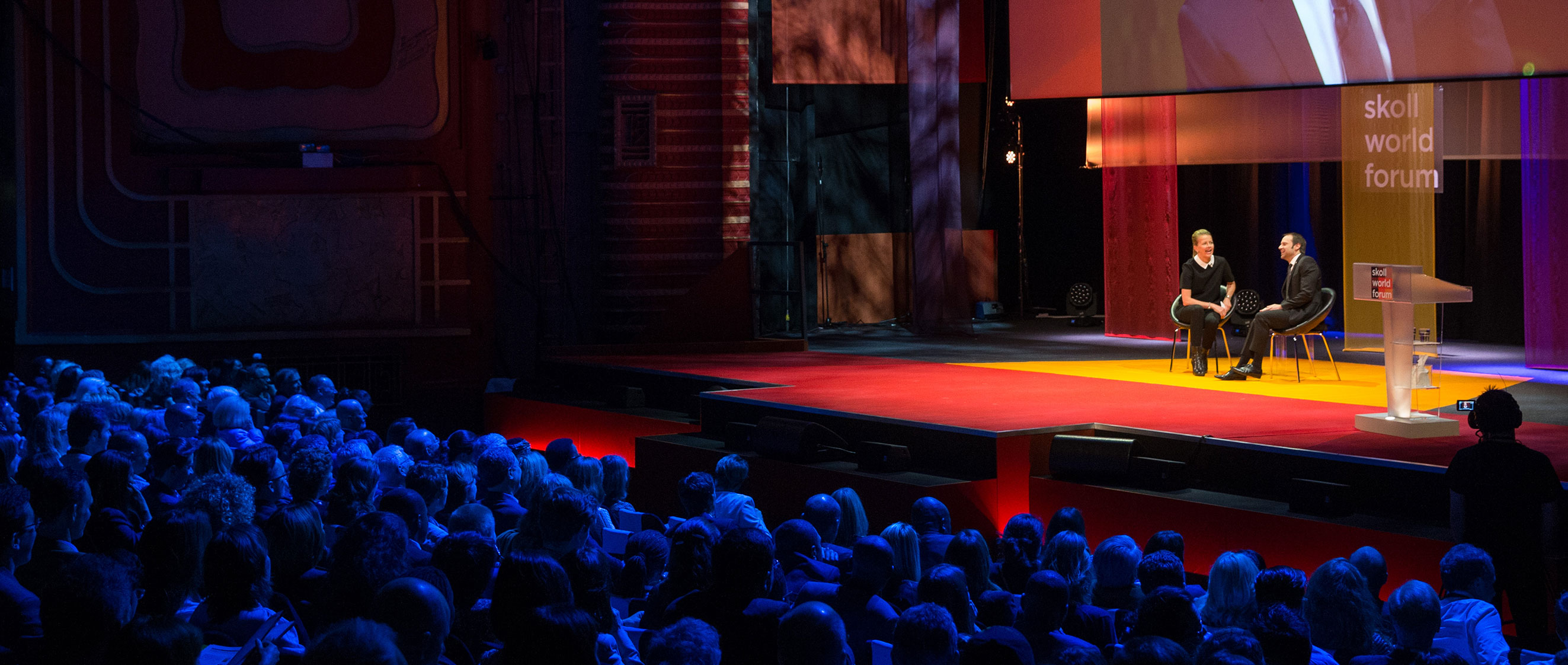
Speaker: Pat Mitchell

President and CEO, The Paley Centre for Media

Pat Mitchell is President and CEO of The Paley Center for Media. Pat has been a network correspondent, a documentary producer and President and CEO of PBS. Her career is characterised by a commitment to optimising the power of media to inform, inspire, entertain and empower. Her work has been recognised with 44 Emmy awards, five Peabody’s, and two Academy Award nominations.

2012 SESSIONS
 

Victors, Not Victims: Women Driving Social Change and Striving for Peace in Conflict Zones

Location: Nelson Mandela Lecture Theatre
Somalia, Sudan and the DRC represent some of the most dangerous places in the world for women and the families they are trying to provide for and protect. Given the paradox that women are a proven, effective entry point for advancing social change and are powerful drivers of peace, how can social entrepreneurs, governments, foreign aid agencies and other funders adapt their own work and contributions to amplify and sustain their efforts? Meet heroic and innovative women who are creating outsized IMPACT in their war-torn homelands—they will tell you exactly what works and why they need you to be there with them.

Speakers: Fahima Hashim, Christine Schuler Deschryver, Eve Ensler, Fartuun Abdisalaan Adan, Pat Mitchell
2010 SESSIONS
 

How To Build A ‘Fierce, Wild Unstoppable Movement And Community’

With an audacious mission, slim staff and $70 million raised to date, V-Day has built a powerful, global movement to end violence against women using an innovative empowerment philanthropy model. Working in 130 countries, V-Day is now launching an unprecedented collaborative initiative in the Democratic Republic of Congo: the City of Joy. Whatever your venture, benefit from a candid nuts and bolts conversation with the founder, renowned author and playwright Eve Ensler. Draw critical lessons from the challenges and successes of this real-world case study in true collaborative impact.

Speakers: Agnes Pareyio, Pat Mitchell
2009 SESSIONS
 

Powerful Women: Shifting The Status Quo

An emerging phenomenon in parts of the developing world is that of women holding power in political structures, including structures previously seen as being the preserve of men. Women also navigate traditional power structures to bring to the fore the economic interests and societal rights of women. Are there robust and sustainable models emerging which can illuminate political, legal and economic power structures? Women share how they brought vitality and hope to their communities.


Speakers: Pat Mitchell, Lungowe Matakala Chishinga, Wu Qing, Sakena Yacoobi
2008 SESSIONS
 

Opening Plenary Of The 2008 Skoll World Forum

The 2008 Skoll World Forum kicked off with a warm welcome from Stephan Chambers, Chairman of the Skoll Centre for Social Entrepreneurship, and Jeff Skoll.

Lord Anthony Giddens of the House of Lords talked about the politics of climate change.

The opening panel was “The dynamics of working cross culturally – experienced voices from the field.Pat Mitchell, president of the Paley Center for Media is the moderator, Panelists included Nafis Sadik, MD, UN Special Envoy for HIV/AIDS in Asia and the Pacific; Karen Tse, founder and CEO of International Bridges to Justice, and Jody Williams, Nobel Peace Prize Laureate, Nobel Women’s Initiative

Phil Hope, MP, parliamentary secretary, Minister for the Third Sector, spoke on Culture, Context and Policy Innovation.

Stephan Chambers gave closing remarks.

Speakers: Lord Anthony Giddens, Nafis Sadik, Jody Williams, Phil Hope, Karen Tse, Pat Mitchell, Stephan Chambers, Jeff Skoll

The Dynamics of Working Cross-Culturally – Experienced Voices from the Field Panel Discusison

Navigating the cross-cultural challenges to achieve the positive social change is very much on the minds of many people in this theater today. It's so much a part of the nature of the work of social entrepreneurship. So it's excellent opportunity for us to hear from three remarkable people who have accomplished positive social change while doing just that, navigating many cross-cultural challenges.

I am going to introduce them briefly because their full bio of accomplishments are in the programs and while each of them has a very hard-earned title, we're also going to speak a little more informally by first names. But let me begin by introducing you to Dr. Nafis Sadik , who is currently the UN special envoy for HIV/AIDS in Asia and the Pacific.

Dr. Sadik is also a special adviser to Secretary General of the UN and she was for many years, the Secretary General of the UN population fund and, was a matter of fact, the person who put together that landmark population conference in Cairo in 1994. Trained in medicine, and with a specialty in gynecology, Dr. Sadik has pursued over the years, the issues of maternal and child health, reproductive and sexual health, and I can't quite imagine any issues in which it would be more cultural challenges in terms of values, norms, deeply held family beliefs.

Can you begin the piece with sharing some specific examples of how you've successfully navigated those challenges in these very important areas.

Thank you, thank you very first and all I must say I'm very pleased to be here in this very impressive hall. Audience, if I don't look at her and speak and I'm suppose to be speaking to Pat I've been told that my voice has to project this way because my microphone is this way. I'm just giving an explanation for my rudeness so to speak.

As you know a large part of my career has been in the United Nations, which by its very nature is multicultural, it's the home of so many, all the countries of the world, and there the whole issue of reproductive health, of reproductive rights, of family planning was a most sensitive and difficult issue to deal with.

And in the U.N. they don't like to deal with sensitive issues necessarily, but on the other hand, the U.N. provides a forum which allows for dialog and debate and comes to agreement in the end on these many of these difficult issues. My own personal experience and the experience that I gained from our organization on this issue of sexual reproductive health was that you had to take culture and traditional values of the society into account and also of the individual, but, but that you also had to have as a principal the international framework of human rights, and therefore you could not allow culture and traditional values to be used to justify behavior that in fact, or actions that you know, discriminated against women or in fact that didn't allow them to have their rights.

Secondly, that unless you also involve the women themselves in the change, it really couldn't happen. Couldn't just be dropped in from the outside because it's a good thing and I thought it was a good thing had to work hard to get women convinced. But to convince the women was not only just family planning, you had get them education you had to get them other health services, and you had to find a way to get them a seat at the table gradually.

And thirdly, that you couldn't work with confrontation I mean, confrontation was easy in our field. I mean, you know, I have given so many speeches full of rhetoric against males and their behavior and how terrible, and you know those are very easy to get, they all about religious leaders and how terrible they are, and every religion discriminates against women, all these come very easily to me, and I did them.

But on the other hand, I also realized that we had to work with these leaders, and that you'd never let it get to the point that it became like, you know, you cut off the dialogue. You had to keep the dialogue open, and I found that in the end, you could really get some tribal leaders, religious leaders, if you pose the problems and the difficulties and then ask them, okay give me the solution.

Okay women shouldn't have access to contraception.
Then, if the women dies, what are you supposed to do? And gradually I found that they started to think about these issues, and in the end, in the U.N. population fund, we found that, you know, every country in the world, in 10 years, had a family plan in program.

including all the countries of Africa, which had in fact, many of them had laws against contraception and so on. So I think you know you have to have courage. You have to have the courage to speak out. You have to take every opportunity to speak out. Never let things just past . I mean, I can give you stories about myself in the U.N., which I won't, but you know.

But you will share the story, I hope, of the bringing the father, the husbands in and telling them the threat to the health of, just quickly one of those stories.

If I can quickly. You know I love talking about this. But you know when I first started in Pakistan. This was before I came to the United Nations and I was really young and looked extremely young in the 50's we didn't have family planning and I worked in a village hospital which was under the sort of patronage of the army and I did paternal and child health for the women in that area, but you know, I did many other things.

Anyway, I asked the commanding officer when I found these women, they were so anemic, so unhealthy, they really shouldn't get pregnant so often, I asked my commanding officer in the hospital, I was a civilian medical officers and said I wanted some money for contraceptive and he really almost fell off his chair.

What? In the army we don't talk about these things. And finally, I tested him so much, he gave me an amount of money and I bought some condoms and diaphragms at that time, which are the only ones available in the 50's and I tried to get the women to use the diaphragms, but of course the women thought I come from Timbuktu and how are they going to decide what they were supposed to do, and then I decided this wasn't going to work and of course, they said the husbands or the mother-in-laws or whatever had to make the decision. And it shows you how out of touch you are with your own society because you're not I took it for granted that if I gave women the contraceptives they would use it.

So finally I decided to get all of the husbands in. And , of course, to describe to the husbands that's why the wives should not get pregnant, was first quite difficult, but anyway they got that message. Then to describe how they should use the condom! That was really quite something, I don't know how I managed in my twenties, one thinks one can do everything, I managed to get them to understand what and then I told them that if any of your wives got pregnant, I would take her off to the hospital with me, and he would never see his wife for at least 2 years, because that was the spacing I wanted.

And they thought that I was mad. And when of course when one wife got pregnant, I did haul her off to the hospital. But of course, returned her in a few months once her anemia was up but then after that, all the men got the message and they came back very embarrassed and said I said you have to sign this agreement with me and to say that you will not get your pregnant.

I wanted to basically...

And finally, they did.
Yeah. I mean, they all did and I mean...

Successful outcome.
It was a successful outcome. It was really brazen of me. When I think back on it, I often wonder how I did I do what I did but what it brought home to me was the fact that you can't just you know like help and family planning, they're so obvious. And you know it's basic. But you can't just make it happen because you think it's a good thing.

You really women's health is so much more entwined with culture, social values, their standard in society and everything else and all decisions are not made by women and unless you get there women to start to understand that they can make the change for themselves, and the families to understand that that change is helpful for not only for her, but for the whole family.

It doesn't happen. So, you know, it's hard work getting social change to happen.

And you just gave many of the dynamics in the lessons learned that do, in fact, result in that social change. Later I'm going to ask her to share a conversation with the Pope about family planning. But let me introduce our next guest, Karen Tse is the founder and CEO of International Bridges To Justice.

This is an amazing organization responsible for promoting and achieving social change and the administration of criminal justice and human rights for prisoners and accused persons. She was trained as a public defender, and then later studied at divinity school and is now minister Tse. And in her work which really began in Cambodia with the interest in finding prisoners in cells awaiting trial.

Karen returned to Cambodia and stayed about eight years and during that time.

Actually, only a couple.

...did an amazing thing during her time there, both in mentoring judges about criminal justice, but also training public defenders. And the International Bridges for Justice has now gone on to accomplish measurable changes in judicial reform in China, Vietnam, Cambodia, and under her leadership recently expanded the program into Rwanda, Burundi, and India.

Certainly those represent diverse cultures, cultures with deeply rooted powers, deeply held beliefs and particularly in the areas of criminal justice, crime and punishment, how does one like yourself go into such a culture, and accomplish the change you've gotten and to bring about?

Well, thank you Pat, and thank you everyone. I guess I could start first by talking about what I did first, which didn't work and sort of led to our understanding of how international bridges to justice should approach our work. Which is about 1994, many years ago when I was working for the United Nations I was at a time where I would see police officers and they would bring prisoners in and sometimes you would see blood dripping down their head.

I was beginning to train police officers. And I remember, because I was trained as a Public Defender, and I was hired as a judicial mentor, as a lawyer, that I first came in and I talked about law. These are the laws. This is what you should do. And you know what? It didn't work, and I couldn't figure it out.

And so I thought about, well maybe since this doesn't work. There's something else and I remember finally realizing maybe I have to move beyond the law. Maybe it's something else and I came across an understanding that what the police officers really wanted to start to understand was how I connected to their values.

So I started doing different training, and I could devise training. We started with - what are your values? Why did you become a police officer? Because I was a public defender before, it was primarily in the beginning training public defenders in Cambodia. I had a very strong bias against police officers, judges, prosecutors.

But I said, OK, what are your values? What did you start? And they began sharing: I became a police officer because I wanted to move forward in society. The Khmer Rouge killed all of my family and we don't want this. So then we were Ok, Great, you have these values. And we would put them up on posters all over the place.

And what do you do now? Oh well, when we bring in the Prisoner, we beat them up, we torture them to get a confession, because, you know, we need a confession. I remember I actually brought into a poster from Tolstoy museum, which is where, you know under the Khmer Rouge they tortured people and one of the rules was before you answer, don't lie or you will get x number of lashes.

I said, Okay. This is the society that you're trying to move away from. These are the values of the Khmer Rouge. And what you're saying is that you want to move forward from this. So is there inconsistency here? Now, so first. they were like, not exactly inconsistent. And we used to start to roll play.

We roll played, someone would pretend that he was an officer and the other was a defendant. And he'd say, well if I didn't commit it, I wouldn't do it. But then they started talking to each other and saying You know what? if we really want to move forward in society maybe there's inconsistency here. And this is really where I began to see that there was a shift in behavior.

And the police officers, that was the first time that they began to change. And from there we began to understand that it's not just about saying this is with the law is, although, I was lawyer, but to say, What are our deeper shared values? and can we go back and reconnect ourselves to it because then we can move forward.

This is such
a good example because there is this growing awareness and need among social entrepreneurs to honor, respect and negotiate with the cultural values except as you have pointed out sometime they must be pushed against to bring change.

And now to to Professor Williams, Jody Williams, we aren't calling each other by first names. It was agreed, but to recognized the statue of the people who have come today to share with us Jody is the founding coordinator of the international campaign to ban anti-personnel landmines. She is now currently the campaign adviser and has gone on to do some other things which I'll tell you about as well. Go back to 1992 when the effort began to ban landmines.

It was at that time 2 NGOs and one staff person which was you. But it very quickly grew to 13000 organizations working across 95 countries. And they did a successful negotiation which, as most people in this room already know, ended up in a treaty - an international treaty to ban landmines in 1997. And 3 weeks after successful negotiating this treaty Jody Williams was awarded the Nobel Peace Price.

Happened before she came to the Skoll forum. But who knows there may be another one in her future. Because of the work that she's now doing because Jody is now started along with some other Nobel laureates. The Nobel women's initiative. And their purpose is to promote and to raise awareness and work for Women's Rights Activist all over the world, organizations eventing peace and justice and equality for women, but let's go back to those years between ninety to ninety seven, working cross culturally in ninety five countries to negotiate in each country a ban against these landmines.

What were the biggest challenges?

Pat and I've talked about this
a bit before, so I was first thinking about growing the campaign from, to which were in the West. One was in Europe, one was in the US so we could call it international. The myth worked. But obviously we couldn't just have the producer countries which is what the West generally was.

We needed the user countries, we needed the victimized countries. So we quickly had to grow to encompass the whole world. It didn't occur to me that it would be a problem. It really didn't, you know. If we have a simple goal of banning landmines, and we're a coalition of independent organizations, how do we get everybody to believe that the campaign is theirs?

That, probably conceptually was the biggest challenge, but it wasn't hard. It just means involving every organization or representative, in the overall strategizing of how are we going to make this go forward. Okay. We want to get a band. What are we going to do in the first six months and when we accomplish that, what will we do next?

And then saying, "Okay, this is our overall strategy, this is what we want to do this year." How are you in Cambodia going to do it? How are you in Angola going to do it? How are you in Afghanistan going to do it? How am I gonna try to do it in the U.S.? And each campaign just caught the, contributed what they could contribute and worked with their own governments based on their own political culture.

Obviously, the Afghan deminers who formed the core of the Afghan campaign, couldn't tell me how to try to deal with the U.S. Administration. Likewise, I couldn't tell the Cambodians, you know, how to deal with the King and the Cambodian government. It was respect for, and trust in, your partners and colleagues that if they really believed in it as much you did they would do what they said they were going to do and my role was literally coordinating.

I didn't see myself as more important, better etc. It was just, tell me what you're doing to advance our common cause, and I will make sure everybody knows so we're all empowered.

But you were so successful, Jody.
There must have been lessons learned that you apply to this global kind of negotiation. Identifying the right allies? Communication, and follow up?

For me, the fundamental was communication.
If you really were a coalition and you wanted to advance your coalition's goals around the world, everybody has have the same information, and this is not, I'm not joking. You know some people who run a global organization or whatever, want to keep the power. They want to be seen as the most important.

That's one technique, but how do you make everybody in your growing coalition believe that what they do matters, if you don't involve them? If you don't make sure that the French campaign knows the success that the Cambodian campaign had last week, so when they go to the French government, they go to Mitterrand, they can say "do you know that the Cambodian campaign went in the streets and got five hundred thousand signatures, in two months, and they moved the King to call for a ban.

Mitterrand what are you going to to?"


And we got it to be a competition, and every time a campaigner would go to their government they could say, "This was done here. This was done there." This government has done this little step. What are you going to do? And everybody felt empowered. Everybody was empowered.

Nobody was more important than anybody else. That was one of most fundamental. The biggest difficulties in communication I would say was about terms. Like social entrepreneur. They, even though we operated in 95 countries and ultimately the language of our campaign was English. And that was accepted.

It was the only way we could move forward. And sometimes there were real difficulties in things that, you know, to me is clearly obvious, right. Even the name. Ban landmines. For some campaigns in different languages it didn't make sense. You know, I think of this social entrepreneurship, which is a relatively new term.

I'm still having a hard time figuring it out. I really am. Does that, am I still an activist if I'm a social entrepreneur, or if I suddenly become a capitalist like I'm confused? Because when I grew up, in my world, capitalism was a little dodgy.

You're going to find out a lot about that I know,over the next couple of days.

I imagine, imagine how do you explain social entrepreneur to Jem of the beehive in Armenia, who was one of my best campaigners?

I think language is a very important issue. You know the whole, you know I had this experience when I was running the conference on population development in Cairo we had this program document, and I arrived in Cairo where the conference was being held and the headlines apparently were, well they wouldn't even dare telling me what the headlines where. I had to get my own interpreter to read it out to me. They said, Well. This is a conference of evil, of promoting free sex and blah, blah, blah. All kinds of things, and what the Sharif of Halad [sp] was condemning this, even though it was in his own country. And I got really quite perturbed because many Muslim countries then didn't want to be associated.

Anyways, I went to the Sharif Halad [sp] and I asked him why was he saying all these horrible things about my conference and the document. So, he said, Oh, well. You know, it's this. It's that. I said, Have you read the document? He said no. I said, Oh, well. How did you? He said, Well. The Vatican told me that it.

All these things. I said, the Vatican participates in the conference? I'm not quite sure how, you know, because they are members, how they can say all these things. I sent him a copy of the document. And, you know, the Arabic translation. And then he went through all the words, and said to me, well you see, reproductive health means in our, in the translation, giving sexual services, sexual and reproductive health.

Oh, and then we have to change it and it took a long time to find some Arabic word. Empowerment of women had a negative connotation for women. Empowerment of men, he said was fine, but empowerment of women in the Arabic language, was sort of anathema to them. Women can't have power. And it took a long time to get some words which, you know, I have to get many other translators to make sure that they were the right word.

But the term reproductive health also has difficulties. Even the Japanese still use reproductive health. And even in French, empowerment of women is not so easy to translate. So I think language is very important when you're working on a global issue. And of course for us it was too late, and in the end sexual reproductive health has become part of the lingua franca in many countries.

In Pakistan, you will hear reproductive health. In Sudan, you will hear reproductive health. And you know, it's starting to with that local language but they just use it but empowerment of women is still an issue in the translations.

So, you're really getting the language right is very important. And then also the beginning of common ground. With you, it was a common goal. With you, it was common values. With you, it was Health-, health is a shared.

The right of women to have health and to have some control over their own decision making in health, especially in the area of sexual and reproductive health.

Let's talk about some other barriers that are a part of cross cultural work, but also a part of just being who each of you are I think of you, Karen, going into these countries, and going into the prisons, into the courtrooms, into places where you bring your own cultural or at least other people's perceptions of cultural stereotypes.

How how hard do you push? When do you step back? When do you, how do you... how far can you go and how much of it is the way that people are judging you?

I'll probably answer in a way that might surprise you. It might surprise everyone which is to say that oftentimes people have asked me, "Wow, you go into these places, and these stereotypes. You're an Asian woman, you're going to these countries, there might, must be strong stereotypes against you." And, and I'll tell you honestly the place that I have the most difficulty is not in Asia, is not in Africa, its actually within the western world.

You said yes because, and the funny thing is because there is an overt bias in certain places like Asia where it's so overt that you can address it. You can all it on its name and you can laugh because it's so ridiculous. What's much harder to battle is a sort of a subconscious bias where you have to you know prove your whatever, where you're invalidating did but it's not really a conscious, conscious bias.

And, and, what's interesting to me too, is that, and it may be also because when we go into certain places. We have a different mind set. For me when I am walking into a prison or working with the ministry of justice or going into places, I always remember the story of the Shambhala warrior. Do you know the Shambhala warrior?

Well there's a, there's a story, and this was when I was ordained as a minister, whereby, You know there's a, this, it may be a fable. But there's these warriors who are about to go out and save society. It is a very, very dangerous time in society and so, they go to To a process and a ritual. And at the end of the ritual they come because they're about to go out into the world to save the world.

And they're told. If you really want to save the world, and walk into the very corridors of power, there's only two things you need and these two things only. If you remember them, you will succeed. And that is, number one you must have compassion, and number two, you must remember our interconnectedness.

And I feel very strongly that almost every place that we've gone, people are like, "Wow. How did that happen? Why are we in the prisons of Burundi, or you know, why are the doors opening here?" It, it's almost like a miracle, but it's not really a miracle, it's because we're able to connect to something universal within each other that moves us forward.

And so that is why I think in many places the perception is going into some of these places would be difficult. And that's a piece of cake. What's more difficult is subconscious bias. And having to, you know, be questioned in terms of your authority or leadership on a very subconscious level and that's the much harder battle, but we can handle it.

Do you identify with that, Jody?

Yeah. In some ways. I mean I think about the different kinds of cultures too, it's not just cultures of different countries. Then as I thought more about what we talked about before is thinking about the difficult cultures that we had to deal with in campaign was the military culture. Was the, you know, the culture of not government so much as the diplomats who historically negotiate disarmament treaties and they have, this is the way you do it.

Civil society is not there and trying to bridge the gap to their humanity. Trying to make them step outside of their diplomatic suit. And I used to challenge them quite literally that way. Yes, you're a diplomat. Take off your tie. When you go home at night, and you look at your children and your wife.

Do you want to consider them stepping on a landmine? You know, when you are negotiating this piece of paper and changing a comma, and think you've done a great day's work on a treaty you haven't, unless you connect to the humanity of the issue here, you've done nothing of merit. The same with the military, you know?

Debunking the mythology that because they're the military, they're the experts . And they have some like special information that we lowly citizens don't have. It's like, excuse me. I may have to be a rocket scientist to build the nuclear bomb. I do not have to be a rocket scientist to understand that nuclear weapons are indiscriminate , evil, wrong, and must be banned.

That does not take genius. Thank you! And, but, and for me as a woman, I worked in Central America longtime before I worked on weapons, I just acted like I'm a human being, you're a human being. So what I'm a girl. If you have a problem with it, it's your problem. Get out of my way. And that's not very touchy-feely, I know.

So, I'm not quite as sweet as she is. Just because you get the Nobel Peace Prize you do not become Mother Theresa.

And you are certainly a A good example of pushing of the lines, pushing the barriers, but obviously maintaining a certain level of respect because that's necessary to continue the work and yet all three of you are certainly illustrate how important it is to stay committed and passionate while facing these barriers and it's time for the Pope story but you're gonna have to, I mean, I'm just trying to imagine this.

You sitting down with the Pope to talk about reproductive and family planning. Reproductive health, sexual health, and family planning.

I 'm not sure that I'm supposed to talk about my meeting with the Pope, but anyway, here it is. You know when were doing the Cairo conference, I was very keen to have the Catholic church also be part of the consensus. So I worked very hard with the church and they sent many delegations to New York to negotiate with me.

I read every speech the Pope had ever made about natural family planning and so on. And the arguements went on and on. And they kept saying to me that you must understand. You're so clever and. kept repeating this argument to me. It was in the higher good and you know, I said I just. This is all gobblety-gook to me.

I don't really understand what you're trying to say. If you say that, you know, the sexual act is only for procreation, I can understand that. But if you say, well you can have sex and plan your family which is what natural family planning tries to do, then I don't understand why we can't use modern methods because in the scientific just didn't make sense to me.

Anyway, to cut a long story short, in the chapter on fertility and family planning, we decided that we would have. There is already an agreed, and I was thinking about Jody when this was agreed. The recommendation that is agreed everywhere that all couples. Individuals and you wonder why we got all couples and individuals instead of all individuals.

This was inserted by the Holy Church, because they wanted only couples and then everybody else in the world wanted individual to have the right to decide freely and whatever.

Compromise.

Yes, the compromise with all couples and individuals and people often ask me you know why is peculiar formulation anyway, that was the reason. But in the section on that I decided that we wouldn't mention any methods of contraception, but that all couples should have the information and the means and that it was the responsibility of countries to provide that, but the decision on whether to get married or not to be married.

Whether to have children or not to have children or how many children to have should be left to the individual and especially to the individual woman and you know there was a lot of emphasis on women having more in decision making. And I thought that would be very much acceptable to the holy seed because it didn't mention any methods, you know.

So, I went to see the Pope with this expecting to come out triumphant. Instead the Pope started by saying, "This is the year of the family." And I said, "Yeah, it is, but you know, I'm here for the International Conference on Population and Development." He said no, why have you taken this different approach, which is going to lead to the destruction of the family.

And I'm not quite sure, you know, what does that mean. So he said well why have we taken this individual rights approach. I said, "Well. What other kinds of rights are there? I mean that will be individual human rights." He said, "No. There are couples rights." They are and they must be based on religious, natural, and ethical principals.

Not on and the way I had done it. And I said well, what I am presenting is what is based on science, and development, and you know, what we think should be. He said no. There can be no other way of addressing this issue except the religious etcetra. So, then we continued with the discussion. And I said, but whose religion is to be, you know, because there's so many religions in the world.

He said, "No, there is only one, the natural law." etcetera, etcetera.

So, there are certain things you don't compromise.

You see and then on women etc., I mean to try to make call my case about women, and adolescence, and etc., and if my children and your children got whatever, behaved in a way you didn't agree but your values may be different to your children's values but yet you don't want your children to be, you know for your girls to be pregnant or to not have the opportunities or to get infected with HIV etc, etc, but he was totally, totally unconvinced.

So, I decided that you know, that was a total failure as far as I was concerned. I mean as much as I tried I could not convince the policy that should support contraception for a higher cause. And even though they talked about the sanctity of marriage, the sanctity of life, but in the case of HIV/AIDS they were not prepared to make that compromise and in the end I left with the Pope being very unhappy with me and I suppose being very unhappy with him as well.

Well, i ask to share that because many of the social entrepreneurs are going to go up against authority. They're oing to go up against powers that are quite persuasive, but having reasons to The Pope, what he said, I asked him. I said, "How many people do you think in the Catholic religion follow your teaching?" And his response was, "They all do except those materialistic societies of Europe and North America." And I said to him that that is totally untrue because the whole of Latin America has the highest number of abortions in the entire world.

I mean the percentages terms to the pregnancy. So they're certainly They may be following your teaching on family planning, contraception, but they're committing, perhaps, it should be, in your eyes, a greater evil. And he said, "Oh no. that was because women choose to do what they did when they could do to when they could choose to do whatever they wanted they were choosing this."

And so, you know it was like a closed mind and I think they have some, like many other religious leaders, I don't want to talk about the Catholic church, only many religious leaders have this thing about women, that they must be in the home looking after the men. And the family disintegration is due to women when in fact, it's not.

Women, as I was explaining to him, and which he said to me and I said, "Women look after their children. They spend all their life, you know, working hard." Men, I mean leave their children and go on to marry other families and so on, and maybe leave those as well.


We may not find ourselves, most of us will not find ourselves arguing with the Pope about family planning. But it's a good example of the challenges that you do face when you are trying to honor and respect religion, values and but to push against the ones that are, as you say, holding back the health.

But in the end the Catholic church joined the consensus in Cairo, by the way which was something I mean and so I used it to say that they supported family planning, which the holy seed kept reminding me of that they did not and I said who knows that because you joined the consensus in Cairo with supported family planning and all I'm saying is I didn't say you support family planning.

I say you join the consensus at Cairo which implies to people that you support family planning.

Well, I was going to say the other lesson from that was to make sure you have your facts right, which you did with latin America in fact. Can you think other lessons too, Karen, times that when it really felt almost impossible to push against the system to bring about the reform that you were fighting so hard to do and did.

Well again, this answer might surprise us but really what I found is that one is that the hardest, the biggest challenge for us has not been the countries. Has not been the governments. Has not been the police. Has not been the judges. It's actually been the West. Okay.

Right now, there's 113 countries that torture, probably at least 113 named. they're 93 countries that actually have laws on the books that say it's illegal to torture and that you have a right to council. And since we started in China, Vietnam we started receiving request from virtually every corner in the world.

We're defenders throughout said. We have the exact same problem. Can you come help us? We have laws on the books, but we're in danger ourselves. And we need help. Now that the phenomenal thing is here's the defenders. They're courageous. They're saying we've got it. We are the seed of hope, but I've got the West and we've got the culture that says, "Wait a minute, wait a minute, we're not sure we want to be Western imperialists and come do too much here."

It's almost like culture is working against culture. And we have a very superficial analysis of culture, which prevents us from moving beyond. I think we have stop if we really want to do the work, we have to stop beyond the serve superficial view of culture and say since what we noticed is that culture culture across countries.

The defenders throughout the world have a similar culture. A defender from Burundi may have the same experience because he is in danger, has no access to his clients, as a defender from Cambodia. There is something in a shared experience, and this defender, she may feel more connected to the defender in India than a judge in her own country.

And so there's shared experiences that we have to draw from and understand. And then as a community, and this is why I think social entrepreneurship is so exciting, we have a culture of hope. Social entrepreneurship. We have a culture of doing the impossible because there's an X factor and I'm aware of the fact that we're at a business school and business things are wonderful.

And, and at the same time it can't just be that, because we are a variable. People are a variable. Nothing is static. You can't sit there and do an analysis and say, "Oh, we can't go to that country, we can't go to that country," which is what we hear all the time, because there's a problem. If you can plant a seed of hope, If you can make it happen, the defenders who stand up, we gotta say, we'll give you what you need.

We'll support you to make this a reality because you can't define what that. We are variable. The world is not static. Culture is not static. There's a culture of choice and we are all a part of that story. We are creating history. We create culture. We've got to make it happen.


I can't think of a better way to end this panel.
 
2007 SESSIONS
 

Opening Plenary Of The 2007 Skoll World Forum

OPENING MUSIC
Salman Ahmad, Pakistani musician, UN Goodwill Ambassador HIV/AIDS, and founder of Junoon, South Asia’s most popular rock band

WELCOME
Stephan Chambers - MBA Director and Fellow of Saïd Business School, University of Oxford, Forum Moderator

OPENING REMARKS
Jeff Skoll - Founder and Chairman, Skoll Foundation and Participant Productions

OPENING REMARKS
John Hood - Vice Chancellor, University of Oxford

SOCIAL INNOVATION – WHAT IS IT, WHY IS IT IMPORTANT, WHAT ARE THE BARRIERS, HOW CAN IT BE ACCELERATED?
Geoff Mulgan - Director, The Young Foundation
Rushanara Ali - Associate Director, The Young Foundation

QUEEN RANIA OF JORDAN

SOCIAL INNOVATION – THE NEW PHILANTHROPISTS
Charles Handy - Writer, Broadcaster and Social Philosopher

THE CREATIVE IMPULSE: AN ECONOMIST’S ACCOUNT OF THE VERY DIFFERENT PATTERNS OF PERSONAL CREATIVITY
David Galenson - Professor of Economics, University of Chicago

NOBEL LAUREATE MUHAMMAD YUNUS IN CONVERSATION WITH PAT MITCHELL
Muhammad Yunus - Founder, Grameen Bank
Pat Mitchell - President and CEO, Museum of Television and Radio

CLOSING REMARKS
Stephan Chambers

Speakers: Geoff Mulgan, Muhammad Yunus, Salman Ahmad, John Hood, Rushanara Ali, Charles Handy, David Galenson, Queen Rania of Jordan, Pat Mitchell, Stephan Chambers, Jeff Skoll

Muhammad Yunus & Pat Mitchell at the Skoll World Forum 2007