Fri, April 01, 11:00 - 12:30
2011 | Influences
Developments in the global economy, business, demographics, science and technology will define what the world looks like in 25 years. How will these trends shape the complex environment for those working to create large scale change? Daniel Franklin, Executive Editor of The Economist and the acclaimed ‘World In’ series, will host leading thinkers and futurists in a session about megachange over the next 25 years with an emphasis on drivers and inhibitors of social progress.
Videos
What’s next in 25 years? Daniel Franklin’s take
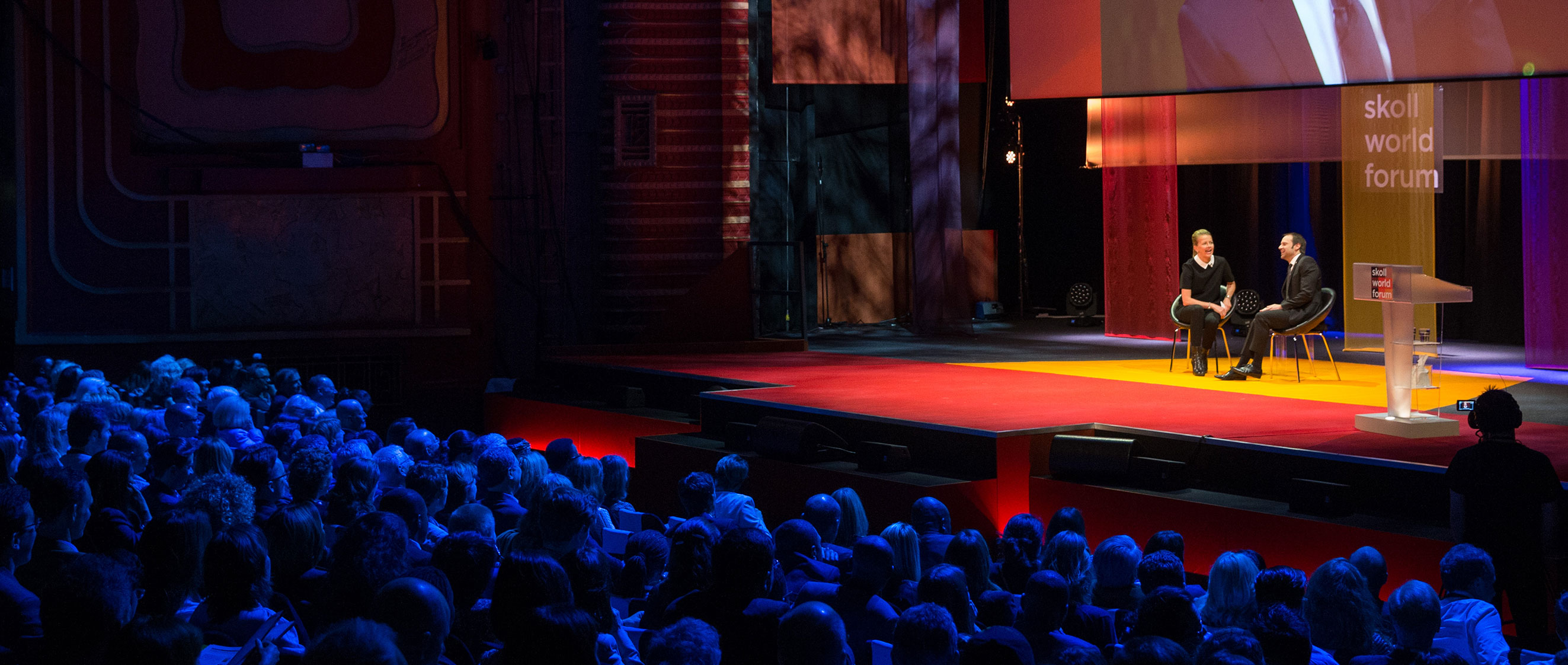
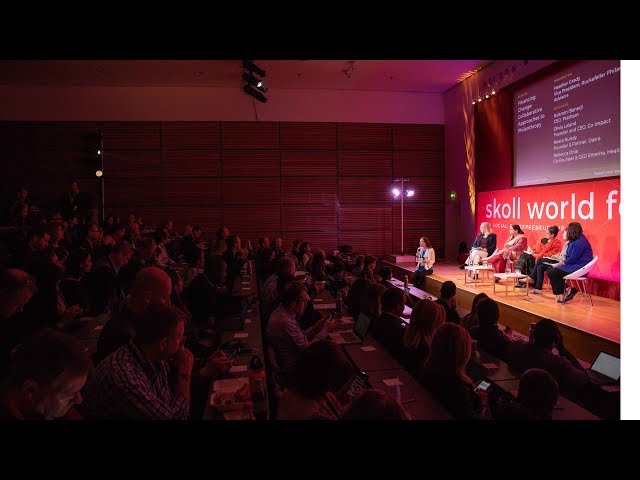
Daniel Franklin, Executive Editor of The Economist, speaks at the Skoll World Forum 2011. He shows two short videos and talks about the themes of the next 25 years.
With: Daniel Franklin
So thank you very much, I am Daniel Franklin from the Economist and that's what I'd like to thank for wonderful collaboration on this session delighted to be here I am asked as all moderator have to ask you please turn off your mobile phones. But feel free to tweet or engage in social media during the session.
Our focus here, I guess, central entrepreneurship is all about trying to make the future better. So our focus here is all about looking at a longer term future, the next 25 years or so, and to try to peer. Do the impossible job of peering into what it might look like and what we might do to influence it.
And just This is a little taster of a beginning. We're going to show two very short clips. We took our cameras. to two places that are in different ways, very different ways at the frontier of the future. So here we go. First of all, let's take a look. That is a little farther out but I also am vocal and I am seeing that they're probably going to find ways in order to perhaps colonize space, and be interacting in the space environment more, and that'll change our global perspective quite a bit.
I believe that Antartica actually will become more accessible to the general population, not just researchers and not just explorers. People will see more of Antarctica and experience Antarctica in more of a first-hand way than they have ever done before. That'll be easily done in, you know, 30 years or so.
So it'll be a continent that's not so isolated so much anymore. With that There's probably going to be some social political ramifications that'll have to be dealt with in 30 years. The past five years have already seen a big change here, so it is impossible to think what it will be like in 25 years.
In Shanghai by the way.
I can only imagine it will be very good. From twenty five years, these buildings will probably have to be torn down to expand the rules. The rules are too narrow here. China will be number one. It will take the place of the UI. I think that all of China and all the world will be destroyed in the future.
25 years, the rich will get richer, the poor will get poorer, and I think that the war economy will shift towards Asia, as it develops, the Asian economy will be doing better. If the earth still here in 25 years, I hope that we can feel free to do whatever we want and that we can have the aliens take us traveling, if they choose us.
I just hope they don't destroy us. I hope in 25 years My child will be able to enjoy his life. I want him to peaceful and healthy. I don't hope that he lives an extravagant lifestyle. Actually, for those of us, the migrants, our biggest wish is just to be able to go home soon. In 25 years I think it will still be peaceful in China, not a like other countries, as long every country minds their own business, it will be fine.
Twenty five years from now China will definitely be the strongest in the world I know this because we believe in ourselves. You can't just say who will be award leader in 25 years. You have to look at how democratic advanced and unified the country can become. Every country is the same, it's just how well, they compete in the peaceful war.
I think some fascinating views there. I love the way that the youngest person shown is the most pessimistic. Slightly changes the stereo type. what I'm going to do in the next ten to fifteen minutes is give a view of, a sort of framework for the next twenty five years, some of the big things that seem to me to be important in thinking about the next twenty five years, and then we're going to have two further short presentations and then a panel discussion in which I hope all of you will take part as well.
So that is what we are going do. A quick look at some of the themes for the next 25 years. Ten of them very quickly. First of all the economy, as you might expect from the economist. This is a notional E7,Emerging Market Seven country growth versus the G7 country growth. The blue line at the top of the emerging markets, the red one at the bottom, the rich world and it just shows what you all know that the likely course of growth of the coming 25, 30 years is going to be much more rapid growth in the emerging markets.
This was a chart from the Economist a few months ago, and I think it's very enlightening. It shows that, in a way, this pattern that you are seeing, the rise of Asia that you heard that person from Shanghai talking about, is a return to normality, that for most of human history, Asia was actually by far the biggest economic area in the world.
You then have the Industrial Revolution. You have first of all Europe and then the United States coming up and Asia falling behind, and now just in recent times you have Asia coming up again and returning what you might call to its rightful place as the most sizable chunk of the world economy. I think that's a fascinating long, long term perspective.
Within Asia itself, just a reminder, this shows this Mount Fuji like shape shows Japan, which at twenty... thirty years ago was soaring off as a share of the US economy, and then it hit the top, the peak Think of Mount Fuji if you like, it started to come down, and now you have China coming up, and as you all know, you've have read in the papers just recently overtaking Japan to become the second biggest economy in the world and I think there's every prospect that China will continue that pattern and continue to become actually right up to overtake America as the worlds biggest economy.
So the Asia, becoming the biggest region in the world, but within Asia, lots of change happening as well. Second big theme, and this will be very familiar one to you, population, of course this influences so much of the challenges, the social change going on in the world. This shows how quickly the world's population has grown.
It was only around 1800 that the humanity reached one billion. This year we're probably going to pass the landmark of seven billion and then plateau around nine, nine and a half billion. around the middle of the century, so the period between each successive billion has become drastically shorter.
I think this is just interesting thing to look at very quickly because it shows over the longer period where these people are, and if you look back to 1950 you see was about a fifth of the world's population over a fifth of the world's population. Africa was under a tenth of the world's population and that's reversing as you look forward.
Europe is going to be under a tenth of the world's population. Africa more than a fifth. Actually Asia's share is pretty much stays constant, so the great switch between Europe and Africa, in terms of share of population. And then within that the trends again this will be very familiar to you. Rapid aging, huge consequences of that.
Some countries actually seeing their populations shrink, which is typically in the developed world and the rich world, but also Russia. We just had results from the latest Russian census and a dramatic picture is emerging there. And then age-dependency ratio is changing very rapidly, including in China because of its...
influenced heavily by its one child policy. But in other places, a dramatically different picture of very young population and all the challenges that that brings - and opportunities, but also challenges. A third big theme, again a familiar one to globalization, this is just by way of showing that globalization is, I believe, evolving and will continue to evolve.
You could very crudely categorize globalization as coming in various stages. It's evolved from a model where Western businesses would go out and do business in the developing world. Now we talk about emerging markets, they are in many cases emerged. And in many cases it's a question of basing your production wherever the resources are best available,where ever the talent is most available, and where ever it makes most sense.
And that can be anywhere in the world to base production. So, it's a much more if you like genuine phase of true globalization, where you can do almost anything anywhere. But the future remains uncertain. There could be resistance to that trend and you could find anti globalization trying to put various aspects of this into reverse.
For team is that of freedom and it's interesting if you look back in the decades how rapidly the number of countries in the world is actually increased. We sort of take this for granted now, but actually with the end of colonization and with the collapse of some countries such as some federations such as Yugoslavia and the Soviet Union, the number of countries grew and the freedom in the world, as measured for example by Freedom House, also expanded.
In recent years, that freedom, according to those measures, has tended to plateau. There's been in some cases indeed a sort of falling back of levels of freedom. But I think what's interesting is to look into the future and say, "Well, this process of splitting up countries may still have further to go and a big open question is, What about the level of freedom in the world?" Are we going to continue the recent trend of a plateauing or going backwards, or, as recent events in the Middle East suggest, are we in for a new era of spreading freedom to parts of the world that haven't really experienced it until now?
Another huge question is that of war and peace. Perhaps you could say it's one of the most fundamental questions of all. There's been a big rise in peace keeping as you can see from this chart, and the good flip-side of that is there's been a fall generally over the recent decades in the numbers of deaths through conflict through the world.
It's not what you would think when you pick up the newspaper in the day, in the morning. Probably you get the opposite impression, but the overall trend actually has been a reduction of death through violent conflict. And, of course, the great hope would be that would continue over that trend would continue over the next twenty five years.
Social change, well this is what you are all about at this forum, but just a couple of covers from recent years in the Economist that show how dramatically things have and are changing. I think this, few would of expected to see that sort of the cover on the Economist decades ago, here's another one packed even more important for effecting change throughout the world, the role of women in the workforce which has changed dramatically in many parts of the world.
Half the work force, more than half in America, and that has the power to change things enormously right around the world. Technology, obviously a crucial agent of change. This chart just shows that the cross over point of between where Mobile, telephones over took landlines and that has been a giant shift enabling also another social change in the world.
Here's a cover that we had recently in the economist talking about 3D manufacturing, which may be a coming revolution in the way that industry is organized, which could again have huge repercussions for or what is done where and how it's done, what becomes possible. So, I don't know whether it will be this, but our other areas of technology that will be the most influential.
This is to say that technology is a driver of change is obviously going to absolutely fundamental. In the corporate world, this is a little playful way of saying that the rate of change of corporate...the corporate hierarchy, if you like the corporate churn, has if anything speeded up. And you have companies like Google, like Facebook, like Twitter, which come from almost nowhere to become giants.
So this is a little view of the future, what sort of companies might be the biggest 10 in the world by then. Well, it's no longer just energy, it's water that is scarce resource, so you have Exxon/Hydro as being the biggest. Tartar manages to buy Microsoft, so you have Tartar Soft. The sovereign wealth funds are hugely important.
Qatar is actually the fastest growing economy in the world right now, Qatar Holdings. This company called GGS, formerly known as Google Goldman Sachs, you know, the...China of course dominates the world of automotive manufacturing. Then you have I won't even bother to pronounce that, but it's the logical extension of what you see in the pharmaceutical world.
Education hugely important, and these are the two giants getting together, Oxbridge, Harvard. McTwitter, well, McDonald's realized that burgers weren't really the way of the future so they had to get tweeting and McTwitter was the result. Apple and News Corp got together, and, of course, Hollywood and Disney is the logical end of the entertainment world.
Global warming, climate change generally...I can't talk about big themes in the world without mentioning it. And I think whatever you think will happen there, the world is going over the next 25 years to be very busy either with trying to reduce climate change or reduce the degree of global warming that may otherwise happen or going to be very busy adapting to the climate change that is happening because we failed to reduce it as much as we had hoped to do so.
So obviously will we have planed to talk about in the future is absolutely fundamental I am in very lastly, just to show that, of course twenty-five years ahead, so much can happen, in the world in 2011, and annual publication from the Economist which I edit. I asked, because it was our 25th anniversary edition, I asked various thinkers to come up with some ideas xx is what they thought might happen in 25 years here are the few of them, you can see they range from the world being right through made any religion.
xx saying "Well, maybe someone will run 100 meters in nine seconds flat". So there you are, I hardly need remind you in this sort of future gazing, there are huge amounts of uncertainty. There's a line on that chart that says the line of on that palm that says the line of humble pie and a lot that you say of course will turn out not to be correct.
But that's not gonna stop us today We're going to be prepared to peer into the future. A lot of it, even given the uncertainties, has to do with the way, the mindset that you approach this future with, and I think that's a lot to do with what this forum is about, and to speak somewhat to that in the next fifteen minutes or so is Steven of business school who has a way of changing the way you think about things, and I think you'll see why in a moment.
Steven.
Our focus here, I guess, central entrepreneurship is all about trying to make the future better. So our focus here is all about looking at a longer term future, the next 25 years or so, and to try to peer. Do the impossible job of peering into what it might look like and what we might do to influence it.
And just This is a little taster of a beginning. We're going to show two very short clips. We took our cameras. to two places that are in different ways, very different ways at the frontier of the future. So here we go. First of all, let's take a look. That is a little farther out but I also am vocal and I am seeing that they're probably going to find ways in order to perhaps colonize space, and be interacting in the space environment more, and that'll change our global perspective quite a bit.
I believe that Antartica actually will become more accessible to the general population, not just researchers and not just explorers. People will see more of Antarctica and experience Antarctica in more of a first-hand way than they have ever done before. That'll be easily done in, you know, 30 years or so.
So it'll be a continent that's not so isolated so much anymore. With that There's probably going to be some social political ramifications that'll have to be dealt with in 30 years. The past five years have already seen a big change here, so it is impossible to think what it will be like in 25 years.
In Shanghai by the way.
I can only imagine it will be very good. From twenty five years, these buildings will probably have to be torn down to expand the rules. The rules are too narrow here. China will be number one. It will take the place of the UI. I think that all of China and all the world will be destroyed in the future.
25 years, the rich will get richer, the poor will get poorer, and I think that the war economy will shift towards Asia, as it develops, the Asian economy will be doing better. If the earth still here in 25 years, I hope that we can feel free to do whatever we want and that we can have the aliens take us traveling, if they choose us.
I just hope they don't destroy us. I hope in 25 years My child will be able to enjoy his life. I want him to peaceful and healthy. I don't hope that he lives an extravagant lifestyle. Actually, for those of us, the migrants, our biggest wish is just to be able to go home soon. In 25 years I think it will still be peaceful in China, not a like other countries, as long every country minds their own business, it will be fine.
Twenty five years from now China will definitely be the strongest in the world I know this because we believe in ourselves. You can't just say who will be award leader in 25 years. You have to look at how democratic advanced and unified the country can become. Every country is the same, it's just how well, they compete in the peaceful war.
I think some fascinating views there. I love the way that the youngest person shown is the most pessimistic. Slightly changes the stereo type. what I'm going to do in the next ten to fifteen minutes is give a view of, a sort of framework for the next twenty five years, some of the big things that seem to me to be important in thinking about the next twenty five years, and then we're going to have two further short presentations and then a panel discussion in which I hope all of you will take part as well.
So that is what we are going do. A quick look at some of the themes for the next 25 years. Ten of them very quickly. First of all the economy, as you might expect from the economist. This is a notional E7,Emerging Market Seven country growth versus the G7 country growth. The blue line at the top of the emerging markets, the red one at the bottom, the rich world and it just shows what you all know that the likely course of growth of the coming 25, 30 years is going to be much more rapid growth in the emerging markets.
This was a chart from the Economist a few months ago, and I think it's very enlightening. It shows that, in a way, this pattern that you are seeing, the rise of Asia that you heard that person from Shanghai talking about, is a return to normality, that for most of human history, Asia was actually by far the biggest economic area in the world.
You then have the Industrial Revolution. You have first of all Europe and then the United States coming up and Asia falling behind, and now just in recent times you have Asia coming up again and returning what you might call to its rightful place as the most sizable chunk of the world economy. I think that's a fascinating long, long term perspective.
Within Asia itself, just a reminder, this shows this Mount Fuji like shape shows Japan, which at twenty... thirty years ago was soaring off as a share of the US economy, and then it hit the top, the peak Think of Mount Fuji if you like, it started to come down, and now you have China coming up, and as you all know, you've have read in the papers just recently overtaking Japan to become the second biggest economy in the world and I think there's every prospect that China will continue that pattern and continue to become actually right up to overtake America as the worlds biggest economy.
So the Asia, becoming the biggest region in the world, but within Asia, lots of change happening as well. Second big theme, and this will be very familiar one to you, population, of course this influences so much of the challenges, the social change going on in the world. This shows how quickly the world's population has grown.
It was only around 1800 that the humanity reached one billion. This year we're probably going to pass the landmark of seven billion and then plateau around nine, nine and a half billion. around the middle of the century, so the period between each successive billion has become drastically shorter.
I think this is just interesting thing to look at very quickly because it shows over the longer period where these people are, and if you look back to 1950 you see was about a fifth of the world's population over a fifth of the world's population. Africa was under a tenth of the world's population and that's reversing as you look forward.
Europe is going to be under a tenth of the world's population. Africa more than a fifth. Actually Asia's share is pretty much stays constant, so the great switch between Europe and Africa, in terms of share of population. And then within that the trends again this will be very familiar to you. Rapid aging, huge consequences of that.
Some countries actually seeing their populations shrink, which is typically in the developed world and the rich world, but also Russia. We just had results from the latest Russian census and a dramatic picture is emerging there. And then age-dependency ratio is changing very rapidly, including in China because of its...
influenced heavily by its one child policy. But in other places, a dramatically different picture of very young population and all the challenges that that brings - and opportunities, but also challenges. A third big theme, again a familiar one to globalization, this is just by way of showing that globalization is, I believe, evolving and will continue to evolve.
You could very crudely categorize globalization as coming in various stages. It's evolved from a model where Western businesses would go out and do business in the developing world. Now we talk about emerging markets, they are in many cases emerged. And in many cases it's a question of basing your production wherever the resources are best available,where ever the talent is most available, and where ever it makes most sense.
And that can be anywhere in the world to base production. So, it's a much more if you like genuine phase of true globalization, where you can do almost anything anywhere. But the future remains uncertain. There could be resistance to that trend and you could find anti globalization trying to put various aspects of this into reverse.
For team is that of freedom and it's interesting if you look back in the decades how rapidly the number of countries in the world is actually increased. We sort of take this for granted now, but actually with the end of colonization and with the collapse of some countries such as some federations such as Yugoslavia and the Soviet Union, the number of countries grew and the freedom in the world, as measured for example by Freedom House, also expanded.
In recent years, that freedom, according to those measures, has tended to plateau. There's been in some cases indeed a sort of falling back of levels of freedom. But I think what's interesting is to look into the future and say, "Well, this process of splitting up countries may still have further to go and a big open question is, What about the level of freedom in the world?" Are we going to continue the recent trend of a plateauing or going backwards, or, as recent events in the Middle East suggest, are we in for a new era of spreading freedom to parts of the world that haven't really experienced it until now?
Another huge question is that of war and peace. Perhaps you could say it's one of the most fundamental questions of all. There's been a big rise in peace keeping as you can see from this chart, and the good flip-side of that is there's been a fall generally over the recent decades in the numbers of deaths through conflict through the world.
It's not what you would think when you pick up the newspaper in the day, in the morning. Probably you get the opposite impression, but the overall trend actually has been a reduction of death through violent conflict. And, of course, the great hope would be that would continue over that trend would continue over the next twenty five years.
Social change, well this is what you are all about at this forum, but just a couple of covers from recent years in the Economist that show how dramatically things have and are changing. I think this, few would of expected to see that sort of the cover on the Economist decades ago, here's another one packed even more important for effecting change throughout the world, the role of women in the workforce which has changed dramatically in many parts of the world.
Half the work force, more than half in America, and that has the power to change things enormously right around the world. Technology, obviously a crucial agent of change. This chart just shows that the cross over point of between where Mobile, telephones over took landlines and that has been a giant shift enabling also another social change in the world.
Here's a cover that we had recently in the economist talking about 3D manufacturing, which may be a coming revolution in the way that industry is organized, which could again have huge repercussions for or what is done where and how it's done, what becomes possible. So, I don't know whether it will be this, but our other areas of technology that will be the most influential.
This is to say that technology is a driver of change is obviously going to absolutely fundamental. In the corporate world, this is a little playful way of saying that the rate of change of corporate...the corporate hierarchy, if you like the corporate churn, has if anything speeded up. And you have companies like Google, like Facebook, like Twitter, which come from almost nowhere to become giants.
So this is a little view of the future, what sort of companies might be the biggest 10 in the world by then. Well, it's no longer just energy, it's water that is scarce resource, so you have Exxon/Hydro as being the biggest. Tartar manages to buy Microsoft, so you have Tartar Soft. The sovereign wealth funds are hugely important.
Qatar is actually the fastest growing economy in the world right now, Qatar Holdings. This company called GGS, formerly known as Google Goldman Sachs, you know, the...China of course dominates the world of automotive manufacturing. Then you have I won't even bother to pronounce that, but it's the logical extension of what you see in the pharmaceutical world.
Education hugely important, and these are the two giants getting together, Oxbridge, Harvard. McTwitter, well, McDonald's realized that burgers weren't really the way of the future so they had to get tweeting and McTwitter was the result. Apple and News Corp got together, and, of course, Hollywood and Disney is the logical end of the entertainment world.
Global warming, climate change generally...I can't talk about big themes in the world without mentioning it. And I think whatever you think will happen there, the world is going over the next 25 years to be very busy either with trying to reduce climate change or reduce the degree of global warming that may otherwise happen or going to be very busy adapting to the climate change that is happening because we failed to reduce it as much as we had hoped to do so.
So obviously will we have planed to talk about in the future is absolutely fundamental I am in very lastly, just to show that, of course twenty-five years ahead, so much can happen, in the world in 2011, and annual publication from the Economist which I edit. I asked, because it was our 25th anniversary edition, I asked various thinkers to come up with some ideas xx is what they thought might happen in 25 years here are the few of them, you can see they range from the world being right through made any religion.
xx saying "Well, maybe someone will run 100 meters in nine seconds flat". So there you are, I hardly need remind you in this sort of future gazing, there are huge amounts of uncertainty. There's a line on that chart that says the line of on that palm that says the line of humble pie and a lot that you say of course will turn out not to be correct.
But that's not gonna stop us today We're going to be prepared to peer into the future. A lot of it, even given the uncertainties, has to do with the way, the mindset that you approach this future with, and I think that's a lot to do with what this forum is about, and to speak somewhat to that in the next fifteen minutes or so is Steven of business school who has a way of changing the way you think about things, and I think you'll see why in a moment.
Steven.
Related Videos
-
Stephen Carver on How Real Change Happens -
The World In 25 Years: Megatrends And Context For Large Scale Change