Session: Social Good With Market Returns? Investors And Entrepreneurs Are Having It Both Ways

Thu, April 15, 11:00 - 12:30
2010 | Innovators | Investment

The idea of using profit-seeking investment to generate social and environmental good is moving from a periphery of activist investors to the core of mainstream financial institutions. This emerging class of investors reaches far beyond the ‘do no harm’ world of socially responsible investing to actively place capital toward solutions that philanthropy alone cannot reach. This panel includes investors on the leading edge of the wave that is simultaneously creating largescale social, environmental, and financial returns.


Videos

Social Good With Market Returns? Investors And Entrepreneurs Are Having It Both Ways

The idea of using profit-seeking investment to generate social and environmental good is moving from a periphery of activist investors to the core of mainstream financial institutions. This emerging class of investors reaches far beyond the ‘do no harm’ world of socially responsible investing to actively place capital toward solutions that philanthropy alone cannot reach. This panel includes investors on the leading edge of the wave that is simultaneously creating largescale social, environmental, and financial returns.

How many of you are actually funders or investors? Could you raise your hands? OK, quite a few. How many of you think you can have your cake and eat it, too? All right. So I'd like to see what this looks like at the end of the, at the end of the session. Because really that's what we are talking about this morning.

Quantifiable social benefits, quantifiable environmental benefits, but also market returns. We have an illustrious panel to address these questions. And I will introduce each one of them very briefly. Their bios are in your Indian materials.

David Chan focuses on sustainability. He set up Equilibrium Capital Group, the most focused, integrated, and market-leading investment firm in sustainability. David, that is a tall order!


Somehow I think that got rewritten.

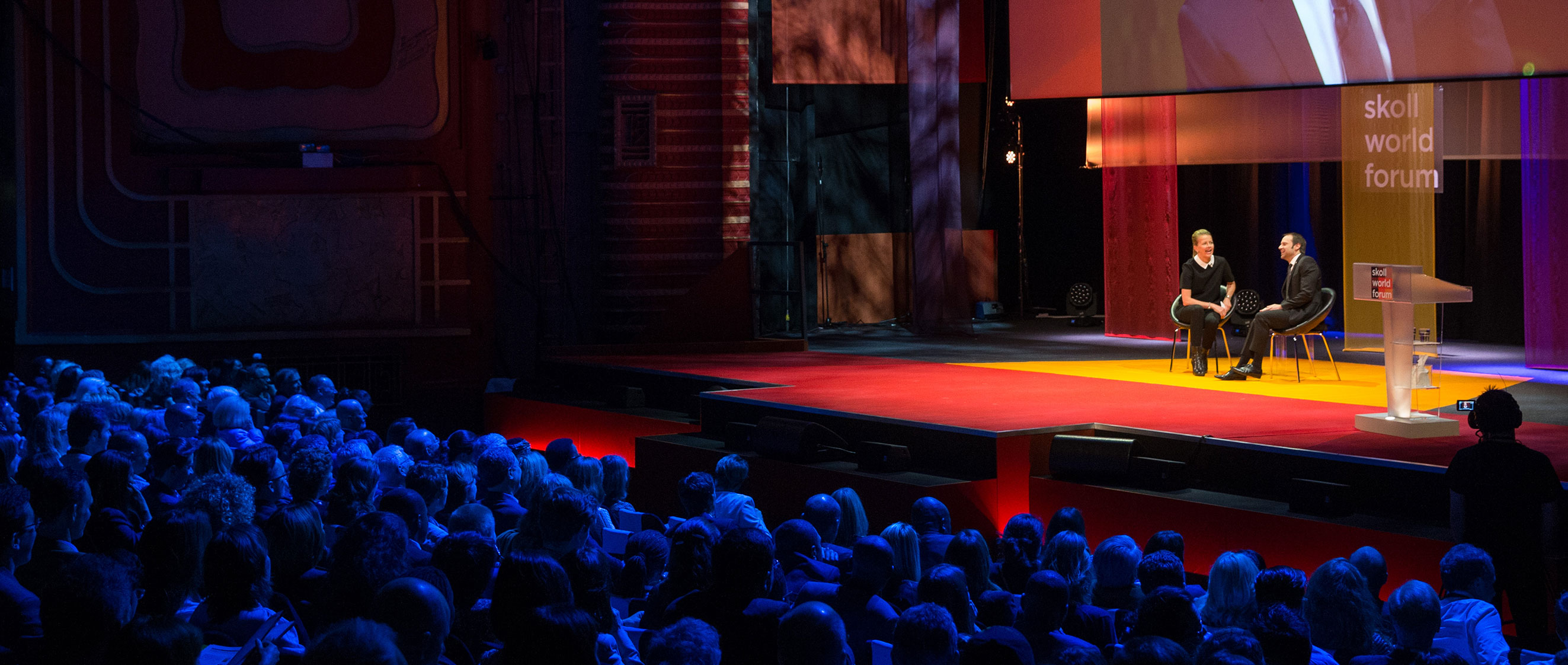
You're uncomfortable with the most are you? OK, alright. Well, there is modesty here as well. So, David Chen. Next to David is John McCall MacBain, a very interesting entrepreneur in his own right, a founder of his own charity with his wife, Marcy; connection with Oxford Rhode Scholar here at Oxford, so this is homecoming in a way.

So: John McCall MacBain. Then next to John is Nick O'Donohoe, head of global research at JP Morgan, one of the firms that I worked in as well. He also sponsors the firm's social finance group. So, a very diverse panel here from an investor Perspective, a GP perspective, and a foundation perspective as well.

So David, if you would be so kind and start us with the particular emphasis on your on impact investing. Whether investors need to sacrifice return to achieve social good. And what is it specifically that you are doing in this space.

Great. Thank you. First of all, I have to apologize. I don't know quite how that intro took place. Quite the contrary, we're a very small and a very young company. I spent the vast majority of my career, the last 30 years, in the high tech industry. And then the last 10 years as a general partner in, and two and a half years ago, some would call it crazy, embarked on trying to, in many ways conduct a a bold experiment, which is to try to find out and try to define a set of ways that in fact you could have the phrase that we started off with; your cake and eat it too.

a little bit of perspective, what Equilibrium Capital Group is focused on is investing in building asset management companies in key areas of sustainability. It's a really, really very, very defined niche. A very small niche. And it's basically built on our premise that when you look at sustainability issues We found that it was very rare that it was lack of technology or lack of products.

It almost always boiled down that you couldn't see scalable, sustainable impact because you couldn't find the mechanisms that change behavior and you couldn't find find the right way to route market-based capital in sufficient quantities to address the issues. When we looked at the capital issue, we started to really understand that, at the heart of it was not really, when you could see Taking place and when you can see capital being applied into one of these sectors, it was when you properly align the incentives, properly align the benefits, and found investors and align their specific needs to that.

Now that all sounds very conceptual and I'll give you two examples of that. we all forget that the thirty year fully amortized home mortgage is actually an artifact of social and public policy. It was an artifact of government wanting more home ownership. Prior to that period of time, and this was 80, 90 years ago, the idea of a loan being fully amortized over a 30 year period, that's a financial innovation.

More recently And by the way, it goes without saying, aside from the last 2 years of the sub prime, this has been very robust financial services market. It's been supported by entire ecosystem. Capital has streamed in in multiple formats into the home mortgage marketplace. It's a robust, liquid marketplace.

It's a transparent marketplace. Again, other than what's happened in the last few years.

A more recent example of applying incentives--and this may get a little esoteric for some of the folks in the room--but in the wind energy area, in late 90s, early 2000s, a structure known as the tax equity flip structure, the tax equity market, appeared. And up until then, I would submit to you that between 1999 and the year 2002 and 2003 no difference in windmill technology.

Frankly, if you take the United States, there was no difference in the governmental incentive programs. What was created was a mechanism whereupon those that had the benefits could accrue those benefits and that structure, the tax equity flip structure, was a financial innovation and a financial instrument that ultimately unlocked the capital markets.

It was something that Wall Street knew how to sell. And it was something that investors knew how to buy. And it was something that lawyers knew how to paper a contract around. And so it was these set of examples that fascinated us, and we started to take a look at what sustainability factors, sustainability market places, where if we could apply that kind of innovation, financial innovation, I realize that that in these days and age that's a bit of a dirty word, but where we could apply financial innovation to that.

We think the markets of green building, the built environment, energy, water, carbon and food, and of natural resource and land sustainability are markets that are all right for this kind of innovation to take place. We think if we can solve this problem, you have tremendous impact on both environmental as well as as societal and social impact, as well as because these are huge robust marketplaces, you absolutely have the opportunity to create market rates of return on this.

But the is in how to create the proper structuring. For me, at the heart of this, and maybe this sounds a little too academic and theoretical, but at the heart of this, is looking forward over the course of the next few decades, and if I use investor speak, it's not about, one of the ways to describe it has been quote unquote the pricing in of externalites.

If I were to look at this from an investor's standpoint, I think this is the most basic of basics and that is that what we're trying to do is to find, as we now go into the next few decades, what are the sources of value creation that align with these trends of environment and societal. So the new forms of value creation.

What constitutes a more valuable asset as we go into the future. The second one is the risk side. And that is that, as we see environmental degradation and societal issues, how are these then, the risks that make an asset into the future less valuable, or put the value of that asset at risk. So I think that in many ways, the issue of whether you can have your cake and eat it to boils down to, are you a smart investor who's looking out into the future?

And asking where the future sources of value and the future sources of risk and the degradation of your value really are there. And so I think I'll stop there without giving the next example.

David, you raise a number of very interesting points. One being that the markets are there provided that the structure and innovations are there. And you mentioned wind, you mentioned a number or examples in the clean energy space. I would just like to get a couple of quick reactions from the audience.

Do you think the market is there? Particularly in renewable energy to make really investments that really have impact. And by impact we mean generate market returns but also have and environmental impact. Okay. Where are the stewards, please? Just a couple, any, any quick reactions please. Yes, please.

Just a question of market return. What do you expect? Five percent, ten percent, double digits? Do you really think that today we can have double digit returns and social return? Okay. The question is, what do we mean by market return? Okay, fine. Yes, over here please. Just there, thank you. I think until the pricing of externalities has been properly completed, and I don't know how that's done, you will have it, find it very difficult to have a level playing field.

Okay.

I think that's one of the most interesting questions that arises.

Okay. So let's focus on. Okay, this throw has the monopoly, this is wonderfu,l go ahead. Third comments here.

Yelolebelence from Inspire. I think the key question which you can get into, can we transfer this, for us, interesting investment event and so on, into something which the general public can understand easily. So this transfer, I'm very interested in seeing how we can do that, and that's not only for wind but for similar issues.

Let me just clarify, make sure we understand, that the point being, for the renewable energy or clean energy, can we create it in a way that the public understands it.

So simple that a normal banker can sell it to a normal customer.

Normal banker to normal customer, that's quite an assumption. Okay, terrific, terrific. Thank you so much for all three comments. What do you mean by market return, externalities, the importance of externality. Can we really create the structures that normal people can understand. Fantastic. John, over to you please.

Thank You. I'm not actually an investor. I'm more an owner, which I think is a little different and more owner and entrepreneur. So, to couch my comments in that light, but my wife Marcy. here as well. I am setting up a foundation. And trying to separate what I call the church and state dilemma. Which is the church being the donation site, and the state investment side or the ownership side.

And we try to sort of cross over a bit. And I guess to go right to the question whether investors need to sacrifice return or whether owners need to sacrifice return. I think that I'll sort of give 3 answers to that and sort of the perspectives. One is that we've found, although that's our theory, we're still in the middle of the experiment.

So I'll tell you in a few months whether its true, but our view will be that we can make equal return on 2 conditions. Number one is that we take more risk. So maybe the risk adjusted return may be lower. But we also work a lot harder on it, which has a feedback on it reduces our risk. So I think if you are willing to work harder and take a little more risk, you shouldn't sacrifice returns.

And that's sort of our theory. And we're trying to prove that and we are. Also.

John, sorry for barging in here, maybe picking up the comment question of what do we mean by market returns? Can you extoll Yeah, I was going to jump, my third point was actually that. I think that market returns should be looked at in a realistic perspective. If you're taking large foundation. You're taking lower inflation right now, at least right now. You're taking I think, expected lower returns in the stock I'd say that that return is in the, for a foundation the average would be in a 7 to 10 percent range.

I think that a foundation long term planning to do over 10 percent returns every year is probably, they're going to have a down year. And secondly, I think that if we take those numbers, those number at least on an ownership private basis, not that hard to meet. I think that we can meet them with social returns.

So I'm looking at that number, I think that if you're looking at Twenty, twenty five percent returns maybe not, but maybe they know it won't be sustainable as well. So, that was actually my third point, but then so, that's the number we're sort of talking So back to the first one, and secondly what role does social enterprise and we do, and then I'll give you some examples.

and is social aspect. The goal and the economics of the goal, in other words the way you price things as well as what you're delivering. Or can you deliver something which has a social purpose and the way you think it should be priced to make your return, and then take your profits and actually reinvest them as subsidies internally to your own project.

So, in other words, if you were scanning for breast cancer in a hospital in the developing world would you, you know, do it for everyone for 50 dollars in social enterprise or would you price everyone 100 and then subsidize 25 people for free? So that's sort of our, and we're not, I think they're both social enterprises.

In our case, what we do in our business is, we will try to have it as a business so we can bring in partners, owners, operators, managers, who can get equity and take downside [sp?] - not just options - in equity so they can make a return. And sometimes we will adjust those returns if we do something direct in the business, but most of the time we will just take a 80 percent or 90 percent or whatever our ownership position is and reinvest it in either the country or the project as a donation.

So, that's the first thing; the risk and work. The second aspect is how we came upon this. And we came upon this by saying, gee, you know, what should we invest in? And obviously, the first thing is don't invest in bad things. I think we all have got that. The second thing we said is, let's look at the functional areas we're working on in our foundation.

So, we have 3 general functional areas. One is education health in the environment . So we said let's look first at investments where we can hit one of those three areas. It may not be investments of any social purpose. Purpose ah beyond that, but at least we are learning something of that sector.

hence, we can use learning in our foundation. if by example we also learned that by investing in a sector, which might not be a social investment, it leads us to a social investment. as well as leading us to more knowledge in our own donation sector. example is actually one from this town. I have several children and my children were taking the international baccalaureate revision courses from a company called The Oxford Study Courses, which is a leading reviser of this area, and so we thought we was a great business on actually bought that company.


Who?

which is a profit making enterprise the profits go to a foundation. Will be giving them away for education purposes.

So that was a social enterprise, but what's interesting is. That brought us closer to the International Baccalaureate. So, we learned about education, etc. But we also started thinking a lot about online education. That led us to meet the people at the International Baccalaureate organization in Geneva and four weeks ago we signed a deal with them to put all their courses online in a seven-year deal.

So, it's a social enterprise. We're putting about twenty million euros into that deal. My two managers, each of them are putting in a million euros, so we've got downside and we've got good protection on that. So what we've got is, we've got a system where we started by a theory that you know, "Gee, we could help the foundation by learning about the education." But it also helped us learn about other social business we can do in that area.

And hence we got this deal with the International Baccalaureate, which I think is hopefully going to increase access. They had access agenda. We hooked onto that agenda and said, "Gee, we can increase access by not having to use bricks and mortar, and how do we do that?" So that's one example. Our second business example is, we started the other way, we started from the foundation side.

We said "Gee, we'd like to do work on maternal mortality issues in Liberia," which is a country we focus on, and My wife looked at the hospital budgets and some of the counties and bong and few others and saw that, gee half the hospital budget is basically repairing a diesel generator, buying diesel generators Transporting fuel, buying diesel fuel.

We say gee, this isn't very good because all we are doing is basis subsidizing. subsiding CO2 emissions by a good project. So in that one we've got some good and some bad. So in that one we said, gee, what we really need is to get power to those hospitals and clinics because then we would get power of half the price we basically given a donation of 25% of the budget for every hospital with in our distribution area.

So what happened there is we said gee that's interesting. So we Looked around and we found out that, gentleman in the area said, "You know, there's two great correlations." And we knew one of the great correlations development which, is women's education and GDP per capita, but the other great the correlation is kilowatt hours hours per person and the energy per capitol.

So if you look at countries that have very few kilowatt hours per person available electricity we have a fairly low G and P per capita. That's a fairly strong correlation. So we said gee, not only would that help the hospital sector but we could help the country. So what we did was found a Canadian company actually, that was Chipping End of Life Rubber Trees.

and using them to export and to Europe, to replace coal and henceforth you know, they're carbon neutral and are replanting the trees so it's replacing CO2, basically taking CO2 out of the air in Europe, when you had to ship it to Europe. So we bought that company, changed it, and we also do the shipping to Europe part as a biomass strategy to help CO2.

But at the same time, we're taking those chips and building a power plant in Liberia to develop power for them. So what does that do? Well, it hopefully will make a return for the foundation. Secondly, it is an indirect donation to all the hospitals, etcetera, in that area, as well as the schools.

Thirdly, it's creating a lot of employment by chipping the trees. And lastly, what's interesting, the second order effect was it was also increasing the arable, useful, plantation land, hence increasing rural employment for 25 year jobs. And then some of you replace the rubber tree which has a 25 year life cycle.

So there's one where we've said, you know, what is our financial return? So, my third point is when you look at your return, and somebody says, you know, do you have your cake and eat it, too? Depends if you like cake. So the reason I say that is as follows, is because if you are an investor who has pure personal reasons for investing, then your total return may be only your financial return.

If you're actually a cake maker, and somebody walks in and says, 'Gee, I'll pay you, instead of paying you $5 for cake I'll pay you $4 and I'll give you $2 worth of wholesale priced flour,' you might take that deal and actually get a better return than him paying five dollars.

So, in the same way our foundation says 'gee' you know here's what we're doing. We want to go around and make a donation to hospitals, which we could afford to give them 20 percent of their budget. lets say. But, gee whiz, by doing this other thing we're give 25 percent of the budget as well, so basically made a donation of 45 percent as opposed to 20 percent.

So, I think that, you know, have your cake and eat it too, and you have to like cake. So, in other words, the foundations like cake. So, if you are going to take some money from somewhere and put it into reducing CO2, or whatever, then gee, if the business itself can do that then you've actually got a double return.

And my example in that is in sort of where this social enterprise can work, is alright we started, I'm chairman of the European Climate Foundation which I started with the Hewlett Foundation And they're work with energy foundation United States in Europe. And there we see one of our big things is stopping new coal plants.

And that is a classic advocacy in a classic donation. Where you make the donation, they do that, they protest, whatever, and eventually hopefully the coal plants will be stopped. But, the problem is, is the second thing, there's already coal plants existing, believe it or not, and they're still working every day.

And it's very difficult through advocacy, to convince these companies to stop that plant because they've got a 40 year investment. So there is where social enterprise comes in. So with Buchanan Renewables, we're able to fairly dry, to very dry hardwood and substitute that for coal. So our social enterprise, yes, will hopefully make some money, but at the same time it is giving a donation to reduce coal.

And we're, so basically there's no long term supply chains for biomass so we're sort of being the one going out there, that catalyst, for going out to the power plants, that come and say, look you're very Very concerned. We've taken down all the risks. We've gone to the library. We've spent a hundred million dollars on this project, it works, we're credible, come in and invest in that.

But by doing that of course, we're reducing CO2 existing plant. Starting at 10, 20 percent, eventually is fills the pallet rising gentrification actually to reduce to 50, 60 percent of the coal production. So that's an example where i think social enterprise is better at reducing existing coal plants output by creating long term biomass change, as opposed to a donation to the European Climate Foundation, which I'd recommend, which will reduce, creating a new plant.So that's sort of where I see we are.

Fantastic! Anybody who likes cake, would you like to make a short, sharp comment at this point.

yes, over here please, thank you.

The comment I'd like to make is, I'd love to sort of focus in, a little bit on, what what is social, because it's very easy to extrapolate two, three generations down the line that some of these technologies are ultimately increase affecting people's lives, but how broad do we want to make that definition without diluting what we really mean?

OK, good question. What is social? Any other comments?

Hello I just want to add, thank you so much for your contributions already, on John's comments on risk and return and liking cake. I work for an, a UK-based organization that's an early investor in risk capital for social enterprises. And what's cake for us is actually not so much the returns that we make on our investments, but the way in which we can unlock further capital investing invested into the vehicles where we're early adopters of.

And so if we're asked, that's the cake. And I think what we've observed over the last two to three years of social investment space in the UK in the new markets, is that we've seen a variety of different forms of capital with different types of appetite, and the important thing is to match the propositions with the appetite of the investments, whether it be about financial or social returns and the types of things they were interested in.

fantastic thank you. David you wanted to Yes.

Yeah, just one more comment here, the lady in the turquoise. Alright, Christina from and it's quite interesting to hear about the integration that you've done between the foundation side and the investment Speaker 1: And it would be a terrific contribution if there was significant, integration along the finance continuum.

But unfortunately it's not really the world that we are living inside. So I would like to ask, when we're working with foundations or the more philanthropic or concessional community, how do we package. The types of investments you were talking about John so we engage that investment capital. That we're able to basically package The types of benefits that you articulated and be able to attract capital that, at least from a governments view point, isn't as intricately connected as your foundation and your.

Speaker 1: Investment Company are. Speaker 2: Christine thank you so much for that. David you wanted to make a quick comment and John would you like to respond to The quick comment was if you, John's comments were tremendous, but if you take apart what he talked about in all of his examples, there's a theme that is very much along the theme of almost everything he's doing is about, and this is where the externality issues come in.

Almost everything of what he's talking about is mapping out, I hate to use these words, but the ecosystem and trying to figure out where the value or where the extra margin or where the inefficiencies were or where the new social or environmental change should be, and then capturing that value. And this issue is going to be just so central to it.

Because if we really believe that things are changing, then we're talking about re-mapping how the value flow, the funds flow, the cash flow, and then figuring out how to take that and deploy upon that. In some ways that's giving with one hand or taking with the other one hand putting one value into another value bucket.

But that's the hard work aspect of it, because you can't have quote unquote, a paradigm change without rethinking what the entire flow is.

Thank you.

Just to respond quickly, I know Nick wants to speak, but to respond quickly to your question: I think that--so if you're going to this foundation or other organization, I think it's--take the example of coal. So you go to--I'm making this up--the Hewlitt Foundation and you say, "Look Hewlitt Foundation, you're very concerned about climate change.

We understand you have great grants and advocacy and they're doing XYZ, but here I've got a social enterprise product which actually does two things. It does part of your, like the existing coal plant reduction in CO2, this project will reduce the CO2 in that way, which you aren't covering and can't cover with donations or is much better covered by this." And by the way, one of the big advantages I think of social enterprises, and one of the reasons it has to make some return, is it's sustainable.

So, even the best grants, every foundation is worried over them being sustainable.

I think one of the easy hoops you jump over in social enterprise, if you can show a return as well, is a G worth more sustainable. So, I think that there is an open ear. The problem is, who do you go to? Because there's laws, as you know, which we sort of are able to play with because we can play both sides of the fence, that say foundations can invest in profitable enterprises.

They have to get over That technically, and I think that David's point is, you know, we need to change a bit the paradigm and how we deal with that because, you know the local, to go back to my cake example, the local [xx], the guy that's making the cakes, he'd love to take that deal four dollars and two dollars worth of whole sale price flowers opposed to five dollars cash, but if he's in a big enterprise... They won't allow him, they say, "No, you got to collect five dollars cash." So its the same in the way we act institutionally, with our rules, and foundations versus investments.

But a foundation should be able to say "Gee, here's our return," it's that plus the fact of substituted donation, which I actually think is better.

Thank you so much. Nick, over to you, please.

Thanks, Herta. Thank you for the invitations. Great privilege and pleasure to be here. I'm have, I wear a couple of hats at JP Morgan as Herta said in her introduction. I'm the global head of research, so I'm responsible for all our various research analysts and economists around the world, and that's my day job.

My interesting job is, or my more interesting job is that I am responsible for a group that we set up about two, two and a half years ago in the bank called social finance, and social finance has a number of different objectives. We invest in social hope enterprises. We tried to effectively use the financial capital or tried to employ some of the financial capital at JP Morgan to support double bottom line enterprises.

We try to mobilize the human capital at the firm to help with structuring and distribution and placement of social investments or impact investments, we're involved in research in a number of areas around this subject, and then we try also to work with our philanthropy dollars to try and promote the development of a sort of an ecosystem or invest in infrastructure, around impact investing, so we're a lead sponsor for example for the global impact investing network.

So that is what we do. So, let me try to, and I guess I'm wearing both my research and my social finance hat here when I tried to answer the question, whether or not there really is a free lunch here. And I want to come back, David mentioned the word externalities in this questionnaire, and the audience also mentioned externalities, and that is really the way that I think about about this issue.

Every time we make an investment, we are creating impact and we are creating externalities. And that's always been true, and when I say investment, I mean allocating new capital, so, that is not buying and selling on the stock exchange where you're effectively creating new capital for the enterprise, just simply changing the ownership of the enterprise, but where I'm defining investment is actually, invest in new capital, leave the death for equity, every time you do that, now or any point in history you've created some form of externality.

And those externalities can be positive; so, creation of jobs, for example. Or, they can be negative. They can create emissions or environmental damage and so on and again that's always been the case, I think what's different about this field of impact investing is for the first time, the investment community community is trying to define and to measure the social impact of what they're doing.

So they're trying to measure this externality that's been created, and they're obviously trying to emphesis in investing those take it back to those investment opportunities that create positive external office and if two one in the people in audience who put up your hand at the beginning and said you thought [xx] this question, you thought there was a free lunch.

I think effectively what you're saying [xx] ity is effectively free. And i think if you're saying that, you either are some what misguided.ok. And i i think you because either you are underestimating the required risk return of the, the required risk adjusted return of the investment you're making.

i see that a lot.and you see a example of micro finance for example poeple walk into us with the ITA of investing sale in micro finance fund and i think micro finance really [xx] the flag ship so far of impact investing and they say to us their target IRR is 15% to 20% and if i am [xx] as a rational risk-adjusted investor, if i'm going to invest in a fund that is at most microfinance funds are.

They're start-up's. They're green field sites. They're in some of the most, they're investing the money in some of the most emerging of the emerging markets around the world. if i am going to rationally approach that investment, 15% to 20% is not a reasonable risk-adjusted return. That is you would bench mark that investment against start-up, venture capital, type investments where typically the targeted RORs are 30, 35, 40 percent.

So there is clearly, if you make the decision to invest, in my view a micro finance fund with a 20 percent target IRR your making a social trade off, you may not recognize it but your making it, in that case the point is it's what i through at you but looks it might return, i don't think there is anyone who might return, it's that you need to think about what the risk of the investments your making, about the appropriate risk adjustments for that investment is so that so i think you may if think this a free lunch you may be underestimate in the the required [xx] you making I think the second possibility here, and I see this regularly too, is that people confuse one possible outcome with the average outcome.

And one of the things about this field of impacts investors, we have no data or we have almost no data. So it's very difficult to rationally answer, to prove one way or the other, whether this free lunch exists. But, if we think in the theoretical sense, if you make thousands of investments of equal risk and equal social impact, you are going to get a range of outcomes.

And some of those outcomes are going to be superior to normal commercial returns. So again, if you use a micro finance example, which any of you in the audience will be familiar with, is clearly a very commercial return for the people that initially invested capital. But I don't think you should confuse one outcome or exactly one outcome, to assume that that's going to be the average outcome of every impact investment you make.

So I think those are two, so if you're making the free lunch case, I think, as I said, you maybe slightly misguided, or perhaps just a little over optimistic. I think there are also more rational reasons why you might be seen to be having a free lunch one of them is many of these impact investment have been [xx] responses, so that the commercial investors are getting what is effectively a commercial return.

The reason they are getting that is because there are other investors more junior on the capital structure that are actually getting a less than commercial return so they are affected by subsidizing commercial people. I actually think that's a big part of the do this whole field is to try and find ways of bringing this often foundation in DFIS together with commercial investments and structuring investments that can effectively keep both sides sides happy.

But again i dont think that same is saying it's a free lunch i mean the fact is you getting a subsidy and that subsidy is coming in [xx] foundation of GFI some times there is a case to be made that the social out come with your creating can effectively demagnetized and, and, i think that is a more difficult case to make.

That the idea that by investors certain bottom of the in investments allows me to create scale which allows you to build a business that in turn produces commercial returns, I think I mean, I've heard that case made and I think that's a reasonable, there are certainly areas where opportunities, I think that's were but i think its its its too possible so i guess what i come out in the question what is your free lunch or have to say i don't honest people eat so i think in very rare circumstances, and think there's a danger in this fields in over selling and i think we are seeing so when we come to micro-financing because that's where we have the most data and the most dividends.

I think you see real examples in the micro finance world of overselling, overselling is taking of credit business as we've seen in even in the most developed market over the last 2 or 3 years can be very dangerous. Leads to over-indebtedness, leads to multiple borrowing and so on. So I think we have to be very careful how we tune is this social farm, financial trade off and I'm certain on the camp it says there's a you know if you aspire to phrase a now you don't have to pay for.

Nick, thank you so much. Now, I don't know if the audience would agree that you are a normal banker, but certainly you have put I hope not.

a couple of very, very challenging things into the room. I certainly would start with Q;A at quarter to twelve, and I think that's where we are. So, let's do that. We have a number ofquestions that we certainly want to make sure that they get aired, but let's open the floor and I'll interject the question if need be, if if they have not already been asked.

So, with the formal Q;A, this is an audience that is very passionate and we all have, we are all here because we want to achieve some thing and we want to make a difference. And that means we have a lot to say. So, but, can I just ask that we will try to get as many comments, you know, that's absolutely possible and as many questions so just a little bit of house keeping here, would you kindly identify yourself, would you make your question or comment as brief as possible and then make sure that whatever you say and support the question mark?

Can we do that? So please, over here, first question at the aisle.

Jason Saw with Kellogg Business School at Northwestern. My question is, it seems, first a statement, then a question. It seems that we may be conflating two things, one is, this sort of joint hybrid return of a social and economic return. And the other is, the case for a pure economic commercial return by using social change as the means to produce that return.

And what I am interested in is, have you seen any cases where we can produce a competitive, if not even more compelling economic return by social arbitrage of finding social opportunities that are not commercially exploited, that happen to also do good that are primarily not a social purpose investment but an economic purpose investment.

Is that directed to the panel as a whole or.

Yes.

Yeah okay Nick would you like? to take that question first.

Well, yeah, I mean I think there are certainly cases where, if I understand your question correctly where there are were social issues create the opportunity for commercial investment. I am not convinced that that's the purpose of impact investing. You know, I think some of the clean tech investments, for example, have big issue, you've got effectively a major profit opportunity at the same time as you have a major social issue, and you, those, I think the you would hope that the markets, the normal commercial investment market would work pretty well to bring those, to solve some of those problems.

Perhaps impacting investing at the very beginning. Can catalyze some of those investments and has a role to play but I think over time, those opportunities exist but I think that, a functioning market should be able to address those issues.

John, any, would you like to add to that?

Does that actually this time I'll agree with Nick on that. I think that there are lots of good examples to match your thing and we can think of probably hundreds, but probably over time on average there would be equal or lower return I think on that. I don't think that on average, you know, we of course all work very hard not to be average so maybe that's not the answer for us, but for everybody else averages of course never includes anybody in the room.

But, so.

Okay David, I know you're views are a bit different on that. Yeah, the reason I think is a tough, first of all I think that one of the one of the investment we made is the back.one of the things if anyone was in the in the section that was in the this morning One of the observations that I made, and we see this all the time, one of the things that John talks about is the fact that by investing, or delving into social and environmental issues you often times get commercial ideas.

Sometimes in the commercial ideas in these kind of spaces you get opportunities for NGO and not for profit and high impact work. And I think this duality is something that in fact I would argue is going to be a core competency of the investor going for living in these two worlds, and comfortable living in these two worlds.

And so our way of doing it, in our firm is that we spend a lot of our time both on active investment in our portfolio, but also in, but I don't know any other way of putting this. Pro bono work, working with organizations that we find have very nascent business models. And so one of the observations that I was going to make is that if you sat in on the session this morning, all 3 of those entrepreneurs, social entrepreneurs, were not for profits yet they were developing ideas that potentially could have very scalable commercial applications, that if you can retain their mission, their effects you actually have a very interesting business and so one of our company that we invested in is called biological capital.

And biological capital for all practical purposes, or the easiest way to describe it, is the for profit question of the nature of conservancy. And what it's trying to do is to solve a very significant problem, and that is that, aside from very small, potentially very small set of, for example, it's very difficult to actually preserve large tracts of land.

You have to have a rule of law, you have to have a certain economic setting, in order to preserve, and it's a wealthy concept to preserve a large chunk of land. So, in most of the world and most of the applications, you have to create an economic vibrancy in the land, that allows you to preserve it.

And so that means that you have to operate the piece of land as a sustainable land-based business. And it's especially true in the developing countries. So what's the economic model and the business model to do that? And, I won't get into any details, but this idea of real estate subsidizing one thing or another, many of you are actually very comfortable with this.

We do, we see this example in our cities all the time. Subsidized housing or mixed use housing or a developer that develops four downtown blocks and puts a theater on that, in that, because the theater creates a vibrancy in the community, but it's clearly a loss leader. But the way that you justify the theater within that four block redevelopment is because there's profit coming out of the parking lot, or there's profit coming out of the development of the office building.

But to create the value, and this is the value definition, the value of that overall project, you have to create the vibrancy and the longevity of that development. And therefore you'll do things within that development that quote, unquote are not profitable. I think those are some of the core concepts that go into these kinds of thinkings about that.

And I think David, you are touching on the question that was asked earlier, what is social? And if you're looking at the theater as providing a social benefit, then you're coming back full circle, that you've got, you've got a very profitable arrangement that can, if you will subsidize the social.

I'll come back to you in. Excuse me, can, can you give her a microphone please? Because this is all recorded and, and we need you to speak in the microphone. on that example is, I've seen some entrepreneurs arguing that the parking lot is a social enterprise because it's underwriting the theater.

Right.

And those types of things. And so that's where you get into this challenge of how far back does the social go.


So just a quick point on that. As a foundation, you know, why should the social issue in the foundations definition - you can go back to, in the UK, the Charitable Purposes Act and then go from that to what foundations can give to - is that need to be any different than a social enterprise what our social values should be the same as the theoretical charitable values in a foundation?

You know, there's a debate to be had whether they're different. But I think it's a starting point you should assume that foundations must give to charitable purposes, a charitable purpose defined, and those defined charitable purposes are X, Y, Z, and those should be the same in the social enterprise if they meet those goals as well.

But because there's a profit indirectly or directly, our existing structures don't allow that within a foundation. We can't do Buchanan Renewables inside the foundation, so we do it outside. But in the end, the social part of it is the part that is related to the social purpose, which could be the same as in a foundation.

Thank you so much. Mike, question here, please.

Mike Eckhardt with the...Is this on? Yeah.

...with the American Council on Renewable Energy. Shifting our attention. Most of our attention in social enterprise is on the use of funds. The use of funds. I want to turn our attention to source of funds. And the private sector investment banking community is very good at structuring private money: senior debt, sub-debt, preferred equity, junior equity, common equity, preferred equity, and all that.

Very sophisticated. And we're getting a little bit of that in the social foundation world. But are we really making progress on mixing the social capital with the private capital, you know, the grant money and the PRI money and all of the foundation money that that wants to do social good and doesn't even have to be repaid in some cases with the private capital?

And isn't this one of the things going on today, trying to find structures that mix these two sources of capital? And what do you say about that? Are we being successful with that?

I think that's an enormously important question and I think a very timely one. and I made the comment before about the idea that you bring together commercial and social investors. They have different risk trade-off, they have different return trade-offs, they have different perhaps social incentives.

But I think being able to bring those 2 together and mix the capital is very important. We've done work with some of the large foundations in the United States in trying to put together sort of a joint venture company that will try to invest in, in this particular case, in lending and investment in Africa and agriculture.

But the idea is that you would have a vehicle that is attractive both to the foundations for their PRI type money, but also to the commercial investors. You could go around the world to institutions, to private banks, to family offices, to high net worth individuals and there would be problem with the on the capital structure were risk which turns social impact would come together will be attractive to them.but i think its you know this whole area The challenge for everybody in the emerging industry today, and everybody in this room, is building this whole investing over the next, and it's structuring vehicles that work for more than one investor.

It's industries, it's benchmarks. It's all these it takes years to sort of create an active class. But these are the type of questions I think it's important for us to address. Well lets take about, while John responds, lets take about three questions at a time. And if you could get microphones into the hands of this gentleman and these two gentleman put here please.

From an ownership point of view, if you look at what we're, you know, if you take Buchanan Enterprises, there's Stan, Jim and Dawn, and Stan, Jim and Dawn have. You know they put in money in the business, theyve got some stock options, and theyve got a salary. You know, why did they go there in the social enterprise and were going to give away all are profits back to in the enterprise and so is a social and i think is a clear social enterprise but, how can we mix within the business itself, the sort of profit making ways unlike institutional masses, these are individuals, so you can also seek and select really good people who have in themselves and their own values, a mixed bag of values, not a bag of values, but a mixed, they've got a financial return and they've got some social returns.

They're human beings. And so maybe there's a bias in our sort of entrepreneurial ownership thing in the owners and managers we attract, or people who have a more diverse set of interests than just a pure financial interests, and hence we attract them because we can give them a sense of satisfaction and hence maybe they'll work harder so hence they'll make up also the financial difference.

But at least they'll make a good return because they think we're doing good things sustainable, etc. on the business side. On the social site they think theyre doing a good thing as well. So Stan is 65, he retired from Sinci Lavanang, he wanted to do something and hes the best in the business, if you're college graduate in power.

But at the same time he wants to do something good but at the same time he'll hopefully get some financial returns. You know, so the other people are similar. And I think that, by them also they are working hard. We think that we can, you cant do maybe on the average, maybe on the sustained investment but if youre running it as an owner and if we can as a group, you know If the people can be better at what we're doing then and work harder and be the first ones, the innovators in there, probably we'll have a chance of making higher returns.

Over time, yes, on average over there. But you've already got your enterprise then. You've already got your above average returns, so that's okay. So I don't think that you can on an individual basis arbitrage market returns. Now if we decide at one time that Buchanan needs to do something special, we could put in a preferred share and pay for that extra thing that doesn't affect their return.

We can give them a little...a few more stock options if we want to. Or if we run it purely, we can say, "Okay, no, that's fine. They'll get their return and we get ours and we can put ours back into those things through our dividends or whatever." But we can also subsidize it indirectly as a social share holder to keep and attract good private investors, which is sort of an indirect way of trenching the investor.

Because John, you're touching on something which is so different from what we have done historically. Because historically we've been thinking in silos.

Right.

Weve been thinking profit, share holder value over here, max that value over here and we've been thinking doing good over here and never the twain shall meet.

See if the best return your financial investor said was Philip Morris stock and your foundation only worked on reducing smoking. You know, it doesn't matter how much money you give away, the fact that you're subscribing maybe to the IPO of a division of distribution of Phillip Morris, it probably will nullify all the work of your foundation.

So, you know, also it depends on where you want to work. So if you spend your time in your foundation making a slightly better grant, is that better than spending more time in the social enterprise to actually make a bigger impact on reducing coal emissions for existing coal plants. For example. Hi, Vancheto [sp?] progressive foundation in the Netherlands.

I've been working in this place, blended value for 20 years and I'd just like for a second to have a slightly wider perspective. Many of the is the social good markets are still, at least in Europe, in the hands of our government. You know, education, health, the social welfare in general. And I think only now is beginning to open up and allow the entrepreneurs willing to start looking at what are the new innovation.

So it is a revolution that has to do with innovation. issue with entrepreneurship, people who perhaps, ten years ago, were busy with their business, now they have time to look at the wider, social innovation, you know, dimension, and just as an example, also we talked earlier about renewable energy.

You know, there are, to some count, nearly 300 billion dollars of perverse subsidies going to State subsidized oil industries. The way our markets are governed, by our governments and other institutions, has a huge impact on potential of entrepreneurs, to make a difference. So we should also look at that side of the equation.

Okay, over here please.

Hi, I'm Robert Stevenson and I'm a social entrepreneur out of Dublin, Ireland, and I'm teaching young people how to be social entrepreneurs in four countries through music and multimedia. Now, my question for the panel and for the general audience really is, how do we measure this? Because, you know, I've been involved in this neurotic relationship between the value for shareholders and the value for society and I would just like to pose to the forum generally, is if we could somehow agree on certain ways of measuring impact and agree that is a standardization [xx] in the various areas that were all working in, that would help the investors, it would help the foundations, and it would help the participants and the practitioners like myself to deliver the best value, so what do you think about that?

And is there a way of measuring that?

Let's take one more question here, please.

Jim Hornthal, CMEA Capital. I was taken by something David said about the 30 year amortizable mortgages being a public policy that created a financial market. And the point of Nick, on subsidies, what we're seeing in the U.S. at least through the DOE loan guarantees is the federal market. Public policy with Obama putting billions of dollars into a different yield structure where the public policy is enabling companies like 8123 to achieve scale and new batteries.

And the real question is what is the role of public policy in creating that hybridization, and where can we as activists impact public policy, because I think those are what resources can be moved a small amount but have a huge impact. And is that something you think is part this tapestry for change, and how do we make that a bigger voice?

fantastic. So three very good questions in the room. Any one of you who would like to [xx] particular question is resonating.

The measurement question cause i think that's a really, effectively how do you measure social impact, and you know, from my perspective, that is a measurement system and from that erasing system is absolutely fundamental. to creating this impacting investing as an asset class. If it was easy, it would have been done already.

That's the bad news. The good news is that i think there are some very legitimate efforts going on led by people, the Global Impact Investing Network, the Rockefeller Foundation United States have dedicated substantial funds to trying to put together a coherent you know, the principle investors can buy into measures that somehow rate social impact, and I think about it in terms, like I think about the credit market.

You know? If I want to invest in a bond, in credit, I dont go and do a whole lot of credit, I mean somebody does, but I as a private investor I don't do a whole lot of credit analysis to figure out whether it's a probability of going bankrupt. I use, I say it's a AAA, it's a AA, I go to my investment manager and I say, "Look, I want a portfolio of AA bonds." I think it's a difficult thing to do.

Imagine a world where there was a recognized agency that all the major participants bought into that would rank something social impact platinum or social impact and, and then I think that would be hugely powerful in opening up particularly the retail chain to a to a make it easier for, you've got to make it easy for retail investors to invest.

You've got to have a level of trust between the investor and the the investment manager. And I think some sort of ranking, some measurement is absolutely fundamental to that.

Thank you so much. John would you like to pick up the comment and the question, regarding, how to we open up the field? Particularly, on a continent like Europe, where social entrepreneurship may be, to some extent, to the extent that anything social has happened, it's been in the purvey of the government.

I think that's a good point. I think that sort of gives an opportunity too because a lot of traditional purely financial investors would look at things and say money maid in education or health services, because that's the government where as more innovated people would say, "hey lets look there first." So you get the first look which I think is an interesting thing.

One of the things of this conversation is we sort of are going as a financial returns, and maybe, let me just give you an example where if you look at Let's take baseball teams. If you take baseball teams, why do so many owners want to own baseball teams? If you did the financial analysis fine that average baseball teams is not a good investment.So why did they buy baseball teams?richly by baseball teams they feel this other benefits.So lets take baseball team in substitute social impact And if you do that, if you feel social impact is more important than baseball, then you could get a good financial return equal to the baseball person's return.

So that's from an owner's point of view. Now why are very few baseball teams owned by JP Morgan? Because the baseball guys have convinced them to buy the boxes, right? So they can make a financial return to pay back their loan to JP Morgan. No, but more seriously, I think that it's very important.

So if all investing was done "professionally" - and I would view that potentially the fees take away any difference of return, but that's another issue - so if all returns were done by purely financial investors, we wouldn't have very many baseball teams. And also, if you look around, there are still, today, tons of travel agents.

Very few funeral homes. And the reason is that people like to drag out a few little benefits or whatever. So take those benefits of being a travel agent versus of course being a funeral director and take those of a baseball team and substitute social impact. And I think you might answer the question why owners, when they look at their return, look at the overall return, and the overall return may include social impact, which investors can't look at, but....you know.

So do we measure the feel good factor? Is that what you're saying?

No, but what I'm saying is the feel good factor...you've obviously financially rational people, owners have done, bought baseball teams and have got into travel agencies although neither of them on average would make a good investment. So all we say is now gee, my values are actually I'm not crazy about baseball, although I like baseball.

But I'm crazy about having social impact. So if I substitute that, my returns are equal and it's a rational decision. When you get purely financial and get into something that's only looking at financial return, which you know, the baker wouldn't do if he had his own money. And that's why the owner capital isn't very good, because the baker makes a better decision and gets two dollars of flour wholesale plus four dollars versus five dollars for the cake.

He has to take five dollars a cake; I'll take the six dollars every time. That's why there's a market, at least on the ownership side. I think that's why owners are important, foundations if you can get to them are important to actually make a difference on investing because they can look at the financial and the overall return.

And unless they can resell that flour, they can't look at the overall return.

Fantastic. David, would you like to pick up the public policy question?

Before I do that I just wanna touch on one. John's got such great comments to make. Part of this is not whether I have a feel good factor, part of this is there's a real difference in way for example Public Companies Act versus even some of the largest multi-billion dollar family-owned entities act.

Family-owned entities tend to think about creative Assets of enduring, lasting value. And you can make the and really youve used it several times. Im an owner I'm a investor. I'd actually go one step further. I'm an owner versus an investor versus a trader. Alright.

Owner's are not traders.

Owner's are so far away from traders. investors can go either way, alright? But the idea owning and that is. Let me give you one of the things that bothers me most about my ten years in venture capital We uh. It took ten years to figure it out. Oh it did. It did. It did. A quick study. For the first 20 years of my career, I was on the entrepreneurial side.

So we built things. You know we built companies and people and things like that. When I was a part of the venture firm I did a quick analysis after I was there about three or four years. So here's actually something even more damning. It wasn't that I took ten years to learn it. I learned it in three years and then it took me seven years to decide it.


Even worse.

So I made this analysis that in the twenty years that we had invested as a venture capital partnership, and we had ended up in arguably the upper quartile of performance in our category and yet we only had one surviving company. All right, so that meant we built a lot of things, sold a lot of things, a lot of things got transacted, we made a lot of money, they evaporated and we had one company left.

So after 20 years we have one company. And, you know, on one hand, did you make money for your investors? Great. Did you actually create something of enduring value? And if that's where you're parked, then that wasn't a very satisfying experience. And so that's this issue of ownership is inextricably tied to this issue of social entrepreneurship, or of creating enterprises that have a social and environmental and financial impact.

Because I'd make the argument that if you go into a lot of family enterprises, the mentality is, we're here for a long, long time, and the only way we can be here for a long, long time is we've created a vibrant sustainable enterprise and presumably we've not polluted the moral commons.

Alright, to answer your question on public policy, and I will not delve into this issue of the public policy being dual edge sword and unintended consequences, but for Americans, you know, there's an aspect of entrepreneurship that tends to want to be Libertarian. So we have this mythology in entrepreneurship, that entrepreneurs create from the whole, from naked dirt and we go out there and we just create.

Alright. And we forget that one of the greatest public domain assets was the internet. And for the first 10, 15 years of the internet, there was no commerce on it. In fact, if you are old enough and you remember 1992, '93, '94, there was a huge battle between the homesteaders on the internet, which was all about commons.

Alright, and it was all about a public domain and the greater good and the community asset versus my God, Amazon's going to flog books on this public domain. But that was a public policy decision. We forget that electrification and rural electrification was public policy. We forget that that the telecommunication acts were public policy.

The highway was public policy. We forget that the home mortgage was public policy. So we forget that be creation of some of these largest markets we get to take advantage of and play within were created as an artifact of public policy. And so I don't see these things at odds. At all. In fact, we want to foster, sort of enlighten public policy in these areas.

If you ever have any doubt how powerful public policy can be. So in the U.S. right now there is this massive debate and question about whether we will in fact enact carbon policy or not. So if you ask the guys at Mid-America. which is the Berkshire-Hathaway utility. They will tell you that in the last 24 months, in their geographic footprint, which is greatly Western United States.

That ahead of the game, major corporate customers have been unplugging their carbon-generated, carbon power generation resources, and replacing them with electric resources. So the largest users of electricity in Idaho, have unplugged their coal fire and their natural gas fire kilns and replaced them with electric fire.

Public policy, they're looking ahead and they're absolutely convinced that public policy is going to be; whether it's a tax, whether it's carbon, it doesn't matter. They know this is a bad thing from a public policy stand point. They're getting out ahead of the game and this isn't the nicest thing to do.

But they're swapping their risk for the utilities' risk and the utilities are feeling very, very vulnerable because they have no way of passing off that risk. So public policy has a huge, huge impact on this sector in behavior and in changing actual economic behavior.

What an excellent point, because if you really want to scale, we were talking earlier in the session about private-public partnerships in the previous session. If you really want to scale, you need all the various constituents to work together. Let's take another few questions here, please. One over here.

The lady in the red. Yes, thank you. And over there, please. The lady in beige.

Yes. My name is Linda Walker and my company is Walker von Graffenried Asset Management in Switzerland, and I have a question or comment to make to Nick. I think, Nick, what, Nick, your idea is excellent having a rating agency for social entrepreneurs. The only question that I have is, what about the conflict of interest?

We saw the crisis we have right now, one of the reasons for it is because all of this sub-prime debt was packaged and had a triple A rating and then everybody from the pension funds in Germany to everywhere in the world, bought this paper, and my question is, you know, the rating agencies, they do the ratings based on fees that they receive.

How do you propose that youre going to have a system thats going to function, that it's basically going to be an objective system and really give us the best results for the bottom line, socially.

Okay, very good question. Let's hold there. The lady in there.

My name's Chris Anthiger, I'm from Social Enterprise Magazine. My question, again, is picking up something that Nick said earlier, which was that Nick separated out impact investing from mainstream investing. And, am I the only person in this room who thinks that the holy grail is that all investing becomes impact infesting?

And if that is the holy grail, then how do we get there and surely that's something about externalities and the proper pricing of externalities and is there a role, then, for public policy, picking up David's point in terms of making policy that says all investments at the end of the day have to have a balance sheet that says positive externalities.

Okay. Thank you very much. What is the Holy Grail? A question right there behind you. Thank you.

Hi, I'm James Perry from a traditional grant making trust called Pana Pearl and we're just transitioning now into being more, a sort of investment bank for social outcomes. And my question is, is your very sophisticated investors and some of us who may be less sophisticated. Is there a role for social stock exchange?

Okay. Terrific. So, three very, very good questions. Hold it just a second please, so we don't forget what we promised to answer here. Nick, would you kindly take the first one on the rating agencies?


Yeah, I think that's an excellent question rating agencies, obviously there are whole lot of different people who have been to sort of have, take responsibility for the crisis that we had over the last 2 or 3 years and a ranking agency is certainly one of those. and so therefore it's a little bit difficult to sort of suggest what we need in the sector is an S;P or Moody's when effectively , S;P and Moody's to a large extent had become discredited.

I think it's important to look at why they were discredited. I mean, I think it was an example of a very good idea that at the margin became a little bit distorted. Two principle issues, one was that they took on ratings of very complex instruments which I think history shows they didnt really understand.

And secondly, as you said, they introduced a conflict of interest by providing consulting services and at the same time providing a rating. You would hope that that would not happen. I think the risks are much less in a social rating agency. I think the big challenge of a social rating agency is what' s the revenue model?

Who's going to pay for these social ratings? And at the moment, is again, I commend, particularly Rockefeller, who's been instrumental in providing funding for the development of a social rating agency. But it's going to be tough in the long term. I think it's critical to making social and impact investing easy to understand for the non-sophisticated audience.

But the revenue model in the long term is going to be a challenging one. Can I just quickly add to the other question on that. I made the point that I think when you're investing in, when I think about impact investing, Im thinking about providing new capital to companies. So, therefore, Im not thinking about buying and selling of shares on the stock exchange.

I don't think that that's not the same thing as saying that I don't think it's socially responsible investing by every public and private company in the world is important. That it's something that should be encouraged through, as much as possible, through public policy. I mean, I'm encouraged to, I meet with the major institutional investors, particularly equity investors, all the time.

And I've really been encouraged recently, over the last year or eighteen months, how they really, and it really has to come, that push for socially responsible investing, has to come really from the share holders. And I am very encouraged as I go around and meet the are just sort of mutual fund complexes on how seriously they are now beginning to take their responsibilities, in terms of making sure that the companies they invest in have sound environmental policies, good governance, good social policies for workforce and so on.

So I think thats a social response. I dont mean to suggest that it isnt important, its critically important, but I think its a slightly different area.

Let's expand that because that was such an excellent question. What is the Holy Grail really? Is it the idea that impact in, that this notion of financial return but also quantifiable social and environmental benefits, that really permeates the DNA of every investment philosophy, if you will. Shall we open that up John, any comments, David, any other thoughts from you?

Go ahead.

No, I guess I go back to sort of simple beliefs which is it depends on if you like the cake. So if the owners as a group, there's 2 ways, you can own it as a group, you can own it individually, or you can own it through a third party. I think Nick's example basically, is your owning through a third party ,which is investment managers, who manages other peoples business.

So if you get 10 different people, then the investment manager is forced to find the only common denominator and voila, the only common denominator is financial return. If however we had those ten investors, which three were on anti-smoking campaigns, three were... Were going to give money towards renewable energy and four were going to give money to elderly people potentially through a pension fund, whatever.

Than if you ask social enterprises to invest in those three areas then for them it will be a different answer and be easier to do. So I think that that's one thing to look at. It depends on the owner. So, all they're doing is simplifying. I think that if you own through an investment manager... We havent found a way that he can find a common ground among all those different investors.

So he chooses that one where as if we disaggregated to the ten investors we probably would get more social investing. So I guess the answer everybody would like is yes, but we have to find a way to do that. And maybe public investing in some ways at least is more limited in that area. And I think the second indirect point externalities, and we talk about positive externalities, I think that if you look at how - one thing that's very important and one of the reasons that a lot of major things are happening is that we have to look back to the whole as a business person, look back to the accounting.

And if you look at the accounting what do we account for as negative externalities. And if accountants go back to their basic principle of conservatism and going concern principle. If you are mid-America and I'm the accountant there and "Gee, you're volumes are going up. That's great." And then you realize they're going up from people taking away your things and you realize coal price.

Okay, so what do you do on that? And you say, gee, there's also some health issues there. The accountants are going to more and more I think, have to look into wider issues. And have to put just their basic principles of growing concern. So you can't be a growing financial concern if you have this adjacent liability.

I think as those negative externalities are identified to investors, then you know, the cost of capital for coal companies will go up which is a good thing. So that, maybe it's not impacting investing but it's indirectly impacting investing. I think better accounting for negative externalities could be really important.

at least identifying what the whole world is. Because, you know, I think everybody is agreeing, we had a session 2 days ago, where saying that some companies have realized they're part of the world now and I think if that realization becomes true, therefore we have to take, part of their world is they are affecting the world negatively because those negative carbon things from mid-America would be much greater than any increase in revenue and which would give an investor a false concern is your point, I think, a false concern about whether the company is viable or not.

Because it's almost like a drug where you know it's killing people but eventually they'll find out and if the accountants knew that they would put that in your statements.

I think we're touching on something so fundamental here because we talked about historically having thought in silos. And you know, philanthropy's here, business is here, never the twain shall meet. Are we running the risk now unless we are actually taking the question that was raised earlier seriously.

Are we taking the risk that we are going to start sinking in new silos where we have the real business we have impact investing and we have philanthropy. So all we have done is really just create a new silo or do we really need to start thinking in terms of, this is a fundamental philosophy that just needs to be properly integrated.

I may be way too optimistic, because I tend to believe that folks are reasonably rational and will behave rationally, which isn't always the case. So to that point, if you look at the term ESG, environmental, social, and governance, one of the interesting things that we've seen is, as a result of Sarbanes Oxley, the issue of governance, whether it's done properly or not, but there's no longer a rational investment analyst that wouldn't consider governance as a core aspect of looking at the risk management of this investment.

And therefore, both the risk size as well as the value side. I'd make the argument that increasingly the The smarter companies are internally starting to value the externality risks and this isnt, this isn't very, it's no conceptual extrapolation. You know, we're involved with a company that is heavily dependent on cotton and their absolutely convinced its a fortune one company and they are absolutely convinced that within a foreseeable time frame, water at its basis, eighteen hundred gallons of water to get into a pound of cotton, that it doesn't take a rocket scientist to figure out this cannot be a good thing.

Therefore it's a fundamental threat to the company and it's a fundamental threat to their liability. And we think that at some point just like the cost accounting discipline is about managerial accounting versus financial accounting, that externality will become an extension of financial, you know, of managerial accounting.

Because as a manager I need to have a way of looking at the business from a risk stand point and an actual standpoint. I may not be hit with 1,800 gallons of water for every pound of cotton today, but I know I'm going to be. Now the risk is how many years. But I'm almost positive I'm going to be. And so this issue of environmental pricing being factored into business, and therefore, again I'll get back to the smart financial analyst who's looking at these markets, transaction or companies.

We're already watching the E part of ESG. The G is gone. The E part is starting to be gone. In the sense that it's going mainstream. You can't look at a power company. Lets be rational. I have a power company that's 99% weighted coal I have a power company that's 35 percent weighted wind. You're an investor.

You're looking, you're not a trader so you're not trading on the next 12 months, or the next 4 months, or heaven forbid the next few days. You're trying to hold this asset for 5 years. Which one do you want to hold? Alright. So now, the "e" part goes. So now the "s" part, and this gets into can we economically impute S and I think that's still a bit of a challenge.

But we know that the whole issue of, for example, workforce, and child labor, those are Visible elements of S. That have already been imputed and again they're imputed as risk. Alright? So, if I have a work stoppage, if I have a legal issue, if I have a regulatory issue that puts me out. So, I'd make the argument that in some ways the greatest victory and the Holy Grail will be that the E, the S and the G and various aspects of it embedded into almost every asset class and almost every asset.

And I think we see the rudiments of that taking place already. David, thank you so much. Unfortunately, the time has flown. We have time for two more questions and I acknowledge you. Yes, here, there's one. And then one more, please. And over here, please. So those two, and unfortunately. Oh, Im sorry.

No, I promised to come to you as well. So sorry, three more. One mike over hear please. Please.

Thanks very much. Quick question. Along the same lines of the theme of integrated holistic triple bottom line investment and the need to have unlock or unleash the power of social markets. Has there been any thought along the lines of structuring a grants-convertable-to-equity market, having contracts which can then be traded future contracts, but also converted by owners themselves, so grants convertible to equity.

Thank you so much for that question. I just remembered there was the question about the stock exchange. The need for the social stock exchange, we did not answer that. So if you can help may we answer that question.

First of all, my name is Tom Haslitt and my question it to you, Nick. This builds on the Question earlier asked about the sources of funds. You represent a very large bank which has done, from my perspective, great work in pioneering into the space. And your discussion illuminates that. The question I have is that, given the availability or access to private, high net wealth capital through your private banking businesses.

Given the opportunities, we had insights, into the commodity chain, value chains, through the research and investment into the companies that were offering the space. We're is an example with JP Morgan is a big institution in bringing these teams together to create a business unit that is going to, I hate to use the word, exploit these opportunities.

These growing demands from analysts in your research department for insight and potentially from your high net worth clients, who are also seeking more and more of this institutions stick the neck out and take reputation risk.

Very good question, and the last question here please.

Very short. First of all, I agree with David that he might be too optimistic in his concern. We made a service to the Bellagio forum some few years ago about how the foundation actually manage the money. And the vast majority says we take care of the five percent through the rest believe, to the professionals and the professionals have no clue how to do it that way.

So you have a big opportunity and and advice which you might give to the social entrepreneurs. Given that you have not the objective of capital maximization, but wealth preservation over time and keep a longer time horizon, would it make sense to suggest to social entrepreneurs, when they ask for money, rather ask for bond-like structures which give a little dividend long-time which you can accept at the much low interest rate than having the venture capital private equity, I myself am venture capital, that you would lead to something which increases value within a sensible amount of time and has an exit.

OK let's take the, thank you very much. Let's take those two questions together please on the social stock exchange and the social impact bond or whatever you want to call it. Any volunteers? Nick would you like to take it?

Which question do you want?

On the social stock exchange, should we have a social stock exchange.

I think that's a good question. Probably I don't have a good answer for it. The value of a stock exchange is it brings together buyers and sellers. we know there's a lot of social enterprises that would be interested in an easy way, a relatively lightly regulated way of accessing capital. Whether on the investors side.

Whether that would necessarily capitalize huge amount of additional investment into the space. Then again, I don't think we've really spent enough time. I know the ideas been kicked around but, I've never seen any rigorous at my work.

It's an interesting idea. question of whether. Two questions I guess, one is that, on the question that I think is well put, in a way, We're hitting social. And the other big social one we are starting to hit,of course, is food companies and obesity type 2 diabetes. There's one where we can just do the graph, in the, a certain large North American country, and others.

Which will show an enormous health care bubble which is almost is a almost should be put as a star or an asterisk from the US government budget. So I think that's another social one. And I think Jan Erlich's point about the foundation are looking for. That's a real challenge because we're a first generation foundation so a lot of my team, we sold our business by parts.

So a top level team was there so we all came over. we can do things. We're active entrepreneurs/owners. There are other foundations which are many generations away, which are professionally managed, and maybe they're not the best people to be actually active entrepreneur owners. But one of the investments we always thought they'd look at would be what I call preferred share.

Which basically has the more fixed return than certain return. of a bond, but doesn't have the demand for of a bond. So I think that there's something what I would love to have and we love business for Buchanan. There's sort of a social preferred share, which has a minimum seven, but hopefully ten, fifteen year time of.

Has some flexibility around that, has a certain return plus a bonus return if the real thing happens to be home run, because you don't want to take that away. And then also quantifies very clearly what the other as long as the foundation. If the foundations goal was to reduce C02 in the coal plants, then as part of their investment they could show them that by taking this bond let's say six percent plus zero to four percent, depending on the return.

And that return can come at the end, so don't have the ten percent demanded every year, because if you have to have it at the end, and maybe can for a little vile because you don't want the divers to take any money at the develop in the business it has to be at the end you can totally back x you have to x over time pay some dividend but at the beginning maybe none and it accumulates.

And have that bonus at the end and that would allow for you not to have to sell. So I think it's very important. They'd like that and they get a good accounting of what your view is on their goal. Their goal was to reduce CO2. You'd show that your biomass plant over time, for example, reduced this much coal, and you view that initially would have been nobody would have done it and after three years another company came in.

They wouldn't have come in without you, so we rallied that 50 percent. And I think those numbers can be quite oppressive, so I think, and also it's tough for a foundation to find something for six percent with a little bonus for 15 years. Now of course there's risk it doesn't work. I understand that, but still as long as the equity hold the people are behind you, and will clearly lose every thing.

Then there's a good chance that that would a great investment. I'd hope that other foundations who can invest socially will do a socially-preferred bond. And for [xx]. we are not doing a number of your questions justice and and i am very aware that we are standing between you went to cake [xx] so i think we do need to wrap up and i just want to give each of off the pane list [xx] and the opportunity 30 seconds short sharp point that you would like to leave the audience with Nick can we start with you?

Yes. Very quickly, as a final thought, i think there's good news and bad news in this whole whole area. I mean the good news is that i think a huge amount, if i look to when i first got involved in this area a couple of years ago, i think there has been a huge amount of progress over the last Couple of years in term of the energy and enthusiasm and the momentum the quality of people coming in to the field has improved dramatically.

So I think that is all very positive. I think the bad news is that there is an enormous amount of work to do, and I think in all your questions you highlight a lot of those areas. I mean we haven't made it easy enough for people to invest in this broadly-defined asset class yet, and whether that's raising agencies, or social stock exchanges, or indexes, or research; so I think there is enormous of amount of work to be done to really build this as a real asset class.

But I think again I've said in forums like this before, I think this will be one of the great and most powerful investment movements over the next decade or so. And it's great to be a part of it.

Fantastic.

Just three quick points - I think that social enterprise can in some cases do much better than a donation can, and those examples that should be promoted because more efficient allocation of capital. Quick example, from the head of Swedfund in Sweden said that for every dollar of equity put in the business and we make a net return on it, we get 3 dollars of taxes from that company we are investing in, in the local country, which the government theoretically put to social service or elsewhere.

So then, versus a donation, which at best you will get one dollars worth of value, given the same purpose. Okay, assuming the government the same purpose. So that was interesting. And also one of the issues, we haven't heard social enterprise being hit by the criticism which foundations are, which is it's not sustainable, so that's going ahead.

The second point was that I think to answer a bit of Nick's question, we have to look at the full return. And the full return depends on how you value things. And so, therefore the baseball owner, therefore do you like the cake? So if you like the baseball owner, if you like to go to the baseball games, if you like it as a benefit, you should value that, either economically because it's a substitute for donations, so I think we can do it better through Buchanan Substitute Coal than we can in European Climate Foundation to stop new plants.

So, I think we have to take that into account, but secondly even in the financial returns, if we're new to the area you tend to have better financial returns than people have good values [x] good people and they will work hard and they will have other motivations [x] money and so maybe work hard and get better return so there is not statistical average every where and i think lastly we have to find a way to get the disintermediaries in the finance area to be able to look at these things that David, to his credit had a very good idea, they're starting to by looking at the issues that could be potentially negative.

The coal plant example analysts now will write about those issues, like the social ones we talked about, are good. And then potentially even having accountants put it in their statements so that we can help, at least on the negative side enhance maybe positive, direct investment towards more social response [xx].

Fantastic, thank you. Pages 3 quick thoughts. One is that when we use the word innovation, we typically think of it in terms of invention and technology. last hour and a half. Hopefully one of the things that you've,embraced is that financial innovation is going to be one of the sources of change here.

in this field and truly that finance is a form of innovation. The second thing is, is a huge value can be created in the structuring of these instruments. A lot of the discussions have been about how you take lessons learned in this first generation and actually now create structure. Because if you can't create structure, you can't scale and you can't get to retail.

You can't make it easy. And so these three words to me really drive me and that's the opportunity for innovation, the opportunity to structure what is ad hoc into something that's repeatable, and if you can do that, you've created a huge opportunity to scale.

Fantastic. Fantastic. Thank you so much, each of you.
 

Audio